Introduction: The Real Question Isn’t AI vs. SEO Anymore
The conversation around AI and SEO has shifted dramatically. A few years ago, marketers debated whether AI-generated content could rank at all. Today, that question is largely settled — and the industry has moved on to a far more nuanced one: how should AI be used strategically to create content that genuinely performs?
The scale of AI adoption in content marketing makes this question unavoidable. According to a Semrush report, 67% of businesses already use AI for content marketing and SEO, and an impressive 65% report better SEO results since adopting these tools. Moreover, 93% of AI users review generated drafts before publishing, underscoring the importance of human oversight.
Meanwhile, the environment in which that content must perform has changed beyond recognition. Google announced at I/O 2025 that AI Mode represents the future of search. AI Overviews now reach 1.5 billion users monthly across more than 200 countries. Gartner projects a 25% decline in traditional search traffic by the end of 2026. In this landscape, the old playbook is genuinely obsolete.
The thesis of this piece is simple: AI content works — but only when combined with human expertise, strategic intent, and a clear understanding of what search and AI engines actually reward in 2026.
The SEO Landscape in 2026: What Changed
Keywords → Intent → Authority
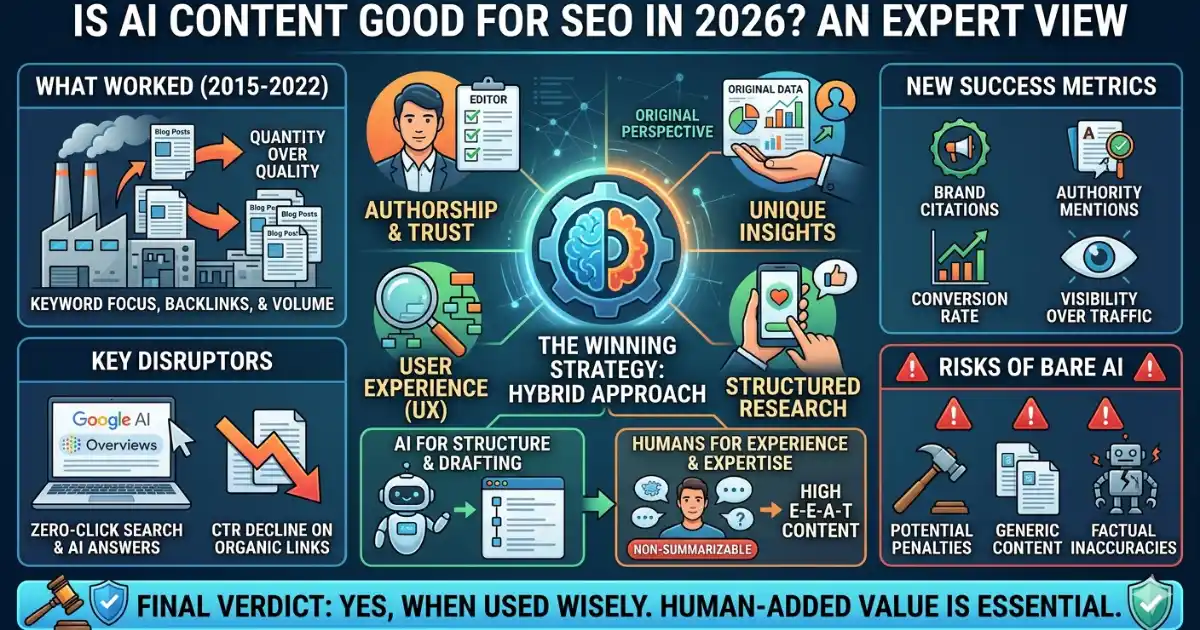
Keyword optimization alone no longer defines SEO success. In past years, especially 2015–2022, SEO rewarded content volume — focusing on keywords used, content length, and strong backlinks. However, in 2026, SEO is all about content quality, authenticity, and user experience, ensuring intent satisfaction. –
Ranking in 2026 means not just using hundreds of keywords and making a brand visible on page one — it’s about using a handful of relevant keywords that fulfill search intent through user experience success signals. The purpose is no longer just getting clicks; it’s about what happens next. Through scroll time, outcome completion, multi-session return value, and bounce-to-return searches, search engines are now tracking how visitors actually interact with websites.
Zero-Click Search & AI Answers
Perhaps the most disruptive shift in the modern SEO landscape is the explosion of zero-click searches — queries where users get their answer directly from the search results page without ever visiting a website.
New data reveals 58% of Google searches now end without a single click to any website — up from 25% just five years ago. The driver behind this shift is the rapid expansion of Google’s AI Overviews. Google’s AI Overviews now appear on 27.43% of search queries as of November 2025, up from just 3.93% in January 2025 — nearly a 7x growth in 10 months.
The CTR consequences are severe. Research from Seer Interactive published in November 2025 found that organic click-through rates plummeted from 1.76% to 0.61% for queries with AI Overviews — a 61% decline. Paid search CTR fared only slightly better, dropping 68% from 19.7% to 6.34% when AI Overviews were present.
Critically, ranking high no longer offers immunity. In March 2024, the average CTR for the #1 result on AI Overview keywords was 7.3%. By March 2025, that number fell to just 2.6% — a 34.5% decrease in clicks when an AI Overview appears at the top of search results.
However, there is a significant silver lining for content that earns citations. When a brand is cited in an AI Overview, it receives 35% more organic clicks and 91% more paid clicks compared to when it is not cited at all.
New Success Metrics
This new reality demands new ways of measuring SEO success. Traditional traffic-centric KPIs tell only part of the story. For 25 years, marketers optimized for rankings, clicks, and traffic. These made sense when every search ended with someone clicking one of ten blue links. That era is over.
AI search drives brand visibility more than referral traffic. Major publishers like Reuters and The Guardian receive less than 1% of referral traffic from AI platforms like ChatGPT and Perplexity despite being frequently cited. The implication is clear: being mentioned matters — not just being linked to. Brand searches, citation frequency, authority mentions, and conversion rates from AI-referred visitors are now the metrics that matter most.
Is AI Content Good for SEO? (Expert Answer)
The definitive answer from Google itself is that AI content is not penalized by default. Google’s official position, as stated by the Search Quality team, is that “appropriate use of AI or automation is not against our guidelines. This means that it is not used to generate content primarily to manipulate search rankings, which is against our spam policies.”
Google’s ranking systems aim to reward original, high-quality content that demonstrates qualities of E-E-A-T: expertise, experience, authoritativeness, and trustworthiness. The focus is on the quality of content, rather than how content is produced.
The data backs this up. According to an Ahrefs study of 600,000 pages, 86.5% of top-ranking pages use AI assistance. Google evaluates E-E-A-T signals and helpfulness — not the production method. AI-generated content gets indexed within 36 days for 70.95% of pages, similar to human-written content.
The real dividing line in 2026 is not AI versus human — it is value versus noise. Recent data from Semrush indicates that sites experiencing AI content penalties typically showed patterns of low-quality, duplicative, or misleading content rather than simple AI usage. The question Google asks is not “was this written by a human?” but “does this genuinely help the person searching?”
What Actually Works with AI Content in 2026
AI for Structure, Not Substance
One of the highest-leverage applications of AI in a content workflow is building strong structure — logical outlines, clear heading hierarchies, and well-organized frameworks that serve as the scaffolding for genuine human insight.
AI-generated text that is repetitive or overly generic won’t provide meaningful value to users or perform well. The best results come from human editing to improve readability, structure, and to ensure facts are accurate. Using AI as a starting point — then adding expertise — is the recommended approach.
AI for Research & Search Intent Mapping
AI tools excel at surfacing patterns in how people search — the specific questions, concerns, and pain points that real users bring to a query. AI tools help identify secondary keywords and semantically related terms. Drafting around clusters boosts content depth and relevance, strengthening a site’s authority. Better internal linking suggestions also improve crawlability and user experience.
AI for Clarity & Readability
AI can significantly improve the readability and structural clarity of content, which has direct implications for both user engagement and AI citation eligibility. Content optimization tips now recommend writing answers in clear 40–60-word paragraphs, using H2 and H3 headings that mirror user queries, and adding FAQ schema and HowTo markup. AI engines favor freshness and recency, and updating content quarterly helps maintain inclusion in AI Overviews.
The Hybrid Content Model (The Winning Strategy)
The most successful content teams in 2026 are not replacing human writers with AI — they are deploying both strategically in a hybrid model where AI handles the structural and research-heavy tasks while humans contribute the irreplaceable layer of real experience and original insight.
AI works best as a support tool — helping with headlines, research, and structure — rather than replacing human writers. Human-authored content remains the most reliable for building trust, authority, and lasting search visibility.
AI tools can assist in content creation, but human oversight and creativity remain essential. Content must be engaging, informative, and aligned with user searches.
What Doesn’t Work (And Hurts SEO)
Mass AI Content Production
The greatest risk of AI in content marketing is the temptation to use it for sheer volume — publishing at scale without a corresponding investment in quality.
Sites that publish large volumes of thin or generic AI blogs often see visibility drop because they fail Google’s Helpful Content standards. You cannot have both content quality and scale — the concepts are opposed to each other unless you have a massive team of subject matter experts.
The algorithmic consequences are real and accelerating. The December 2025 Core Update tightened quality checks further. Websites offering comprehensive, experience-based information saw an estimated 23% boost in organic traffic, while generic content farms saw a nearly 60% drop.
Generic Content with No Information Gain
AI tools often produce text that looks polished but lacks substance. Pages stuffed with generic paragraphs or surface-level information are less engaging for users, leading to high bounce rates, and are flagged by Google’s Helpful Content System as unhelpful — prone to being outranked by competitors with deeper, original insights.
This type of content is also uniquely vulnerable in the zero-click era: if an AI Overview can fully summarize your article, the article itself is not generating clicks. Content must be “non-summarizable” — rich with original data, first-hand experience, and insights that no AI can synthesize from existing sources.
Using Basic AI Tools Without Strategy
The failure mode is not AI itself — it is deploying AI without intent alignment, brand voice, or an understanding of what the target audience actually needs. Even well-written AI content can fall flat if it doesn’t sound like a brand’s voice. AI-generated content can be helpful, but the raw output is rarely ready to publish.
E-E-A-T in the AI Era: The Real Ranking Factor
Google’s E-E-A-T framework — Experience, Expertise, Authoritativeness, and Trustworthiness — has become the defining quality signal in the age of AI-generated content.
It’s important to understand precisely what E-E-A-T is and is not. As Google’s Danny Sullivan has stated, “E-E-A-T itself isn’t a specific ranking factor. We don’t have some E-E-A-T ranking score we use.” Instead, Google’s systems are built to detect signals that align with what good E-E-A-T looks like.
The addition of “Experience” as the first E in 2022 was a deliberate signal about what Google values most. The new “E” for Experience emphasizes the growing importance of authentic, first-hand content. The most important pillar overall is Trust, because without it, the others are worthless.
In 2026, with AI-generated content flooding the web, E-E-A-T signals are more important than ever for differentiation. Sites demonstrating experience and expertise saw 23% gains after the December 2025 Core Update.
The practical implication is that AI alone cannot replicate what Google now values most. Experience is about showing you’ve actually been there and done that — the difference between a review of a coffee machine from someone who has used it for a month versus someone who just reworded the product description on Amazon. Content that just summarizes what’s already out there without adding a unique, lived-in perspective is exactly what this pillar aims to filter out.
Author credibility and multi-platform brand authority compound this effect. Authoritativeness is fundamentally about reputation. Content based on professional knowledge retains its value long after any algorithm has changed. When a site consistently demonstrates authority, it also builds resilience — making expert-driven material one of the best investments for future-proofing SEO strategies.
SEO + AEO + GEO: The New Optimization Framework
The most forward-thinking content and SEO strategists in 2026 have expanded their thinking beyond traditional search rankings to a three-part optimization framework.
Generative engine optimization (GEO) is the practice of optimizing content so large language models like ChatGPT, Perplexity, Gemini, and Claude cite it as a trusted source in their responses. Answer engine optimization (AEO) focuses on formatting content for AI-powered search features like Google’s AI Overviews, Bing Copilot, and Perplexity’s instant answers, preparing content to appear in answer-first snippets that users increasingly rely on.
Gartner predicts a 25% drop in traditional search engine volume by 2026, highlighting the importance of optimizing for SEO, AEO, and GEO simultaneously to maintain visibility in the AI era. The triple-threat optimization strategy includes SEO for search rankings, AEO for featured snippets and AI Overviews, and GEO for influencing AI-generated responses.
These three approaches are complementary rather than competing. GEO and AEO don’t replace SEO. Research by Semrush shows that ChatGPT users don’t abandon Google Search; using generative AI actually expands overall search behavior. Traditional SEO remains important because generative engines rely on the same authority, clarity, and relevance signals that search algorithms have always valued.
As Google’s Nick Fox, Vice President of Google Product, has stated: “Optimizing for AI search is the same as optimizing for traditional search.” The fundamentals do not change — depth, authority, clarity, and trust remain the foundation. What changes is where and how that content gets surfaced.
Real-World Insights from Marketers
The data from real-world practitioners paints a consistent picture. AI content, when used generically, increases impressions but fails to drive meaningful conversions or citations.
Research shows that users increasingly seek authentic voices and first-hand perspectives. Substack demonstrated 40% year-over-year growth in July 2025, rising to the 19th most-visited news website in the U.S. with 67.7 million visits — growth that Google’s own Head of Search identified as driven by users seeking content types that gain traffic in the AI era.
The types of content that win consistently are those that AI cannot easily replicate: original research, personal case studies, expert-sourced data, and practical guides built on lived experience. Pages not updated quarterly lose AI citations at three times the normal rate. Structured data comparison tables are formatted more reliably by AI models than prose for comparative queries.
Brand mentions across platforms now function as authority signals that feed into both traditional rankings and AI citation eligibility. LLMs pull heavily from Reddit, YouTube, and Wikipedia. Reddit alone has 100 million daily active users generating conversations about brands. Brands that treat content as a living asset rather than a one-time publication will maintain stronger AI visibility.
How to Use AI Content Safely (Pro Framework)
Expert-Led AI Workflow
The safest and most effective AI content workflow in 2026 follows a clear sequence: begin with intent and keyword research, use AI to generate a structured outline aligned to that intent, layer in real experience and original insights, optimize readability with AI assistance, and then apply a final human editorial review before publishing.
Google encourages creators to evaluate content in terms of Who, How, and Why in relation to how it is produced — regardless of whether it is AI-generated. Having accurate author bylines when readers would reasonably expect them, and adding AI or automation disclosures when they would be reasonably expected, are both recommended practices.
Content Quality Checklist
Before publishing any AI-assisted piece, apply the following tests derived from Google’s own quality criteria and industry research:
Does the content add new insights not already available on the first page of search results? Does it solve a specific real problem with actionable guidance? Does it include real examples, original data, or first-hand experience? Is there a named, credentialed author whose expertise is verifiable? The sole purpose of creating content should be to help someone get closer to their goals — not to rank. Too many people doing SEO forget this and become fixated on search rankings without considering the target audience and what happens after you rank.
Finally, ask: Can an AI Overview fully summarize this content in three sentences? If the answer is yes, the content is likely too thin to generate clicks even if it ranks, investing in producing it questionable.
The Future of SEO Beyond 2026
The trajectory is clear: SEO is converging with something broader — call it Trust Optimization, or Visibility Optimization across surfaces. EMARKETER’s Kelsey Voss draws the distinction clearly: “SEO is about ranking pages for clicks, while GEO is about being selected as a source in synthesized answers.”
Nearly a third (31.3%) of the US population will use generative AI search in 2026, according to an EMARKETER forecast, pushing marketers to optimize for platforms like ChatGPT, Google AI Overviews, and Perplexity alongside traditional search engines.
In this environment, brands matter more than individual URLs. Mentions are becoming as important as links. Authority — earned through consistent, trustworthy, expert content across multiple platforms — is becoming the primary durable signal. The shift toward Generative Engine Optimization (GEO) — optimizing content for AI citation rather than ranking — represents the emerging strategic framework for the years ahead.
Final Verdict: Is AI Content Good for SEO in 2026?
Google does not penalize AI content by default. Poorly edited, thin, or spammy AI pages can hurt rankings. E-E-A-T applies equally to AI-assisted and human-written content. The blend of human insights with AI is the formula for originality and trust that both users and Google now reward. The most precise way to summarize the current state of AI and SEO comes from the pattern visible in every major study and algorithm update of the past two years: AI is not replacing good SEO — it is exposing bad SEO. Mass-produced, intent-free, experience-less content has always been a poor bet; AI simply makes it far cheaper to produce and far faster for Google to identify and de-prioritize. The real winners in 2026 are those who use AI to work faster and smarter — while anchoring everything they produce in genuine human expertise, original insight, and strategic alignment with what searchers and AI engines actually reward.
Leave a Reply