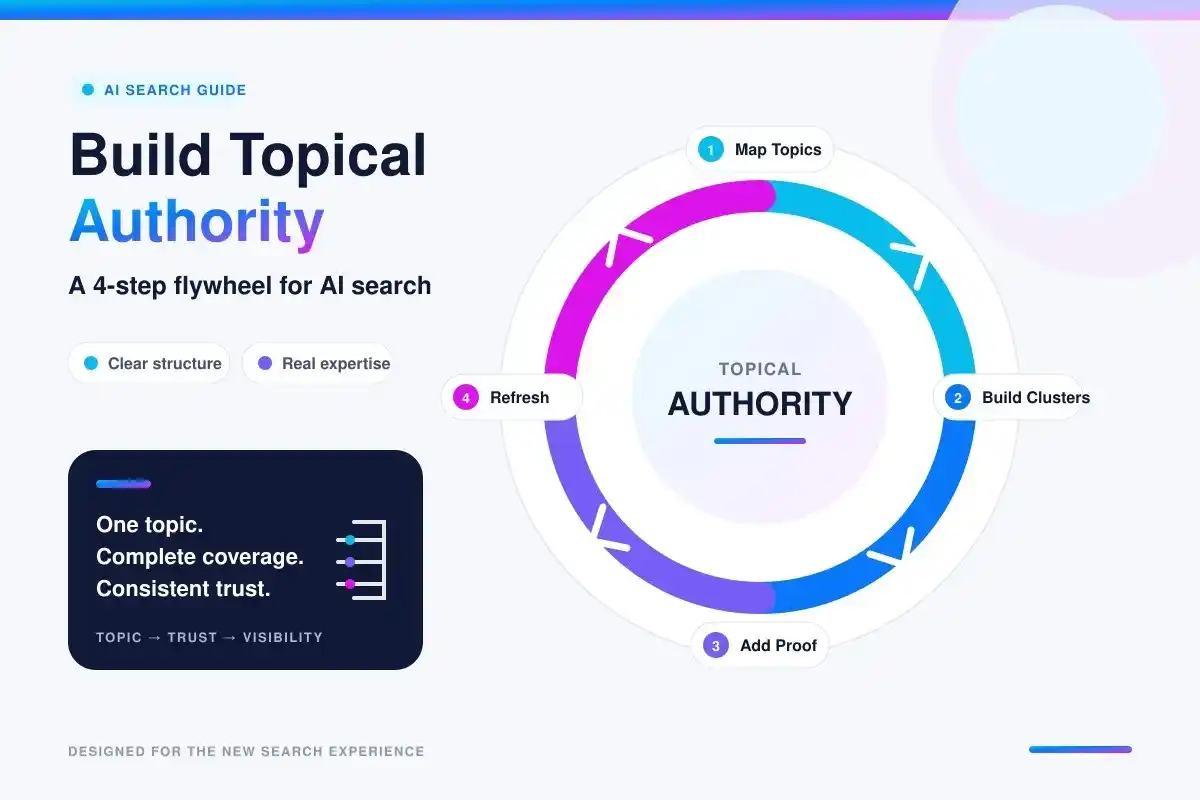
Search is changing. People now use Google, ChatGPT, Perplexity, Gemini, and other AI search tools to find answers, compare products, and choose brands. This makes topical authority important for businesses that want long-term search visibility.
Topical authority means showing strong and consistent knowledge about a specific subject. Your website should cover important parts of a topic, answer related questions, connect relevant pages, and provide useful information backed by experience and trusted sources.
Publishing many articles is not enough. You need a system that connects your content, builds your brand’s reputation, and makes your expertise easier for search engines and AI systems to understand.
What Is Topical Authority for AI Search?
Topical authority is the level of expertise and relevance a website shows around a specific topic. A site with strong topical authority covers the main subject and important subtopics in a useful, connected way.
For example, a website about SEO can cover:
- Search intent
- Technical SEO
- Internal linking
- Topic clusters
- Content optimization
- Link building
- AI search
- SEO tools
These related pages create a broader picture of the site’s knowledge. For AI search, topical authority goes beyond keyword coverage. Consistent, relevant content gives AI systems more context about the topics your website covers and your brand’s expertise.
How Topical Authority Helps Your Brand Appear in AI Search
AI search systems can draw information from many sources when generating answers. A website that consistently covers one subject gives them more relevant information about its focus.
A strong topical authority strategy can help you:
- Connect your brand with a specific topic
- Cover common user questions
- Provide supporting information instead of isolated articles
- Show relationships between related subjects
- Demonstrate first-hand knowledge
- Support claims with reliable evidence
- Build relevant recognition outside your website
For example, a website consistently covering GPUs, GPU temperatures, graphics card compatibility, and GPU performance creates a clearer topical focus than one with only a single GPU article among unrelated content. The goal is not to increase page count but to build a useful resource around a clearly defined subject.
Step 1: Choose a Topic You Can Actually Own
Start with a focused topic that matches your expertise, audience, and business goals. It should have enough depth to support related subjects while remaining focused enough to build a clear brand identity.
Ask:
- Does my website have real knowledge about this subject?
- Does my audience need this information?
- Can I provide useful information beyond basic definitions?
- Are there unanswered questions or content gaps?
- Does this topic support my business goals?
Study current search results to identify what established competitors cover and where their content leaves gaps.
Step 2: Build a Complete Topical Map
After choosing your main topic, map everything users may want to know about it. Start with the core topic and divide it into major subtopics. Under each one, list questions, problems, comparisons, use cases, and related entities.
For example:
Core topic: AI SEO
Subtopics:
- AI search optimization
- AI content
- AI citations
- Entity SEO
- Topical authority
- Search visibility
- Content strategy
Then expand each subtopic into specific questions. Do not focus only on keyword volume. A useful topical map should cover related concepts and entities from different angles. Group keywords with the same search intent instead of creating separate pages for every small variation. This can reduce keyword cannibalization and create a cleaner website structure.
Step 3: Create a Topic Cluster With a Strong Hub
Turn your topical map into a topic cluster. A topic cluster usually contains one main pillar or hub page supported by detailed pages covering specific subtopics.
For example:
Hub: AI SEO Guide
Supporting pages:
- What Is AI Search?
- How to Optimize Content for AI Search
- How AI Citations Work
- How to Build Topical Authority
- What Is Entity SEO?
- How to Track AI Search Visibility
The hub provides a broad overview, while supporting pages answer specific questions.
Each page should have a clear purpose. Avoid creating several pages that target the same search intent simply because their keywords are slightly different.
Step 4: Show Real Expertise and a Clear Point of View
Content volume does not automatically create authority. Your content should provide information that is useful and difficult for competitors to copy.
Add:
- First-hand experience
- Original examples
- Case studies
- Expert opinions
- Original research
- Data and analysis
- Screenshots or demonstrations
- Practical processes
- Clear recommendations
A clear point of view can make your content more distinctive. Explain why you recommend an approach, when it works, and where it may not be suitable.
Step 5: Connect Your Content With Internal Links
Internal linking helps users and search systems move between related pages. Link supporting pages to your main hub and connect them to other relevant pages when useful. For example, an article about AI search optimization can link to pages about AI citations, entity SEO, and topical authority.
Use descriptive anchor text so readers know what they will find. Each link should help users discover related information. A well-connected website creates a clearer topical structure and makes your content easier to navigate.
Step 6: Build Your Brand’s Entity and External Proof
Your website should clearly communicate who you are and what your brand is known for. Keep your brand information consistent across your website and relevant external platforms. Make your authors, expertise, company information, and areas of focus clear.
Build genuine recognition through:
- Relevant industry mentions
- Expert contributions
- Reputable publications
- Reviews
- Partnerships
- Original research
- Relevant backlinks
- Professional profiles
The goal is to create a consistent connection between your brand, expertise, and topic. Do not manufacture mentions or links. Relevant, genuine recognition is more valuable than unrelated links.
Step 7: Make Content Easy for AI Systems to Understand and Cite
AI-friendly content should be easy to read, understand, retrieve, and verify.
Use:
- Short paragraphs
- Clear H2 and H3 headings
- Direct answers
- Lists and tables where useful
- Specific facts
- Examples
- Definitions
- Supporting evidence
- Relevant internal links
- Trusted external sources
Answer important questions directly instead of hiding the answer under a long introduction. Keep important content updated, especially when information changes frequently. Avoid keyword stuffing and unnatural writing. Your priority should be creating genuinely useful content.
How IntelliWriter Can Support Your Topical Authority Workflow
Building topical authority involves topic research, topical mapping, content creation, SEO optimization, and publishing. IntelliWriter offers tools that can support different parts of this workflow, including AI article writing, keyword research, SEO checking, blog automation, and topical authority.
Its Topical Authority Builder can expand a core topic into content pillars and related ideas, helping you create a structured topical map and content cluster. IntelliWriter can then support content creation and SEO optimization, while you maintain the expertise, quality, and strategy behind your content.
An SEO and content tool should support your topical authority strategy, not replace it. You still need to choose the right topics, provide real expertise, create useful content, and build genuine authority.
How to Measure Topical Authority and AI Search Visibility
Topical authority does not have one simple score. Track several signals over time:
- Google rankings for your main topic
- Rankings across related subtopics
- Organic impressions and clicks
- Relevant indexed pages
- Internal linking coverage
- Referring domains and relevant mentions
- AI search citations
- Brand mentions in AI answers
- Competitor visibility
- Content gaps
Test relevant AI search prompts regularly and record whether your brand, pages, or original information appear. If competitors consistently appear across a topic while your website appears for only a few narrow searches, your topical coverage may have gaps. Use these findings to improve, combine, expand, or create content.
Common Topical Authority Mistakes to Avoid
Avoid these common mistakes:
- Publishing unrelated content just for traffic
- Creating pages with the same search intent
- Focusing only on keyword volume
- Writing generic content with no original value
- Ignoring internal links
- Covering topics without showing expertise
- Making unsupported claims
- Building irrelevant backlinks
- Forgetting to update important pages
- Treating AI search as completely separate from useful SEO
More content does not always mean more authority. Relevant, connected, useful, and trustworthy content is the foundation of a strong topical authority strategy.
FAQs
What is topical authority and why does it matter for AI search?
Topical authority means consistently covering a subject with useful, accurate, connected content. It gives search systems more context about your expertise and can strengthen your brand’s relevance for related queries.
What solutions help build topical authority for AI search?
Topic mapping, content clusters, internal linking, first-hand expertise, original research, entity optimization, relevant backlinks, content updates, and SEO tools can support a stronger topical authority strategy.
How does topical authority influence AI citations and brand visibility?
Consistent topical coverage gives AI systems more relevant information about your expertise. This can create more opportunities for your content or brand to appear in relevant AI-generated answers.
How do you build a topical authority plan for AI?
Choose a focused topic, map related subtopics, create connected content clusters, demonstrate expertise, strengthen internal links, build external proof, optimize content, and monitor search and AI visibility.
Conclusion
Building topical authority for AI search takes time. Focus on one topic, cover its key subtopics, create connected content, and show real expertise. Use internal links, entity signals, and external proof to strengthen your brand. Tools like IntelliWriter can help with SEO tasks, while useful and trustworthy content remains the foundation. Track Google and AI search performance, find gaps, and keep improving.
Leave a Reply