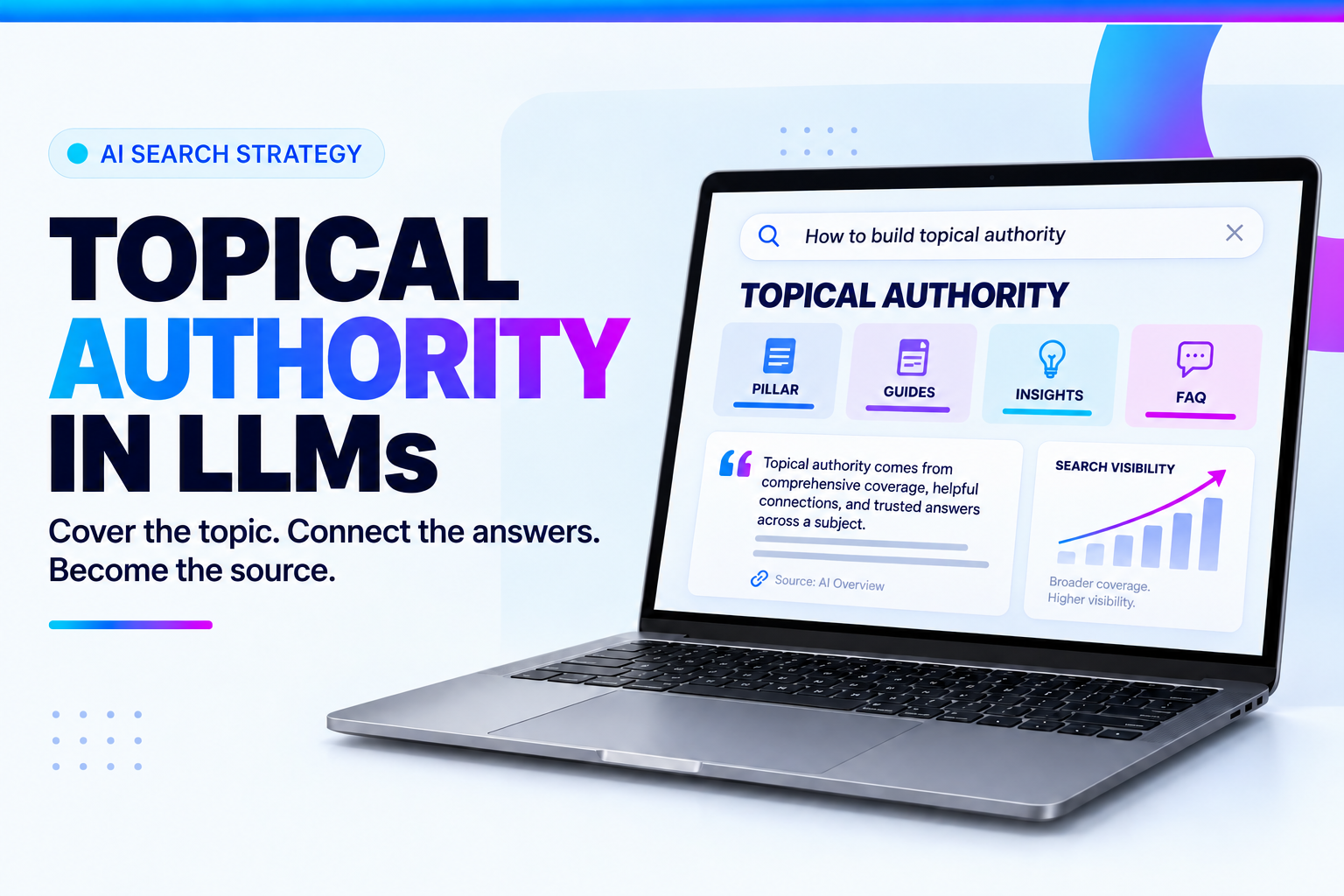
Search is changing. People are no longer using Google alone to find answers. They are also asking ChatGPT, Google AI Overviews, Perplexity, Gemini, and other AI search systems for direct answers.
This shift has made topical authority in LLMs an important part of modern SEO. Ranking one article for one keyword is no longer enough. Your website needs to show consistent expertise across a complete topic so search engines and AI systems can understand what your brand knows best.
But topical authority is not about publishing hundreds of articles. It is about building a connected content system that covers important entities, questions, subtopics, search intents, and relationships. This guide explains a practical step-by-step system for building topical authority in LLMs and improving your visibility across Google and AI search.
What Is Topical Authority in LLMs?
Topical authority in LLMs refers to building relevant, connected, and useful coverage around a subject that can help search engines and AI systems understand your website’s expertise and relevance to that topic.
For example, if a website wants to become an authority in AI SEO, one article about AI SEO is not enough. It could cover related subjects such as:
- AI search optimization
- Generative Engine Optimization (GEO)
- LLM optimization
- AI citations
- semantic SEO
- entity SEO
- topical maps
- content clusters
- search intent
- AI visibility
The goal is to create a connected body of knowledge instead of isolated blog posts. There is no public universal “topical authority score” from OpenAI, Google, or other LLM providers. Instead, topical authority is better understood as the strength and coherence of your coverage, relationships, expertise, and signals around a subject.
Why Topical Authority Matters for LLMs and AI Search
Traditional search may rank a page for one query, while AI search draws from related questions. Broad, connected topic coverage can help search engines and AI systems better understand the depth and relevance of your website’s content.
Topical authority can help you:
- Improve visibility for related searches
- Build stronger semantic relationships
- Help search engines understand your website
- Increase opportunities to appear in AI-generated answers
- Create stronger internal linking structures
- Cover more search intents
- Build trust around a specific subject
Recent SEO research also emphasizes that topical authority should not be treated as a simple page-count or keyword-count exercise. Structure, coverage, entities, and relationships matter.
How to Build Topical Authority in LLMs: 8 Steps
1. Choose Your Core Topic
Start with one clear subject that is closely connected to your business. Your core topic should match what you want your brand to be known for. Avoid selecting a broad subject only because it has high search volume.
For example, a content platform could choose:
Core topic: AI content and SEO
From there, you can identify related areas such as:
- AI article writing
- SEO content optimization
- keyword research
- topical authority
- AI search
- content planning
- content automation
- SEO analysis
A focused topical direction makes it easier to build meaningful coverage over time.
2. Build a Topical Map
Before creating content, map the complete topic. A topical map organizes your main topic into related entities, subtopics, questions, and content opportunities. Instead of starting with a list of keywords, think about the subject as a connected network.
For example:
AI SEO → AI search → LLM optimization → AI citations → entities → semantic SEO → topical authority
Then break each area into more specific questions.
Your map should identify:
- Core topics
- Subtopics
- Related entities
- Questions
- Search intents
- Supporting topics
- Content gaps
- Connections between pages
This approach helps prevent random content production and gives every article a clear role in your topical structure. Knowledge-graph-based SEO approaches similarly treat the map as the foundation for deciding what content is missing and how topics connect.
3. Cover Search Intent and Query Variations
A topic can have different search intents. One user may want a definition, another may want to know how to build it, while others may search for tools or topical map examples. That means you should not target only one keyword. Build content around different query patterns, including:
- What is topical authority?
- Why is topical authority important?
- How to build topical authority
- Topical authority vs domain authority
- How topical authority works for AI search
- How to create a topical map
- How to build topic clusters
- How to improve LLM visibility
Query-template coverage can expand topical authority beyond individual keywords by addressing different ways users search for the same subject.
4. Create Pillar Pages and Supporting Content
Now turn your topical map into a content structure. Create a pillar page for the broad subject and supporting articles for specific subtopics. This can all be done by Intelliwriter AI Aritcle writer and Blog Automation tool
For example:
Pillar: Topical Authority
Supporting content:
- What Is Topical Authority?
- Topical Authority vs Domain Authority
- How to Build a Topical Map
- Topic Clusters Explained
- Internal Linking for Topical Authority
- Topical Authority for AI Search
- Entity SEO and Topical Authority
Each supporting article should answer a specific question and link to related pages. This creates a connected content cluster instead of unrelated posts, with pillar content, internal links, and consistent topical focus.
5. Build Strong Semantic and Entity Connections
Keywords alone do not explain a topic completely. Entities and relationships help create a clearer picture of what your content is about. For example, an article about LLM optimization may naturally connect:
LLMs → ChatGPT → AI search → retrieval → entities → citations → content → topical authority
Use consistent terms, define related entities clearly, and show how concepts connect. Semantic SEO helps search engines and AI systems understand these relationships instead of just seeing repeated keywords.
6. Strengthen Internal Linking
Internal links turn separate articles into a connected knowledge system. Link your pillar page to important supporting pages. Then link supporting pages back to the relevant pillar and to other closely related content. Use descriptive anchor text rather than generic phrases such as “click here.”
For example, instead of:
Click here to learn more
use:
how to build a topical map
The link should help both users and search systems understand the relationship between the pages.
7. Add Original Expertise and External Validation
Topical authority is not created by rewriting everything that already exists. Your content should add something useful.
That could include:
- First-hand experience
- Original examples
- Unique frameworks
- Expert opinions
- Original research
- Data
- Case studies
- Practical processes
Relevant external mentions and links from credible sources can contribute to a website’s overall credibility and visibility. However, they do not guarantee that an AI system will cite or select a particular website as a source.
8. Optimize, Measure, and Fill Content Gaps
Topical authority is an ongoing process. After publishing your content, review what is working and where coverage is still weak.
Track:
- Google rankings
- Organic traffic
- Search impressions
- AI search visibility
- Brand mentions
- AI citations
- Internal-link coverage
- Missing subtopics
- Competitor content gaps
Test your brand across AI platforms for relevant prompts. If competitors appear and you don’t, identify their missing signals or content gaps, then update your topical map and create the needed content.
How IntelliWriter Can Help Build Topical Authority?
Building topical authority manually can involve topic research, keyword discovery, content planning, writing, SEO analysis, and publishing. IntelliWriter brings these activities together in one AI-powered content platform.
Its capabilities can support the workflow from topic research and planning to content creation, SEO optimization, and publishing. The Topical Authority Builder can help identify core and supporting topics so you can create a more organized content strategy instead of choosing article ideas randomly.
You can then use AI article writing to produce content, keyword research to expand topic coverage, and SEO checking to identify optimization opportunities.
Together, these features can support a more systematic workflow:
Research → Map → Create → Optimize → Connect → Publish → Improve
This workflow provides a structured approach to building and managing topical content rather than relying on random article ideas.
The important point is that the tool should support a strategy—not replace it. Publishing more AI-generated articles without a clear topical structure will not automatically create authority.
Common Topical Authority Mistakes
- Publishing Too Much Unrelated Content: More pages do not automatically mean more authority. Stay focused on topics that support your main subject.
- Targeting Only Keywords: Keywords are useful, but they do not represent the entire topic. Include entities, questions, relationships, and search intent.
- Creating Similar Articles: Publishing multiple pages that answer nearly the same question can create unnecessary overlap. Give each page a clear purpose.
- Ignoring Internal Links: Even strong articles can remain disconnected if related pages are not linked together.
- Writing Only for AI: Do not sacrifice human readability to make content “AI-friendly.” Clear structure, direct answers, useful information, and good writing benefit both readers and machines.
Frequently Asked Questions
What is topical authority in LLMs?
Topical authority in LLMs is the strength of a website’s connected coverage around a subject, helping AI systems associate its content, entities, expertise, and information with that topic.
How do you build topical authority?
Build topical authority by mapping a topic, covering related entities and search intents, creating pillar and cluster content, connecting pages with internal links, adding expertise, and filling content gaps.
Does topical authority help with AI search?
Topical authority can support AI search visibility by giving search and AI systems broader, connected evidence about a website’s expertise, although it does not guarantee citations or rankings.
How long does it take to build topical authority?
There is no fixed timeline. Results depend on topic competition, existing content, expertise, site quality, external signals, and how completely and consistently the website builds its topical coverage.
Conclusion:
Building topical authority in LLMs requires more than publishing content. It means creating connected, useful, and trustworthy coverage around a topic. By using topical maps, search intent, semantic connections, internal links, and continuous optimization, IntelliWriter can help turn scattered content into a strong system for SEO and AI search visibility.
Leave a Reply