Understanding the AI Content Workflow
What is an AI Content Workflow?
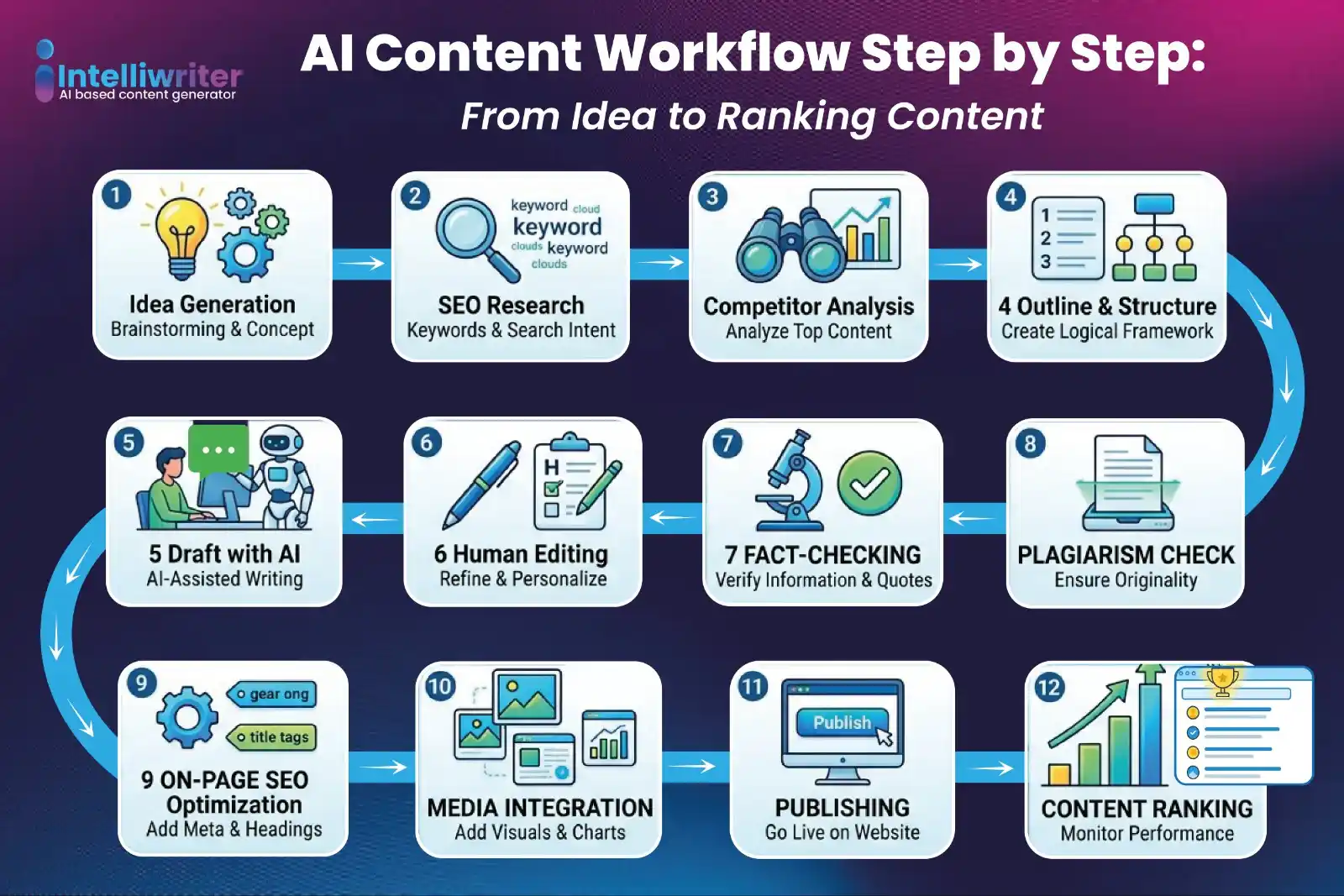
An AI content workflow is a structured, repeatable system that uses artificial intelligence to handle every stage of the content lifecycle — from initial research and keyword targeting, through drafting and optimization, to publishing, distribution, and performance tracking. Rather than treating AI as a simple writing shortcut, a proper workflow integrates it as a strategic layer across multiple stages, each with clearly defined inputs, outputs, and human checkpoints.
The distinction matters enormously. An effective automated workflow covers the entire content creation lifecycle: ideation, where AI tools generate content ideas based on keywords, trends, and competitor analysis; research, where automated tools gather and analyze relevant data; drafting, where AI-powered writing assistants generate initial drafts based on provided keywords, tone, and style guidelines; and optimization, where automated SEO tools analyze your content for keyword density and readability.
Why Traditional Content Processes Are No Longer Enough
The content landscape has shifted dramatically. In 2022, ChatGPT launched and quickly reached one billion daily interactions — people having conversations with AI for answers they once found through keyword searches. In 2024, AI Overviews emerged, disrupting Google Search itself, leaving marketers asking whether SEO was enough.
The numbers tell a sobering story. Ahrefs found that 96.55% of pages get no organic traffic from Google. SparkToro’s 2024 analysis found that only around 36% of U.S. Google searches resulted in clicks to the open web. Traditional content processes — write, publish, hope — are simply no longer competitive.
Benefits of a Structured AI Content Workflow for SEO
A structured AI content workflow solves the most painful bottleneck in modern content marketing: producing high-quality, optimized content consistently and at scale. Incorporating AI tools into your content creation workflow significantly reduces the time spent on manual tasks, ensures your content is optimized for search engines, and helps maintain a consistent brand voice and style across all content, enhancing brand credibility and authority.
Beyond efficiency, the strategic benefits compound over time. Forrester predicts AI-powered search will drive 20% of all organic traffic by the end of 2025. Teams that build structured, repeatable AI workflows now are positioning themselves for that shift.
Step 1 – Define Goals and Search Intent
Identifying Your Content Objectives (Traffic, Leads, Sales)
Before writing a single word or running a single query, you need clarity on what success looks like for each piece of content. Is the goal to rank for an informational keyword and build topical authority? Generate qualified leads for a product? Drive bottom-of-funnel conversions? Your objective shapes every downstream decision — keyword selection, content format, word count, and calls to action.
Understanding User Intent (Informational, Navigational, Transactional)
Search intent is the strategic north star of any content plan. Intellliwriter points out that many keywords carry blended intent, and that a simple intent classification step prevents the classic mistake of writing a 2,500-word educational guide for a keyword where people really just want a provider comparison.
The four intent categories — informational, navigational, commercial, and transactional — each demand a different content type, structure, and conversion strategy. Mapping these correctly at the start of your workflow prevents wasted effort and misaligned content.
Mapping Keywords to Search Intent
Once you understand user intent, map your target keywords to the appropriate content format. Informational queries deserve comprehensive guides and explainers. Commercial queries call for comparison pages and product deep-dives. Transactional queries belong on landing pages and product pages with clear CTAs. This mapping stage should be documented and reviewed before any brief is created.
Step 2 – Keyword Research and Topic Clustering
Finding Primary and Secondary Keywords
Keyword research in 2026 goes beyond search volume and competition scores. Use tools like Intelliwriter, Semrush, Ahrefs, or Google Search Console to identify not just high-volume keywords, but also long-tail and intent-driven phrases, and understand the questions your audience is asking. Your primary keyword anchors your content; secondary keywords and related phrases give it depth and semantic breadth.
Using AI for Semantic Keyword Expansion (LSI & Entities)
AI tools significantly accelerate the process of expanding a keyword list into a full semantic map. AI can provide a list of related subtopics and terms that should appear naturally in an article, grouped by definitions, comparisons, costs, timelines, FAQs, mistakes, and tools. This semantic expansion is critical because modern search engines evaluate content based on entity relationships, not just keyword frequency.
Building Topic Clusters for Topical Authority
Topic clusters are the architecture that turns individual pieces of content into compounding SEO assets. An effective topic cluster strategy that involves publishing quality content on relevant topics builds topical authority that helps with both search engine optimization (SEO) and generative engine optimization (GEO). When you build topical authority, you’re able to rank for more keywords in search engines and appear for more prompts in large language model tools.
The structure is straightforward: a pillar page serves as the central hub targeting a broader subject area, while cluster pages are in-depth content assets that explore subtopics or common questions related to the pillar page, targeting long-tail keywords with semantic relationships to the primary topic. Tools purpose-built for this include Intelliwriter AI Topical Authority Builder, Semrush’s Keyword Magic Tool, Ahrefs Keyword Explorer, and the HubSpot Topic Cluster Tool.
Step 3 – SERP Analysis and Competitor Research
Analyzing Top-Ranking Pages
Before writing, study what is already winning. Examine the top five to ten results for your target keyword. Analyze their structure, average word count, heading hierarchy, content depth, and the types of media used. This SERP audit tells you the baseline standard you need to meet — and ideally exceed. All these things should be done by Intelliwriter Artificial Intelligence.
Identifying Content Gaps and Opportunities
Content gaps are where rankings are won. Any subtopic that multiple top-ranking competitors have covered represents a validated gap in your cluster. Multiple publishers addressing the same subtopic confirms that Google is rewarding that coverage. Look for angles, questions, or subtopics that competitors have ignored entirely — these are often the highest-ROI additions to your content.
Extracting NLP Entities and Content Patterns
Modern SEO requires thinking in entities, not just keywords. Generative models go beyond understanding keywords — they understand entities and relationships too. To show up in coveted AI answers, your content must reflect structured, interconnected knowledge. During SERP analysis, note which entities (people, places, concepts, tools, brands) appear consistently across top-ranking pages. These are signals from Google about what belongs in a thorough treatment of the topic.
Step 4 – Creating an SEO-Optimized Content Brief
Structuring Headings (H1, H2, H3) Based on SERP Data
A content brief built from SERP data removes guesswork for writers and AI tools alike. Your heading structure should reflect the actual subtopics Google is rewarding, not internal assumptions about what the audience wants. Model your H2 and H3 hierarchy on patterns you observe across the top three to five ranking pages, then differentiate by adding angles your competitors missed.
Defining Word Count, Tone, and Content Depth
Word count should be determined by SERP data, not arbitrary targets. Analyzing competitors can reveal the average word count of top-ranking pages — for example, an analysis of ten competitor pages for a given keyword might show an average of 2,400 words. Tone should be specified explicitly in the brief: technical or conversational, authoritative or accessible, first-person or editorial. Vague briefs produce vague content.
Including Entities, FAQs, and Internal Linking Strategy
A complete brief includes the semantic entities that must appear in the content, a list of FAQ questions drawn from “People Also Ask” results, and a clear internal linking strategy. Google has directly emphasized internal linking practices like descriptive anchor text and building a structure that helps users and search engines navigate. Map out which existing pages should receive links from this content before the first draft is ever written.
Step 5 – AI Content Generation (First Draft)
Choosing the Right AI Writing Tool
Not all AI writing tools are built equally. Tools like Intelliwriter are purpose-built for content teams that need SEO-optimized output, consistent brand voice, and structured drafts — rather than generic text generation. The right tool should understand your niche, support your content type (guides, comparisons, product pages), and integrate into your broader workflow.
Writing Prompts That Produce High-Quality Content
Prompt quality determines output quality. Using AI in layers — rather than asking it to “write the whole article” — produces far better results. Write prompts that specify the target audience, the heading being addressed, tone requirements, and style references. If you want AI output to sound like you, you have to tell it what “you” sounds like, for example, by sharing two paragraphs of your own writing and asking the model to match that tone.
Generating Structured, Human-Like Drafts
The goal of the first draft stage is a structured skeleton with coherent prose — not a polished final article. AI content generation is where automation delivers the most dramatic time savings, but quality concerns run highest. The solution is building a multi-layered system where AI handles the heavy lifting while strategic guardrails maintain standards. Generate section by section, review as you go, and preserve your human editing pass for the next step.
Step 6 – Human Editing and Content Enhancement
Fact-Checking and Accuracy Improvements
AI-generated drafts require rigorous fact-checking. When bringing AI into content workflows, fact-check all content on numbers, statistics, quotes, attributions, citations, and names of people, companies, locations, and legal statutes. Never publish figures or claims sourced from an AI draft without independently verifying them against primary sources.
Improving Readability and Engagement
Human editors add what AI cannot: rhythm, personality, and the instinct to cut what’s boring. Read the draft aloud. Shorten sentences that lose the reader. Add subheadings where sections run long. Introduce concrete examples and analogies that ground abstract claims. These are the edits that separate content people want to read from content that technically covers a topic.
Adding Experience, Expertise, and Original Insights (E-E-A-T)
This editing pass is where E-E-A-T signals are built in. Content should demonstrate expertise, clear sourcing, and trustworthiness. Google asks content producers to focus on who created the content, how it was produced, and most importantly, why it was created. Add named authors with verifiable credentials, embed first-hand observations or case study data, and cite authoritative external sources. AI should serve as a starting point, not the final product — add your perspective, refine the voice, and check the facts, because readers can tell when something has been phoned in.
Step 7 – NLP Optimization and Entity Enhancement
Optimizing for Google NLP and Entity Recognition
After human editing, run your content through an NLP lens. Google’s natural language processing evaluates which entities your content discusses and how prominently it discusses them. Ensure your primary topic entities appear early, clearly, and in contextually appropriate ways throughout the piece.
Improving Entity Salience and Content Relevance
Entity salience refers to how central and prominent an entity is within your content. To show up in AI answers and be the top choice, content must reflect structured, interconnected knowledge. Building a brand knowledge graph that maps people, products, and topics that define your expertise — supported by schema markup that shows how these entities connect — is essential for modern SEO.
Using AI Tools for Content Scoring and Optimization
Tools like Intelliwriter’s content scoring features, Surfer SEO, and Semrush’s SEO Writing Assistant provide real-time feedback on entity coverage, readability, and topical completeness. Real-time SEO scoring, topic suggestions, and competitive benchmarks highlight every gap so nothing gets missed before publication. Run your edited draft through one of these tools and address the highest-priority recommendations before moving to on-page SEO.
Step 8 – On-Page SEO Optimization
Optimizing Title Tags, Meta Descriptions, and URLs
Title tags should lead with the primary keyword, stay under 60 characters, and convey a clear value proposition. Meta descriptions, while not a direct ranking factor, influence click-through rates. Intelliwriter Super SEO Agent wordpress seo plugin can analyze your content, identify its unique selling points, and generate a meta description that summarizes them accurately, complete with a call to action to encourage click-through. URLs should be clean, keyword-rich, and free of unnecessary parameters.
Internal Linking and Anchor Text Strategy
Internal linking distributes authority across your site and reinforces your topic cluster architecture. Use descriptive, keyword-relevant anchor text rather than generic phrases like “click here.” Every new piece of content should link to your pillar page and receive links from at least two to three related cluster pages.
Image Optimization and Schema Markup
Images should include descriptive alt text that incorporates relevant keywords. Compress files for fast load times. For structured content like how-to guides, FAQs, and product reviews, implement schema markup to qualify for rich results. Schema is also a signal to AI systems about how your content entities relate to one another.
Step 9 – Publishing and Indexing
Best Practices for Publishing AI Content
Publish with full transparency about your content production process. If automation is used to substantially generate content, Google asks whether the use of automation is self-evident to visitors through disclosures, and whether you are providing background about how automation or AI-generation was used. Include author bios, publication dates, and last-updated timestamps on every piece.
Submitting to Google Search Console
After publishing, submit the URL directly in Google Search Console’s URL Inspection tool and request indexing. This does not guarantee immediate indexing but signals to Google that the page is ready for crawling. For large content operations, ensure your sitemap is up to date and submitted.
Ensuring Proper Indexing and Crawlability
Verify that your page is not blocked by robots.txt, does not have a noindex tag inadvertently applied, and loads within acceptable Core Web Vitals thresholds. Great content means nothing if AI crawlers cannot access or understand it.
Step 10 – Content Promotion and Distribution
Leveraging Social Media and Communities
Distribution amplifies the reach of content that would otherwise sit unseen. Share new content across your brand’s social channels, in relevant LinkedIn groups, and in niche communities where your target audience is active. Authentic participation in these spaces — not just broadcast posting — builds the brand signals that contribute to E-E-A-T over time.
Building Backlinks to AI Content
Backlinks remain a trust signal, even as topical authority grows in importance. Mentions across the web, relevant backlinks, and clean content architecture are all signals that your site knows its subject matter, and one of the biggest SEO trends in 2025 is content architecture and backlinks proving more important each month. Pursue digital PR, expert roundup contributions, and resource page outreach to earn links to your most authoritative content.
Repurposing Content into Multiple Formats
A single well-researched article can generate significant additional reach when repurposed. Brands seeing the most success with video strategically use it to enhance their overall content experience and capture visibility across multiple search formats, adding explanatory videos within complex how-to guides and creating visual demonstrations of products or services. Turn your long-form guide into a LinkedIn carousel, a short-form video, or a downloadable checklist.
Step 11 – Performance Tracking and Continuous Optimization
Monitoring Rankings and Organic Traffic
Use Google Search Console to track impressions, clicks, average position, and click-through rates for your target keywords. Supplement this with a third-party rank tracking tool for competitor benchmarking. Monitor AI visibility as well as traditional rankings — track AI visibility using Perplexity or ChatGPT citations, not just Google rankings, because in 2025, SEO is about ranking, while AI SEO is about being the answer.
Updating Content Based on Performance Data
Content decay is real. Pages that rank well at launch will lose ground without regular updates. Add new content as regularly as possible without compromising quality to keep your site competitive and up to date, and do not forget to update existing content — some queries demand updates, such as breaking news, product releases, or recurring events, and Google will prioritize updated pieces in those instances.
Scaling Your AI Content Workflow for Growth
A repeatable workflow becomes scalable when every step is documented, every role is defined, and every tool is configured. By the end of a well-built automated workflow, you will have a repeatable system that produces SEO-optimized content faster, maintains your quality standards, and scales without proportionally scaling your team.
Common Mistakes in AI Content Workflows (And How to Avoid Them)
Over-Reliance on AI Without Human Editing
The most common mistake teams make is treating AI output as a finished product. Google’s “scaled content abuse” policy penalizes unedited or low-quality AI text. AI should assist content creation, not replace expertise — always have a human editor improve tone, accuracy, and factual integrity.
Ignoring Search Intent and SERP Data
Producing content without analyzing what Google is already rewarding is a fundamental workflow failure. In 2025, SEO is about building the kind of brand trust and semantic authority that LLM-based ranking systems value. AI systems prefer and prioritize content that is well-sourced, attributable, and authoritative — content velocity is no longer the end game.
Publishing Without Optimization or Strategy
Publishing raw AI drafts at volume — without briefs, entity optimization, internal linking, or schema — produces the kind of low-quality content that triggers spam filters and undermines domain authority. Flooding your site with hundreds of low-value posts can trigger spam filters. Build topically related clusters slowly, ensuring each page provides unique, helpful information. Quality over quantity is the way to go, especially post-Spam Update 2025.
Final Thoughts: Building a Scalable AI Content System
Turning Workflow into a Repeatable Process
The difference between teams that struggle with AI content and those that thrive is systematization. Document every step of your workflow — from brief template to publishing checklist — so that any team member can execute it consistently. A well-documented process is the foundation for scaling without sacrificing quality.
Combining AI Efficiency with Human Creativity
AI should augment workflows, streamline processes, and improve decision-making — but human expertise remains essential for trust and strategic oversight. The teams winning with AI content are not replacing human writers; they are freeing them from repetitive tasks so their creativity and judgment can be applied where it matters most — in E-E-A-T signals, original insights, and strategic narrative.
Future of AI Content in SEO
Brands now compete for top rankings in search engine results (SEO), citations in AI answers via answer engine optimization (AEO), and mentions in generative AI tools like ChatGPT and Perplexity via generative engine optimization (GEO). SEO fundamentals like authority, quality, and clarity remain non-negotiable — what is different is how AI interprets those signals.
The future belongs to content operations that treat AI as a strategic partner embedded across a structured workflow — not a button you press to generate articles in bulk. Tools like Intelliwriter are built precisely for this: combining AI-powered drafting, NLP optimization, and content scoring into a single platform that supports every step described in this guide. That is how you build a content machine that ranks today and compounds in value tomorrow.
Leave a Reply