Introduction: Why Blog Automation Is No Longer Optional
Most marketers today face the same bottleneck: content demand far outpaces the time and resources available to produce it. Writing, optimising, and publishing a single blog post manually can consume 3–6 hours, and that’s before you factor in keyword research, formatting, and SEO checks.
The result? Inconsistent publishing schedules, stagnant organic traffic, and lost competitive ground to brands that ship content at scale.
IntelliWriter’s AI Blog Automation changes the equation entirely. By automating every step of the blogging workflow — from keyword discovery to WordPress publishing — IntelliWriter hands back 10+ hours every week while producing SEO-optimised, human-sounding content that actually ranks.
This guide walks you through the complete workflow:
idea → research → draft → optimise → publish → scale.
What Is Blog Content Automation? (And How It Works)
Blog content automation is the use of AI and workflow tools to handle the repetitive, time-intensive tasks involved in producing blog content, without sacrificing quality.
Traditional manual blogging looks like this:
Spend hours on keyword research tools
Write a brief, then a draft, then revise
Manually optimise headings, meta tags, and internal links
Copy-paste into WordPress and format from scratch
An automated workflow compresses all of that into a single pipeline:
Input a seed keyword or topic
AI researches, outlines, drafts, and optimises the article
Content is published directly to your site — no manual steps
The key stages automated by IntelliWriter include: keyword research, content generation, SEO optimisation, humanisation, and direct publishing to WordPress, Wix, or Shopify.
💡 Automation doesn’t replace your strategy — it executes it at a speed and scale no human team can match alone.
What Is IntelliWriter AI Blog Automation?
IntelliWriter is an all-in-one SEO content and blog automation platform designed to help marketers, agencies, bloggers, and businesses produce and publish high-ranking blog content at scale — without the usual time investment.
It is built for:
Digital marketing agencies managing multiple client blogs
SaaS companies and online businesses are scaling organic traffic
Bloggers and niche site owners are building topical authority
Affiliate marketers who need volume without sacrificing quality
IntelliWriter’s core promise is simple:
Faster content production — from hours to minutes per article
SEO-optimised output — structured, NLP-enriched, and ranking-ready
Human-like content — passes AI detection and reads naturally
Key Features That Enable Full Blog Automation
AI Keyword Research Engine
IntelliWriter’s built-in keyword engine automatically surfaces high-ranking, low-competition keywords for any niche. Instead of jumping between multiple SEO tools, you get primary keywords, secondary terms, and search intent data in one place — ready to feed directly into the content pipeline.
Topical Authority Builder
Ranking today requires more than a single blog post — it requires owning a topic. IntelliWriter’s Topical Authority Builder maps out complete content clusters around your niche, so you can plan and produce pillar pages plus supporting articles that signal deep expertise to search engines.
AI SEO Article Writer
The core of IntelliWriter’s automation is its long-form ai seo article writer. It generates fully structured blog posts complete with H1–H4 headings, NLP keyword integration, FAQs, and readability optimisation. Output is ranking-ready from the first draft.
Content Humanizer
AI-generated content can sound robotic. IntelliWriter’s Content Humanizer strips out that mechanical tone, improves flow, and ensures the article reads naturally — helping it pass AI detection tools while genuinely engaging readers.
WordPress Integration
Connect IntelliWriter directly to your WordPress site and publish — or schedule — articles without ever opening the backend. No copy-pasting, no formatting fixes. The integration also works with Wix and Shopify.
Automation Workflow Engine
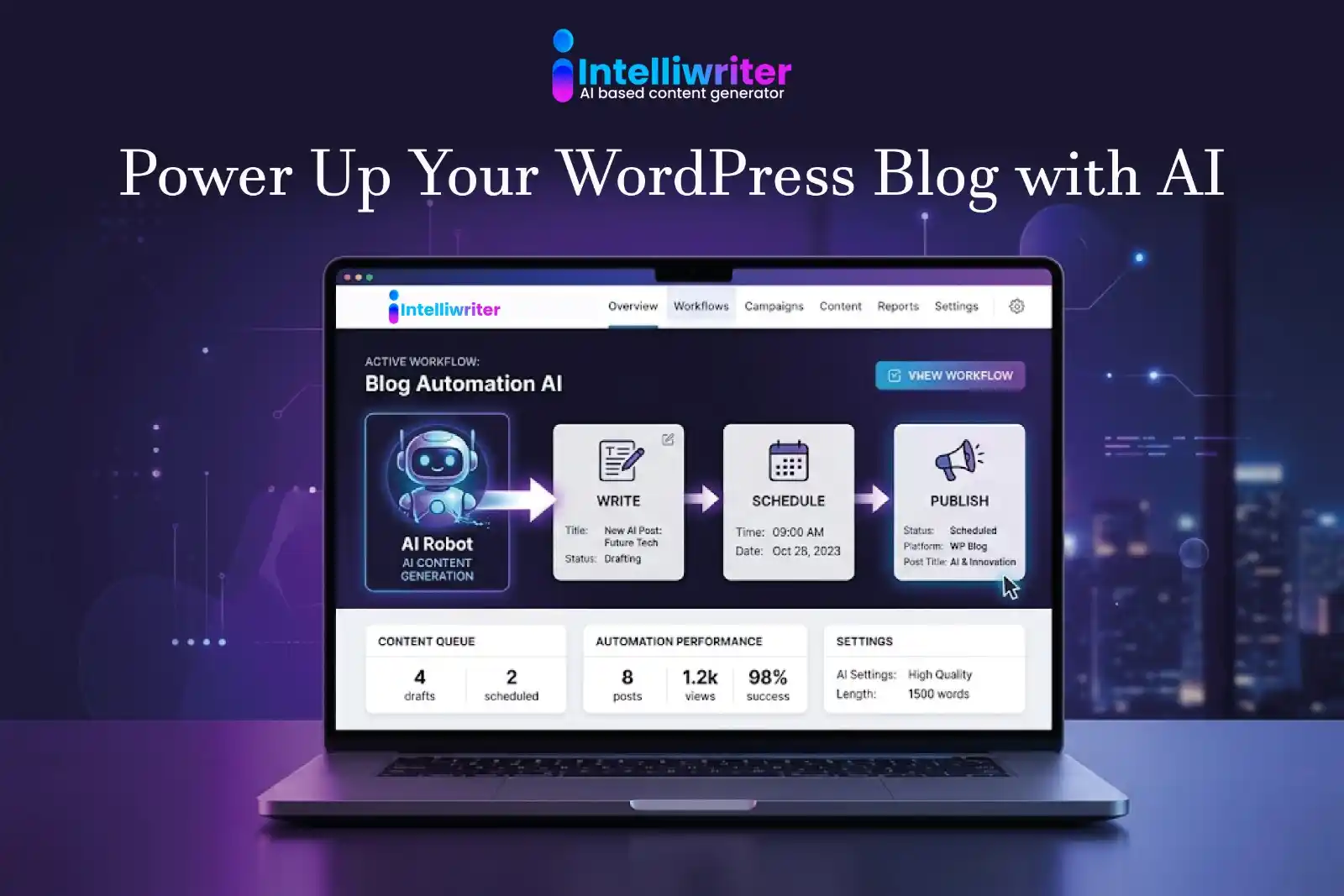
The Automation Workflow Engine is what ties everything together. Feed it a keyword or topic and it orchestrates the entire pipeline: research → outline → draft → optimise → publish. One input. One complete, published blog post.
Step-by-Step: How to Automate Blog Content with IntelliWriter
Follow these 11 steps to go from blank page to published, optimised blog post — in minutes.
Step 1 – Set Your Content Strategy
Before generating a single article, define your niche and target audience. Are you driving organic traffic, generating leads, or building topical authority? Use IntelliWriter’s Topical Authority Builder to map content clusters aligned with your goals. This ensures every article you produce contributes to a coherent, ranking-focused content plan.
Step 2 – Perform Automated Keyword Research
Enter a seed keyword into IntelliWriter’s Keyword Research Engine. The platform returns primary keywords, secondary keywords, and search intent signals — filtered for ranking potential. Select the best opportunities and move them directly into the content pipeline.
Step 3 – Generate Blog Topics at Scale
Use IntelliWriter’s AI to generate multiple blog topic ideas from your selected keywords in seconds. Cluster related topics for SEO dominance and build a full content calendar instantly — weeks or months of content planned without manual brainstorming.
Step 4 – Create SEO-Optimised Outlines
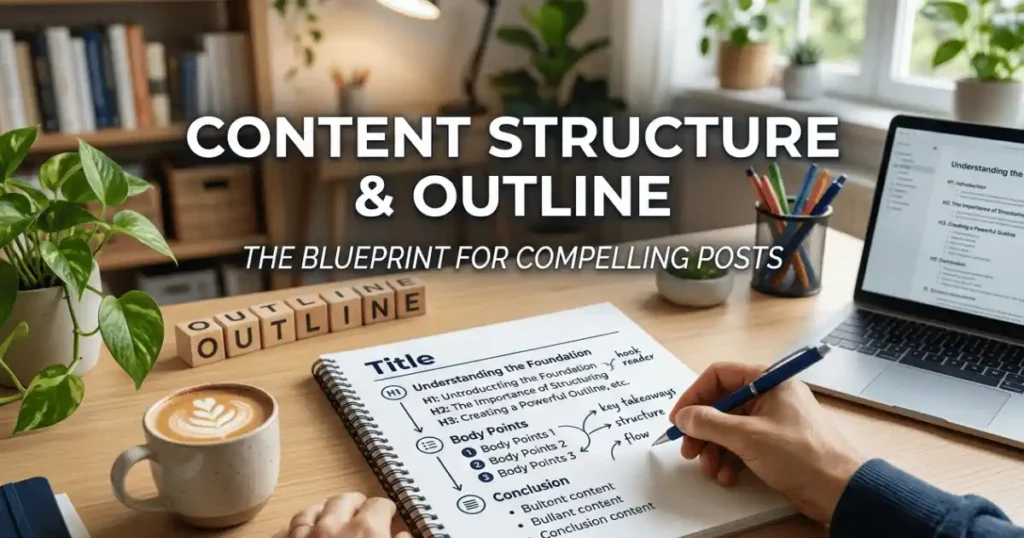
IntelliWriter generates structured outlines (H1 through H4) aligned with competitor analysis and topical coverage gaps. Every outline is built to satisfy search intent and cover the topic comprehensively — giving your article the best possible foundation before a single word of body content is written.
Step 5 – Generate Full-Length Blog Articles
With one click, IntelliWriter expands the outline into a complete, long-form blog post. The output includes an engaging introduction, fully developed body sections, an FAQ block, and a conclusion — all optimised for both search engines and human readers.
Step 6 – Enhance Content with Humanization
Run the finished draft through IntelliWriter’s Content Humanizer. It removes robotic phrasing, improves sentence flow, and ensures the article sounds like it was written by a knowledgeable human — not generated by a machine. This step is critical for reader engagement and AI detection compliance.
Step 7 – Optimise for SEO Automatically
IntelliWriter automatically weaves NLP keywords into the content, suggests internal links, generates meta titles and descriptions, and provides an SEO score. No manual tag editing or separate SEO plugin work required.
Step 8 – Add Media & Enhancements
Enrich your article with AI-generated images, formatted tables, structured lists, and FAQ schema markup for rich snippets. IntelliWriter handles formatting so every published post looks polished and professional straight out of the pipeline.
Step 9 – Auto-Publish to WordPress
Connect IntelliWriter to your WordPress (or Wix / Shopify) site. Once connected, you can publish articles instantly or schedule them for later — all without logging into your CMS. The manual upload process is completely eliminated.
Step 10 – Scale Content Production
Run the pipeline in bulk. IntelliWriter lets you generate and publish multiple articles simultaneously, automate weekly or monthly content plans, and operate full content pipelines — turning what used to take a team weeks into a matter of hours.
Step 11 – Track Performance & Optimise
Monitor keyword rankings and organic traffic directly. IntelliWriter also allows you to update existing articles automatically based on performance data — keeping your content fresh, competitive, and improving over time without starting from scratch.
Complete Automation Workflow (Visual Breakdown)
Here is how a single keyword input becomes a fully published, optimised blog post inside IntelliWriter:
Input: One seed keyword or topic
Research: AI identifies primary keywords, intent, and competitor gaps
Optimise: NLP terms, meta tags, internal links, and SEO score applied
Publish: Article pushed directly to WordPress, Wix, or Shopify
💡 The entire pipeline runs from a single input. No switching tools. No manual handoffs. IntelliWriter handles every stage inside one platform.
How Much Time Can You Actually Save?
A realistic breakdown of manual vs automated blog production:
Manual: Keyword research — 45–60 min per article
Manual: Writing a full draft — 2–4 hours per article
Manual: SEO optimisation — 30–60 min per article
Manual: Formatting and publishing — 30–45 min per article
Manual total: 3–6 hours per article
With IntelliWriter:
Keyword research: under 2 minutes
Full draft generation: 3–5 minutes
SEO optimisation: automated
Publishing: one click
Total: under 10 minutes per article
For a team publishing 3–5 articles per week, IntelliWriter delivers a saving of 10–25 hours weekly — time that can be redirected to strategy, distribution, and growth.
Benefits of Automating Blog Content with IntelliWriter
Consistent publishing schedule — no more content droughts caused by time constraints
Improved SEO rankings — every article is structured and optimised from the start
Scalable content production — go from 4 articles a month to 40 without adding headcount
Reduced dependency on freelance writers — lower cost per article, faster turnaround
Higher ROI on content marketing — more content, more rankings, more traffic
Common Mistakes to Avoid in Blog Automation
Publishing without any human review — always do a quick quality pass before going live
Ignoring search intent — automation is only as good as the keyword strategy behind it
Skipping humanisation — raw AI drafts can sound mechanical; use IntelliWriter’s Humanizer
Not building topical authority — isolated articles rank less effectively than content clusters
💡 IntelliWriter handles the heavy lifting, but a brief human review before publishing ensures every post reflects your brand voice and meets your quality bar.
Best Practices for High-Quality Automated Content
Always review before publishing — a 5-minute review catches anything that needs a human touch
Add unique insights — proprietary data, case studies, or expert opinion elevate automated drafts
Use internal linking strategically — IntelliWriter suggests links; choose the ones that add value
Maintain brand voice consistency — configure IntelliWriter’s tone settings to match your style
Who Should Use IntelliWriter Blog Automation?
IntelliWriter is purpose-built for anyone who needs to publish quality content at scale:
SEO agencies managing content for 10, 20, or 100+ clients
Bloggers and niche site owners building affiliate or ad-revenue sites
Affiliate marketers who need high volumes of review and comparison content
Local businesses wanting to compete for regional search traffic
IntelliWriter vs Traditional Content Creation
Criteria
Manual Process
IntelliWriter Automation
Time per article
3–6 hours
Under 10 minutes
Cost per article
High (writer fees)
Fraction of the cost
SEO optimisation
Manual — error-prone
Automated and consistent
Publishing
Manual CMS upload
One-click auto-publish
Monthly output
4–8 articles (small team)
40–100+ articles
Final Thoughts: Is Blog Automation Worth It?
For any business or creator serious about organic growth, the answer is yes — with one important caveat: automation is a force multiplier, not a replacement for strategy.
IntelliWriter handles everything that can be systematised: research, drafting, optimisation, and publishing. What it amplifies is your strategic direction — your choice of niche, your brand voice, your unique expertise. Feed it a solid content strategy, and it returns a content engine that runs at a scale no manual process can match.
AI-powered blogging isn’t the future — it’s the present. The businesses investing in automation now are building content moats that will be nearly impossible to close for competitors still writing articles one by one.
FAQs About Blog Automation with IntelliWriter
Is AI-generated content safe for SEO?
Yes — when it’s properly optimised and humanised. IntelliWriter produces structured, NLP-enriched content and runs it through a Content Humanizer to ensure it meets Google’s quality standards.
Can Google detect AI content?
Google evaluates content on quality, relevance, and user experience — not on whether it was AI-assisted. IntelliWriter’s humanisation step ensures content reads naturally and delivers genuine value, which is what Google rewards.
Do I still need human editing?
A brief review before publishing is recommended to add brand-specific insights and ensure tone consistency. IntelliWriter handles the heavy lifting; you provide the final quality check.
How many blogs can I automate per week?
As many as your content strategy calls for. IntelliWriter supports bulk generation, so teams can go from a handful of articles per month to dozens per week.
Is IntelliWriter beginner-friendly?
Yes. The platform is designed for marketers and business owners — not technical users. The workflow is intuitive: enter a keyword, follow the pipeline, publish.
Start Automating Your Blog with IntelliWriter Today
Stop trading hours for blog posts. IntelliWriter’s AI Blog Automation platform handles keyword research, content creation, SEO optimisation, and WordPress publishing in a single, seamless workflow — so you can focus on growing your business, not feeding a content calendar.
Whether you’re an agency scaling client content, a blogger building organic traffic, or a business competing for search rankings — IntelliWriter gives you the speed, quality, and consistency to win.
👉 Try IntelliWriter AI Blog Automation → intelliwriter.io/ai-blog-automation
In 2026, SEO is no longer about stuffing keywords into isolated blog posts and hoping Google notices. Topical authority is now the dominant ranking signal — it means Google recognizes your website as a trusted, comprehensive source on a specific subject.
When you consistently cover a topic from every angle — the basics, the technical details, the use cases, the FAQs — Google rewards you with higher rankings across the entire topic ecosystem, not just one keyword at a time.
Keyword-Based SEO
Topic-Based SEO
Targets individual keywords
Covers entire topic ecosystems
Produces isolated articles
Builds interconnected content clusters
Short-term ranking spikes
Sustained, compounding authority
Vulnerable to algorithm updates
Aligns with Google’s entity understanding
AI has completely changed how fast you can build this authority. What used to take months of manual research, competitor analysis, and content planning can now be done in minutes — and that’s exactly what IntelliWriter’s AI Topical Authority Builder is designed to do.
What is IntelliWriter Topical Authority Builder?
IntelliWriter’s AI Topical Authority Builder is an all-in-one SEO content platform that automates the entire process of researching, mapping, planning, and producing topically authoritative content for your website.
Who it’s for:
Bloggers building niche authority sites
SEO agencies managing multiple client websites
SaaS companies targeting content-led growth
Niche site operators competing in specialized markets
Key capabilities:
AI-powered topic clustering and semantic analysis
Automated content pillar and subtopic generation
SEO content brief creation with NLP terms and intent mapping
Internal linking strategy automation
Competitor gap analysis
Unlike traditional keyword research tools that hand you a list of keywords and leave you to figure out the rest, IntelliWriter builds you a complete, strategic content architecture — ready to execute.
Why Building Topical Authority is Critical for Rankings
Google doesn’t just rank pages — it ranks websites it trusts. When your site demonstrates deep, comprehensive coverage of a subject, Google’s algorithms recognize your domain as an authoritative entity on that topic. The result: your pages rank for hundreds or thousands of related keywords, not just the one you optimized for.
The core benefits of topical authority:
Higher rankings across multiple keywords — A single well-structured cluster can rank for dozens of long-tail variations simultaneously.
Stronger EEAT signals — Google’s Experience, Expertise, Authority, and Trust framework rewards sites that demonstrate subject mastery.
Better internal linking structure — Topic clusters naturally create logical, crawlable site architectures that distribute link equity efficiently.
The biggest mistake site owners make is publishing random articles without a unifying strategy. Content clusters fix this by organizing your site around pillar pages (broad, comprehensive hub content) supported by subtopic articles (detailed supporting spokes). This hub-and-spoke model is the backbone of modern topical SEO — and IntelliWriter builds it for you automatically.
Step-by-Step Blueprint to Build Topical Authority Using IntelliWriter
Step 1 – Enter Your Core Topic or Niche
Everything starts with defining your primary topic. Be specific enough to be meaningful, but broad enough to support a full cluster ecosystem.
Examples of well-defined core topics:
“Digital Marketing for Lawyers”
“E-commerce SEO”
“Personal Finance for Freelancers”
Once you enter your topic, IntelliWriter’s AI immediately analyzes search intent patterns, the surrounding keyword ecosystem, and overall market demand — giving you a research-backed foundation instead of guesswork.
Step 2 – AI Topic Research & Semantic Analysis
IntelliWriter scans your topic across three dimensions:
Keywords — Volume, difficulty, and intent signals across the full keyword landscape
Competitor content — What the top-ranking sites cover and where their gaps are
Related queries — People Also Ask data, semantic variations, and entity connections
This semantic analysis is critical. Google no longer reads pages as strings of keywords — it understands entities, relationships, and context. IntelliWriter’s entity-based optimization ensures your content architecture speaks Google’s language. The outcome is a full topic landscape: a complete picture of everything you need to cover to own your niche.
Step 3 – Generate Content Pillars (Core Topics)
With your topic landscape mapped, IntelliWriter generates your content pillars — the main authority categories that define the breadth of your coverage.
Example pillar structure for an SEO site:
SEO Basics
Technical SEO
Local SEO
Link Building
Content Strategy
Each pillar becomes a hub page — a comprehensive, authoritative resource that links out to all supporting subtopic articles. Pillars are aligned with your business goals.
Step 4 – Expand into Subtopics (Cluster Creation)
For each pillar, IntelliWriter generates 50+ subtopics that ensure complete topical coverage across all content types:
Informational: “What is technical SEO?” / “How does crawl budget work?”
Commercial: “Best technical SEO tools” / “IntelliWriter vs. competitors”
Transactional: “Technical SEO audit service” / “Hire an SEO consultant”
This diversity ensures your cluster captures intent at every stage of the buyer journey while signaling to Google that your site covers the topic comprehensively.
Step 5 – Build a Complete Topical Map
IntelliWriter visualizes your entire content architecture as an interactive topical map. You can see at a glance:
Pillar pages (hubs) — The central authority pages for each main topic
Supporting content (spokes) — The subtopic articles that build depth around each hub
This hub-and-spoke visualization is a direct representation of how Google crawls and evaluates your site’s authority structure. When your internal links mirror this map, you’re sending clear, deliberate authority signals to search engines.
Step 6 – Generate SEO-Optimized Content Briefs
Before a single word is written, IntelliWriter creates detailed SEO briefs for every piece of content in your cluster. Each brief includes:
Target keywords — Primary and secondary keywords with intent context
Search intent — Whether the piece should inform, compare, or convert
Heading structure — Recommended H2/H3 hierarchy for the article
NLP terms — Semantically related phrases Google expects to see on authoritative pages
Every article is built on a strategic foundation — writers know exactly what to cover, how to structure it, and what terms to include to maximize ranking potential.
Step 7 – Internal Linking Strategy Automation
IntelliWriter automates internal linking by suggesting inter-cluster links and recommending keyword-rich anchor text for every link. The benefits cascade through your entire site:
Crawlability — Search engine bots can discover and index all your content efficiently
Authority flow — Link equity flows from strong pages to pages that need a boost
Zero orphan pages — Every article is connected to the cluster, no content left stranded
Step 8 – Identify Content Gaps & Opportunities
IntelliWriter’s competitor gap analysis identifies exactly where your coverage holes are by scanning what top-ranking competitors cover that you don’t. This surfaces:
Missing topics — High-value subjects your competitors rank for that you haven’t addressed
Weak coverage areas — Topics where your existing content is thin and vulnerable
IntelliWriter then prioritizes these gaps by impact — so you know where to focus your publishing energy for the fastest authority gains.
Step 9 – Content Publishing & Scaling
The order you publish content matters. Publishing subtopic articles before your pillar page means Google has no hub to anchor them to. IntelliWriter’s recommended publishing sequence is:
Pillar page first → Supporting subtopics second
IntelliWriter also helps you scale efficiently with automated writing, consistent brief-driven quality, and production velocity that lets you accomplish in days what would otherwise take weeks.
Step 10 – Monitor & Optimize Authority Growth
IntelliWriter helps you track and sustain growth by monitoring rankings, traffic, and topic coverage. As your site grows, you’ll update older content to keep it fresh, expand existing clusters with new subtopics, and identify emerging topics to build new pillars around. This continuous optimization loop is what separates sites with temporary ranking spikes from sites that compound authority year over year.
Advanced Strategies to Build Authority Faster
Once your core clusters are in place, these advanced strategies accelerate the trust signals that push rankings higher:
Strengthen EEAT signals — Add original case studies, proprietary data, and first-hand analysis to your pillar pages.
Content refresh cycles — Set a recurring schedule to update your highest-traffic articles with new data and expanded sections.
AI + human hybrid editing — Use IntelliWriter to produce strategic, brief-driven drafts at scale, then apply human editorial polish for tone, accuracy, and depth.
Build entity authority — Establish your brand as a recognized entity through consistent structured data markup, brand mentions, and authoritative backlinks.
Common Mistakes to Avoid
Publishing random articles without structure: Every post needs to belong to a cluster.
Keyword cannibalization: Multiple articles targeting the same keyword confuse Google. IntelliWriter’s cluster mapping prevents this by design.
Weak internal linking: Creating clusters without linking them wastes the authority you’re building.
Over-relying on AI without strategy: Use IntelliWriter’s research and mapping to set the strategy, then use its writing tools to execute.
Ignoring user intent: Match your content format and depth to what users actually want at each stage.
Real Example of a Topical Authority Structure
Here’s how a topical authority cluster looks in practice for a site targeting “E-commerce SEO”:
Main Topic: E-commerce SEO
Pillar 1: E-commerce SEO Fundamentals
What is e-commerce SEO?
E-commerce SEO vs. traditional SEO
E-commerce SEO checklist for beginners
Pillar 2: Product Page Optimization
How to write product descriptions for SEO
Product schema markup guide
Image optimization for e-commerce
Pillar 3: Technical SEO for E-commerce
Crawl budget management for large catalogues
Handling duplicate content on product pages
Faceted navigation and SEO
Internal linking example: The ‘E-commerce SEO checklist’ links to each pillar. Each pillar links to all its subtopics. Pillar 1 links to Pillar 2 and Pillar 3. This interconnected structure distributes authority across the entire cluster and gives Google a clear, crawlable map of your expertise.
How IntelliWriter Speeds Up the Entire Process
Task
Manual Approach
With IntelliWriter
Topic research & competitor analysis
8–12 hours
Under 10 minutes
Content pillar identification
3–5 hours
Instant
Subtopic cluster creation (50+ topics)
10–15 hours
Minutes
SEO brief creation per article
1–2 hours each
Automated
Internal linking strategy
Ongoing, manual
Automated suggestions
Content gap analysis
4–6 hours
Minutes
For agencies managing multiple client sites simultaneously, this isn’t just a time-saver — it’s the difference between a service that scales and one that doesn’t. IntelliWriter turns a process that would require a dedicated team weeks of work into something one strategist can execute in a single session.
Final Thoughts: Your Complete Blueprint to Dominate SEO
Topical authority isn’t a tactic — it’s a long-term SEO asset that compounds over time. Every cluster you build makes your entire site more authoritative. Every internal link you add strengthens every connected page. Every content gap you close pushes you further ahead of competitors who are still publishing in isolation.
The blueprint is straightforward:
Define your core topic
Map your pillars and clusters with AI
Generate strategic content briefs
Publish in the right order
Link everything together
Monitor, update, and expand
The barrier has never been knowing what to do — it’s been the time and complexity required to do it at scale. IntelliWriter’s AI Topical Authority Builder removes that barrier entirely. The strategy is in your hands. The execution is automated.
FAQs
What is topical authority in SEO?
Topical authority is the degree to which Google recognizes your website as a comprehensive, trustworthy source on a specific subject. It’s built by systematically covering a topic in depth through organized content clusters rather than publishing isolated, disconnected articles.
How long does it take to build topical authority?
It depends on your niche competitiveness and publishing velocity. Most sites see meaningful ranking improvements within 3–6 months of launching a well-structured cluster strategy. The more content you publish — and the more strategically you link it — the faster authority compounds.
Can AI fully replace SEO strategy?
No. AI accelerates research, clustering, brief creation, and content production — but it doesn’t replace strategic thinking. You still need to set your business goals, define your target audience, and make editorial decisions. IntelliWriter handles the heavy lifting; you apply the judgment.
How many articles are needed for topical authority?
There’s no magic number, but a well-structured cluster typically includes 1 pillar page and 10–20 supporting subtopic articles per main topic. The key is coverage and interconnection — not raw article count.
Is IntelliWriter suitable for beginners?
Yes. IntelliWriter is designed to be accessible regardless of your SEO experience level. The AI guides you through the entire process — from topic entry to content brief generation — so you don’t need deep technical SEO knowledge to build a strategically sound content architecture.
1. Introduction: Why SEO Automation Matters in 2026
SEO has come a long way. A few years ago, ranking on Google meant manually stuffing keywords, building backlinks one by one, and spending hours fine-tuning meta tags. Today, search engines are smarter — and so are the tools used to beat them.
Manual SEO still works, but it doesn’t scale. WordPress site owners face three persistent challenges:
Time: Optimizing every page, post, and image manually takes hours that most site owners don’t have.
Complexity: Technical SEO — crawl budgets, robots.txt, indexation errors, schema markup — is overwhelming for non-experts.
Constant change: Google’s algorithm updates regularly, making yesterday’s strategy obsolete.
This is exactly the gap IntelliWriter’s WordPress AI SEO Agents Plugin is built to close. Instead of a single passive plugin that scores your content and leaves the work to you, IntelliWriter deploys a team of intelligent AI agents that actively monitor, optimize, and improve your site’s SEO — automatically.
By the end of this guide, you’ll know how to set up and use every agent in the IntelliWriter ecosystem to build a fully automated SEO system — from first install to advanced scaling strategies.
2. What is IntelliWriter’s WordPress SEO Plugin?
IntelliWriter’s WordPress AI Super SEO Agents Plugin is an AI-powered SEO automation plugin that operates directly inside your WordPress dashboard.
Unlike traditional SEO plugins that give you checklists and suggestions, IntelliWriter’s plugin uses autonomous AI agents that take action. Each agent handles a specific area of SEO and works continuously in the background to keep your site optimized.
Core Capabilities
AI-driven content generation and optimization
Automated meta title and description writing
Real-time indexation monitoring and error fixing
Robots.txt management and crawl budget control
Keyword performance tracking and reporting
Who Should Use It
Bloggers who want to publish faster without sacrificing SEO quality
Agencies (like w3torch) managing multiple client sites that need scalable automation
Small businesses competing in crowded niches without a dedicated SEO team
SEO professionals who want to automate repetitive tasks and focus on strategy
3. How the Plugin Works (AI SEO Workflow Overview)
IntelliWriter’s plugin functions as a unified AI SEO system. Each agent specializes in one layer of SEO, but they share data and work together to deliver compound results.
End-to-End Workflow
Content is created or published on your WordPress site
The Meta Data Agent generates optimized titles, descriptions, and social tags
The Indexation Agent submits URLs to search engines and monitors indexing status
The Robots.txt Agent controls crawler access and protects crawl budget
The Content Optimization Agent analyzes competitors and improves on-page SEO
The Performance Tracking Agent monitors rankings, traffic, and drops — then feeds insights back to other agents
This creates a continuous loop of publish → optimize → track → improve. Traditional SEO plugins stop at suggestions. IntelliWriter’s agents execute.
Beginner Section: Setup & Quick SEO Wins
4. Step 1: Installing and Setting Up the IntelliWriter Plugin
Getting started with IntelliWriter is straightforward, even if you’ve never used an SEO plugin before.
Installation Steps
Go to your WordPress dashboard and navigate to Plugins → Add New
Search for IntelliWriter or upload the plugin ZIP file directly
Click Install Now, then Activate
Connect your IntelliWriter account when prompted
Complete the initial configuration walkthrough inside the plugin dashboard
Setting Your SEO Goals
During setup, you’ll be asked to define your primary SEO objectives. These might include:
Increasing organic traffic
Improving keyword rankings
Boosting click-through rate (CTR) from search results
Setting clear goals upfront helps the AI agents prioritize which optimizations matter most for your site.
5. Step 2: Activating AI SEO Agents
Once the plugin is installed, you’ll see your agent dashboard. IntelliWriter includes five core AI agents:
Agent
Function
Meta Data Agent
Generates and optimizes titles, descriptions, and social tags
Indexation Agent
Monitors indexing and submits URLs to Google/Bing
Robots.txt Agent
Manages crawler rules and crawl budget
Content Optimization Agent
Improves on-page SEO and content depth
Performance Tracking Agent
Tracks rankings, traffic, and SEO performance
To activate each agent, navigate to the IntelliWriter dashboard, select the agent, and toggle it on. Each agent will prompt you to configure basic settings before it begins working.
Recommended setup for beginners: Start by activating the Meta Data Agent and Indexation Agent first. These two deliver the fastest early wins — better click-through rates from improved titles and descriptions, and faster indexing for new content.
6. Step 3: Automating Meta SEO with Meta Data Agent
Meta Data Agent – Complete Workflow
The Meta Data Agent handles one of the most critical yet time-consuming parts of SEO: writing the metadata that determines how your pages appear in search results and on social media.
1. Analyzes search intent: Before writing anything, the agent identifies what users are actually searching for when they look up your topic. It matches your content to the correct intent — informational, navigational, or transactional.
2. Generates SEO titles: The agent writes click-worthy titles that naturally include your primary keyword while staying within Google’s recommended character limits. Titles are written to maximize CTR, not just rankings.
3. Writes high-converting meta descriptions: Each meta description is crafted to give searchers a compelling reason to click your result over competitors. The agent includes relevant keywords naturally without stuffing.
4. Adds social preview tags: The agent automatically adds Open Graph tags (for Facebook) and Twitter Card tags, so your content looks polished when shared on social media.
5. Continuously optimizes based on performance: Once your pages accumulate click data, the Meta Data Agent reviews performance and rewrites underperforming titles and descriptions to improve CTR over time.
Beginner Tips
Avoid keyword stuffing: The agent is already optimized to include keywords naturally. Don’t override it by forcing exact-match phrases repeatedly.
Focus on CTR, not just rankings: A page ranking #3 with a great meta description often gets more clicks than a page in #1 with a generic one.
7. Step 4: Fixing Indexing Issues with Indexation Agent
Indexation Agent – Step-by-Step Process
Publishing a page doesn’t guarantee Google will find it. The Indexation Agent removes that uncertainty.
1. Monitors indexation status in real time: The agent continuously checks which of your pages are indexed by Google and Bing — and which ones aren’t.
2. Detects crawl errors automatically: If Googlebot encounters problems reaching your pages, the agent flags them immediately so they can be fixed.
3. Fixes indexing issues: The agent identifies common reasons why pages fail to get indexed — noindex tags left on accidentally, orphaned pages, canonicalization conflicts — and resolves them.
4. Submits URLs to search engines: After publishing new content or fixing issues, the agent automatically submits your URLs to Google and Bing, accelerating the time it takes for your content to appear in search results.
Quick Wins
Faster indexing for new blog posts: Instead of waiting days or weeks, the Indexation Agent gets content in front of search engines within hours.
Preventing “not indexed” issues: One of the most frustrating SEO problems is proactively prevented.
8. Step 5: Optimizing Crawl Behavior with Robots.txt Agent
Robots.txt Agent Workflow
Your robots.txt file tells search engine crawlers which parts of your site they can and cannot access. A misconfigured robots.txt can accidentally block important pages — or waste your crawl budget on pages that don’t matter.
1. Creates optimized robots.txt rules: The agent analyzes your site structure and generates rules that protect your crawl budget and ensure the right pages get crawled.
2. Manages crawler access: You can configure which crawlers are allowed or disallowed across different sections of your site — no manual file editing required.
3. Protects sensitive pages: Admin pages, login pages, thank-you pages, and other non-SEO pages are automatically blocked from crawlers.
4. Adds sitemap references: The agent automatically references your XML sitemap in robots.txt, making it easier for search engines to discover all your indexable content.
5. Manages crawl budget: For larger sites especially, the agent directs crawler attention toward your highest-value pages and away from low-value or duplicate content.
Beginner Strategy
What to allow: Your main posts, pages, categories, and any content you want ranked.
What to block: Admin areas, checkout pages, thank-you pages, duplicate content URLs, and pages with no SEO value.
Common mistake to avoid: Never block your CSS or JavaScript files — Google needs them to render your pages correctly.
Intermediate Section: Content & On-Page SEO
9. Step 6: Optimizing Content with Content Optimization Agent
Content Optimization Agent – Full Process
Strong on-page SEO isn’t just about keywords anymore. Google ranks content that is thorough, well-structured, and genuinely useful.
1. Analyzes top-ranking competitors: The agent studies the pages currently ranking in the top 10 for your target keywords and identifies what they cover that your content may be missing.
2. Adds semantically relevant keywords: Beyond your primary keyword, the agent adds LSI keywords and related terms that signal topical depth to search engines — without disrupting the natural flow of your writing.
3. Improves heading structure: Proper H1, H2, and H3 hierarchy helps both readers and search engines understand your content’s structure. The agent audits and improves your headings.
4. Enhances readability and engagement: Short paragraphs, clear sentence structure, and logical flow all reduce bounce rate. The agent flags and improves content that may lose readers.
5. Suggests internal linking opportunities: The agent identifies where new internal links should be added to strengthen your site’s topical architecture.
6. Expands thin content: The agent identifies thin pages and recommends specific topics or subtopics to add so the content fully satisfies search intent.
On-Page SEO Checklist
Primary keyword appears naturally in H1, first paragraph, and throughout the body
Content thoroughly covers the topic based on competitor analysis
User intent (informational, commercial, transactional) is clearly matched
Headings are logically structured from H1 to H3
Internal links point to and from relevant related content
10. Step 7: Enhancing Media & Technical Content Elements
Image SEO optimization: Every image on your site should have descriptive alt text that includes relevant keywords. The plugin generates and applies alt text automatically, and can also flag oversized images that are slowing down your page speed.
Improving page structure: Proper use of semantic HTML makes your content more accessible to both users and crawlers. The plugin audits your page structure and highlights areas for improvement.
Internal linking strategies: IntelliWriter helps you build a deliberate internal linking strategy across your site, ensuring your most important pages receive the most internal link authority.
Schema suggestions: The plugin identifies where FAQ schema, product schema, and other markup types would be most valuable and generates the appropriate code for rich results in Google.
Advanced Section: Scaling & Data-Driven SEO
11. Step 8: Tracking SEO Performance with Performance Tracking Agent
Performance Tracking Agent Workflow
You can’t improve what you don’t measure. The Performance Tracking Agent gives you clear visibility into what’s working, what’s declining, and where your next opportunity lies.
1. Tracks keyword rankings: The agent monitors your target keywords daily and records ranking changes over time, so you always know where you stand in search results.
2. Monitors page performance: Beyond rankings, the agent tracks organic clicks, impressions, and CTR for each page — surfaced directly inside your WordPress dashboard.
3. Identifies traffic-driving queries: The agent surfaces the specific search queries actually bringing visitors to your site, revealing opportunities to double down on what’s already working.
4. Detects ranking drops: When a page loses ranking positions, the agent flags it immediately. Early detection gives you time to investigate and recover before traffic losses become significant.
5. Generates SEO reports: Regular automated reports summarize your site’s overall SEO health, keyword performance, indexation status, and content opportunities.
How to Use Data for Growth
Identifying winning pages: Pages gaining rankings and traffic deserve more support — additional internal links, content updates, and promotion.
Fixing declining pages: Pages losing ground need investigation. The agent helps pinpoint the likely cause.
Scaling high-performing content: Once you identify what works, produce more of it with IntelliWriter’s content generation tools.
12. Step 9: Continuous SEO Optimization Loop
One of IntelliWriter’s most powerful advantages is that it doesn’t stop working after the initial setup. The agents operate continuously, creating a self-improving SEO feedback loop.
How the Loop Works
Publish content on your WordPress site
Track performance via the Performance Tracking Agent — rankings, clicks, CTR
Optimize metadata and content based on real performance data
Improve rankings as updated content and metadata begin outperforming earlier versions
Repeat — the loop runs automatically without manual intervention
This means your SEO improves over time even while you focus on other aspects of your business. Rather than one-time optimization that decays as competitors improve, IntelliWriter keeps your site continuously moving forward.
13. Step 10: Advanced SEO Strategies Using IntelliWriter
Topic clustering and topical authority building: Plan and publish clusters of related content — a pillar page supported by several detailed supporting articles — that signal genuine expertise in your niche.
Programmatic SEO at scale: For sites targeting hundreds or thousands of keyword variations, IntelliWriter can generate optimized content at volume while maintaining quality and consistency across all pages.
Content refresh strategy: IntelliWriter identifies your declining pages and automates the refresh process — updating statistics, expanding thin sections, and improving meta data.
Internal linking automation: IntelliWriter continuously audits your internal link structure and adds new connections as you publish content, keeping your site architecture tight.
Combining multiple agents for maximum impact: A new post gets optimized metadata, submitted for indexing, given proper crawl access, enriched with semantic keywords, and tracked for performance — all simultaneously and automatically.
14. Real-World Use Case (Agency Perspective – w3torch)
Agencies face a unique SEO challenge: they need to deliver consistent, high-quality SEO results across many client websites at once — without scaling headcount at the same rate as clients.
w3torch, an agency using IntelliWriter’s plugin, represents exactly this use case. By deploying IntelliWriter across multiple client sites, they were able to:
Automate repetitive SEO tasks — meta writing, indexation checks, and performance reporting — that previously consumed hours of team time each week
Maintain consistent SEO quality across all sites, regardless of how different the clients’ niches are
Scale faster by onboarding new clients without needing to hire additional SEO specialists for each account
Demonstrate ROI clearly using IntelliWriter’s automated reporting, which surfaces ranking improvements and traffic growth in a client-ready format
For agencies, IntelliWriter acts as an always-on SEO team member that handles execution while your human experts focus on strategy and client relationships.
15. Common SEO Mistakes to Avoid When Using AI Plugins
Over-automation without review: Important pages — especially high-revenue or high-traffic ones — benefit from a human review of the generated metadata and content suggestions before publishing.
Ignoring search intent: Targeting the wrong intent is worse than not ranking at all. If your product page is optimized for an informational query, visitors will bounce immediately.
Poor keyword targeting: Chasing high-volume keywords without considering competition and relevance leads to wasted effort. Use the Performance Tracking Agent’s data to identify keywords where you can realistically compete.
Misconfigured robots.txt: A single wrong line in your robots.txt can block Google from accessing your entire site. Before the Robots.txt Agent makes changes, review what is being blocked versus allowed.
Not tracking performance: Running the agents without monitoring results means you won’t know what’s working or catch problems early. Activate the Performance Tracking Agent from day one.
16. IntelliWriter Plugin vs Traditional SEO Plugins
Feature
Traditional SEO Plugins
IntelliWriter AI Agents
Meta optimization
Manual — you write it
Automated — AI writes and tests it
Indexation monitoring
Not included
Real-time, automatic submission
Robots.txt management
Manual file editing
Guided, automated rule creation
Content optimization
Checklist-based scoring
Active competitor analysis and rewriting
Performance tracking
Separate tool required
Built-in, continuous monitoring
Ongoing optimization
Manual updates only
Continuous feedback loop
Scalability
Limited by team capacity
Scales to any number of pages/sites
Traditional plugins like Yoast or Rank Math tell you what to do. IntelliWriter’s agents do it for you — and keep doing it as your site grows.
17. Best Practices for Maximum SEO Results
Combine AI with human oversight: Let the agents handle the work, but schedule a monthly review of your top pages, key metadata, and ranking trends. Your strategic judgment is still the most valuable input in the system.
Focus on user intent above all else: Every SEO decision should start with understanding what your audience actually wants. The agents are optimized for this, but verify the intent match is correct for your most important content.
Monitor performance regularly: The Performance Tracking Agent will flag drops and opportunities, but actively look for patterns: which content types perform best? Which keywords are gaining momentum?
Keep content continuously optimized: SEO is not a one-time task. The Continuous Optimization Loop exists for a reason. Don’t turn off agents after initial setup — ongoing optimization is where the compounding gains come from.
18. FAQs
Is IntelliWriter plugin beginner-friendly?
Yes. The setup walkthrough guides you through each step, and the recommended beginner configuration activates the most impactful agents first. You don’t need any SEO or technical knowledge to get started.
Does it replace SEO experts?
No — and it’s not designed to. IntelliWriter handles execution and monitoring automatically, freeing SEO professionals to focus on strategy, keyword research, and high-level decision making rather than repetitive tasks.
How fast can I see results?
Indexation improvements and meta data changes can show effects within days. Ranking improvements from content optimization typically take 4–12 weeks, depending on your site’s authority and the competitiveness of your target keywords.
Is it safe for Google guidelines?
Yes. IntelliWriter’s agents are built to operate within Google’s Webmaster Guidelines. The plugin does not engage in black-hat techniques such as keyword stuffing, cloaking, or link schemes.
Can it handle large websites?
Yes. IntelliWriter is specifically designed to scale — making it especially well-suited for agencies and large sites with hundreds or thousands of pages that would be impossible to optimize manually.
19. Conclusion: Building a Fully Automated SEO System
SEO in 2026 rewards sites that publish well, optimize continuously, and respond to data quickly. Doing all of that manually is no longer practical at scale.
IntelliWriter’s WordPress AI SEO Agents Plugin gives you a complete, automated SEO system that operates inside WordPress — handling metadata, indexation, crawl management, content optimization, and performance tracking without constant manual input.
The Complete Workflow
Install and configure the plugin
Activate the five AI SEO agents
Let the Meta Data Agent handle all title and description writing
Use the Indexation Agent to ensure every page gets found
Configure crawl behavior with the Robots.txt Agent
Deepen content quality with the Content Optimization Agent
Track everything with the Performance Tracking Agent
Let the continuous optimization loop compound your results over time
Scale with advanced strategies: topic clusters, programmatic SEO, content refreshes
The result is an SEO system that improves your site while you focus on building your business.
20. Call to Action
Ready to put your SEO on autopilot?
Try IntelliWriter’s WordPress AI Super SEO Agents Plugin
If you’re just getting started, activate at least three agents on day one: the Meta Data Agent, the Indexation Agent, and the Performance Tracking Agent. These three together will deliver immediate improvements in how your site is indexed, how it appears in search results, and how clearly you can measure what’s working.
Once you’re comfortable, bring in the Robots.txt Agent and Content Optimization Agent to take your SEO to the next level — and start scaling with the advanced strategies outlined in this guide.
AI-powered SEO isn’t the future. It’s the standard.
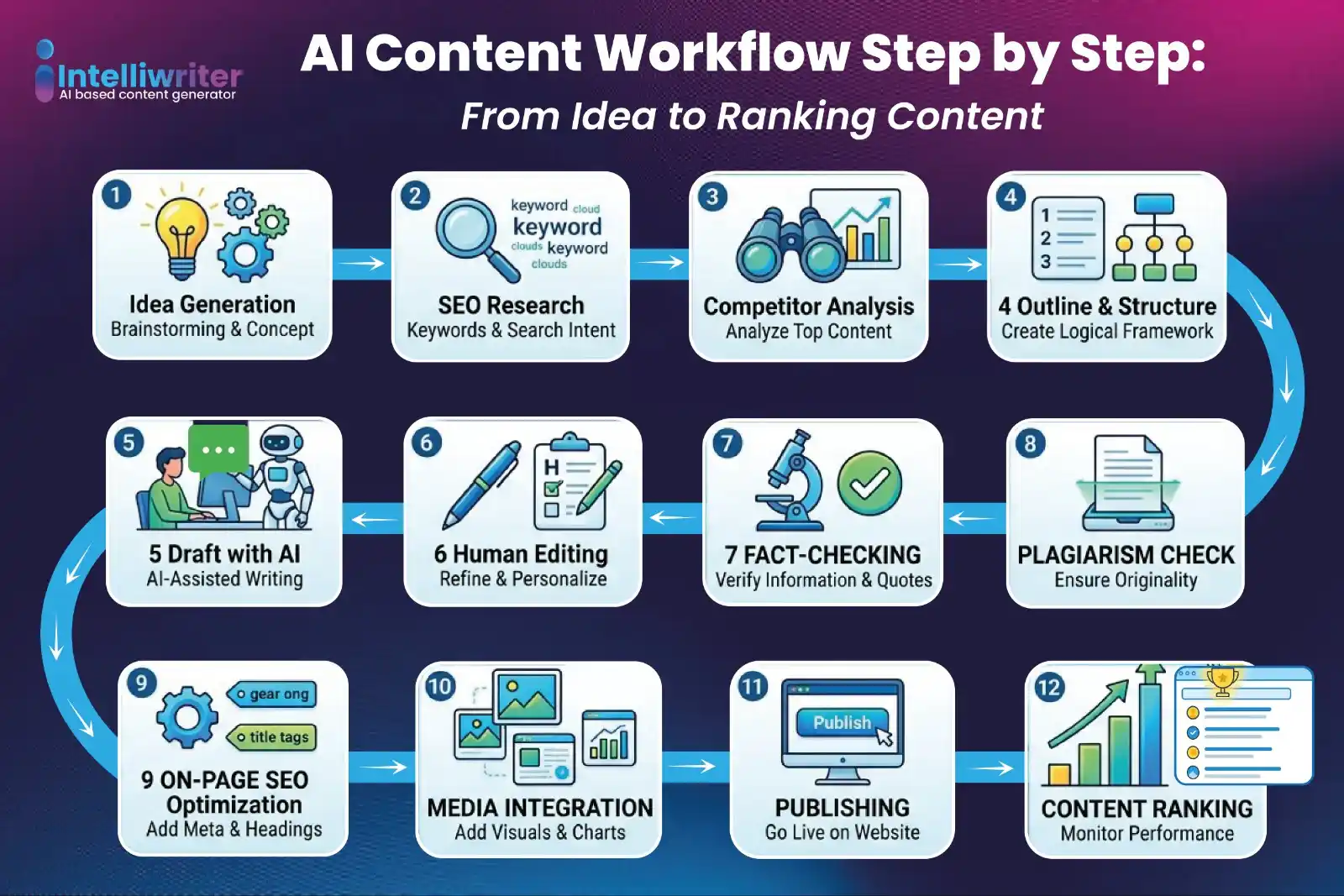
An AI content workflow is a structured, repeatable system that uses artificial intelligence to handle every stage of the content lifecycle — from initial research and keyword targeting, through drafting and optimization, to publishing, distribution, and performance tracking. Rather than treating AI as a simple writing shortcut, a proper workflow integrates it as a strategic layer across multiple stages, each with clearly defined inputs, outputs, and human checkpoints.
The distinction matters enormously. An effective automated workflow covers the entire content creation lifecycle: ideation, where AI tools generate content ideas based on keywords, trends, and competitor analysis; research, where automated tools gather and analyze relevant data; drafting, where AI-powered writing assistants generate initial drafts based on provided keywords, tone, and style guidelines; and optimization, where automated SEO tools analyze your content for keyword density and readability.
Why Traditional Content Processes Are No Longer Enough
The content landscape has shifted dramatically. In 2022, ChatGPT launched and quickly reached one billion daily interactions — people having conversations with AI for answers they once found through keyword searches. In 2024, AI Overviews emerged, disrupting Google Search itself, leaving marketers asking whether SEO was enough.
The numbers tell a sobering story. Ahrefs found that 96.55% of pages get no organic traffic from Google. SparkToro’s 2024 analysis found that only around 36% of U.S. Google searches resulted in clicks to the open web. Traditional content processes — write, publish, hope — are simply no longer competitive.
Benefits of a Structured AI Content Workflow for SEO
A structured AI content workflow solves the most painful bottleneck in modern content marketing: producing high-quality, optimized content consistently and at scale. Incorporating AI tools into your content creation workflow significantly reduces the time spent on manual tasks, ensures your content is optimized for search engines, and helps maintain a consistent brand voice and style across all content, enhancing brand credibility and authority.
Beyond efficiency, the strategic benefits compound over time. Forrester predicts AI-powered search will drive 20% of all organic traffic by the end of 2025. Teams that build structured, repeatable AI workflows now are positioning themselves for that shift.
Step 1 – Define Goals and Search Intent
Identifying Your Content Objectives (Traffic, Leads, Sales)
Before writing a single word or running a single query, you need clarity on what success looks like for each piece of content. Is the goal to rank for an informational keyword and build topical authority? Generate qualified leads for a product? Drive bottom-of-funnel conversions? Your objective shapes every downstream decision — keyword selection, content format, word count, and calls to action.
Understanding User Intent (Informational, Navigational, Transactional)
Search intent is the strategic north star of any content plan. Intellliwriter points out that many keywords carry blended intent, and that a simple intent classification step prevents the classic mistake of writing a 2,500-word educational guide for a keyword where people really just want a provider comparison.
The four intent categories — informational, navigational, commercial, and transactional — each demand a different content type, structure, and conversion strategy. Mapping these correctly at the start of your workflow prevents wasted effort and misaligned content.
Mapping Keywords to Search Intent
Once you understand user intent, map your target keywords to the appropriate content format. Informational queries deserve comprehensive guides and explainers. Commercial queries call for comparison pages and product deep-dives. Transactional queries belong on landing pages and product pages with clear CTAs. This mapping stage should be documented and reviewed before any brief is created.
Step 2 – Keyword Research and Topic Clustering
Finding Primary and Secondary Keywords
Keyword research in 2026 goes beyond search volume and competition scores. Use tools like Intelliwriter, Semrush, Ahrefs, or Google Search Console to identify not just high-volume keywords, but also long-tail and intent-driven phrases, and understand the questions your audience is asking. Your primary keyword anchors your content; secondary keywords and related phrases give it depth and semantic breadth.
Using AI for Semantic Keyword Expansion (LSI & Entities)
AI tools significantly accelerate the process of expanding a keyword list into a full semantic map. AI can provide a list of related subtopics and terms that should appear naturally in an article, grouped by definitions, comparisons, costs, timelines, FAQs, mistakes, and tools. This semantic expansion is critical because modern search engines evaluate content based on entity relationships, not just keyword frequency.
Building Topic Clusters for Topical Authority
Topic clusters are the architecture that turns individual pieces of content into compounding SEO assets. An effective topic cluster strategy that involves publishing quality content on relevant topics builds topical authority that helps with both search engine optimization (SEO) and generative engine optimization (GEO). When you build topical authority, you’re able to rank for more keywords in search engines and appear for more prompts in large language model tools.
The structure is straightforward: a pillar page serves as the central hub targeting a broader subject area, while cluster pages are in-depth content assets that explore subtopics or common questions related to the pillar page, targeting long-tail keywords with semantic relationships to the primary topic. Tools purpose-built for this include Intelliwriter AI Topical Authority Builder, Semrush’s Keyword Magic Tool, Ahrefs Keyword Explorer, and the HubSpot Topic Cluster Tool.
Step 3 – SERP Analysis and Competitor Research
Analyzing Top-Ranking Pages
Before writing, study what is already winning. Examine the top five to ten results for your target keyword. Analyze their structure, average word count, heading hierarchy, content depth, and the types of media used. This SERP audit tells you the baseline standard you need to meet — and ideally exceed. All these things should be done by Intelliwriter Artificial Intelligence.
Identifying Content Gaps and Opportunities
Content gaps are where rankings are won. Any subtopic that multiple top-ranking competitors have covered represents a validated gap in your cluster. Multiple publishers addressing the same subtopic confirms that Google is rewarding that coverage. Look for angles, questions, or subtopics that competitors have ignored entirely — these are often the highest-ROI additions to your content.
Extracting NLP Entities and Content Patterns
Modern SEO requires thinking in entities, not just keywords. Generative models go beyond understanding keywords — they understand entities and relationships too. To show up in coveted AI answers, your content must reflect structured, interconnected knowledge. During SERP analysis, note which entities (people, places, concepts, tools, brands) appear consistently across top-ranking pages. These are signals from Google about what belongs in a thorough treatment of the topic.
Step 4 – Creating an SEO-Optimized Content Brief
Structuring Headings (H1, H2, H3) Based on SERP Data
A content brief built from SERP data removes guesswork for writers and AI tools alike. Your heading structure should reflect the actual subtopics Google is rewarding, not internal assumptions about what the audience wants. Model your H2 and H3 hierarchy on patterns you observe across the top three to five ranking pages, then differentiate by adding angles your competitors missed.
Defining Word Count, Tone, and Content Depth
Word count should be determined by SERP data, not arbitrary targets. Analyzing competitors can reveal the average word count of top-ranking pages — for example, an analysis of ten competitor pages for a given keyword might show an average of 2,400 words. Tone should be specified explicitly in the brief: technical or conversational, authoritative or accessible, first-person or editorial. Vague briefs produce vague content.
Including Entities, FAQs, and Internal Linking Strategy
A complete brief includes the semantic entities that must appear in the content, a list of FAQ questions drawn from “People Also Ask” results, and a clear internal linking strategy. Google has directly emphasized internal linking practices like descriptive anchor text and building a structure that helps users and search engines navigate. Map out which existing pages should receive links from this content before the first draft is ever written.
Step 5 – AI Content Generation (First Draft)
Choosing the Right AI Writing Tool
Not all AI writing tools are built equally. Tools like Intelliwriter are purpose-built for content teams that need SEO-optimized output, consistent brand voice, and structured drafts — rather than generic text generation. The right tool should understand your niche, support your content type (guides, comparisons, product pages), and integrate into your broader workflow.
Writing Prompts That Produce High-Quality Content
Prompt quality determines output quality. Using AI in layers — rather than asking it to “write the whole article” — produces far better results. Write prompts that specify the target audience, the heading being addressed, tone requirements, and style references. If you want AI output to sound like you, you have to tell it what “you” sounds like, for example, by sharing two paragraphs of your own writing and asking the model to match that tone.
Generating Structured, Human-Like Drafts
The goal of the first draft stage is a structured skeleton with coherent prose — not a polished final article. AI content generation is where automation delivers the most dramatic time savings, but quality concerns run highest. The solution is building a multi-layered system where AI handles the heavy lifting while strategic guardrails maintain standards. Generate section by section, review as you go, and preserve your human editing pass for the next step.
Step 6 – Human Editing and Content Enhancement
Fact-Checking and Accuracy Improvements
AI-generated drafts require rigorous fact-checking. When bringing AI into content workflows, fact-check all content on numbers, statistics, quotes, attributions, citations, and names of people, companies, locations, and legal statutes. Never publish figures or claims sourced from an AI draft without independently verifying them against primary sources.
Improving Readability and Engagement
Human editors add what AI cannot: rhythm, personality, and the instinct to cut what’s boring. Read the draft aloud. Shorten sentences that lose the reader. Add subheadings where sections run long. Introduce concrete examples and analogies that ground abstract claims. These are the edits that separate content people want to read from content that technically covers a topic.
Adding Experience, Expertise, and Original Insights (E-E-A-T)
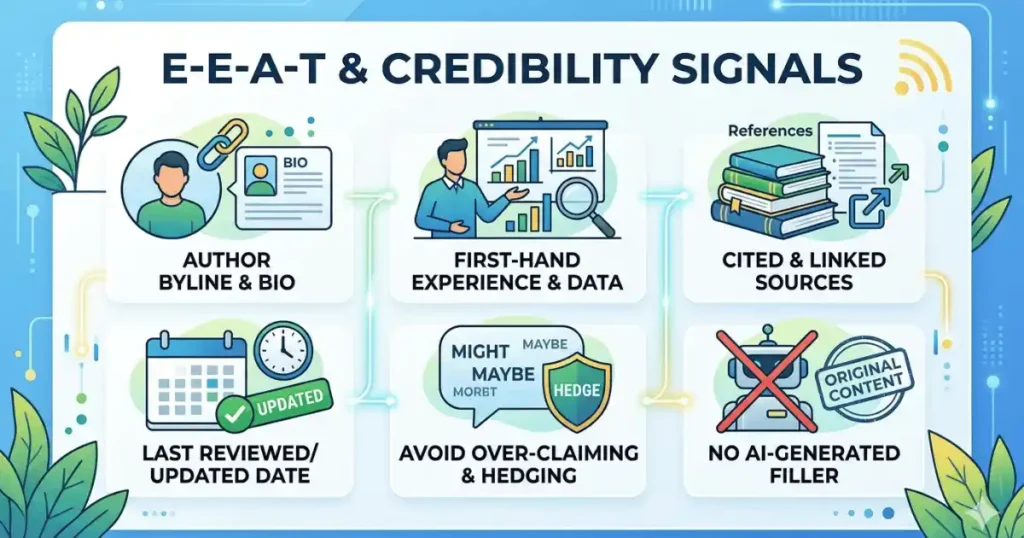
This editing pass is where E-E-A-T signals are built in. Content should demonstrate expertise, clear sourcing, and trustworthiness. Google asks content producers to focus on who created the content, how it was produced, and most importantly, why it was created. Add named authors with verifiable credentials, embed first-hand observations or case study data, and cite authoritative external sources. AI should serve as a starting point, not the final product — add your perspective, refine the voice, and check the facts, because readers can tell when something has been phoned in.
Step 7 – NLP Optimization and Entity Enhancement
Optimizing for Google NLP and Entity Recognition
After human editing, run your content through an NLP lens. Google’s natural language processing evaluates which entities your content discusses and how prominently it discusses them. Ensure your primary topic entities appear early, clearly, and in contextually appropriate ways throughout the piece.
Improving Entity Salience and Content Relevance
Entity salience refers to how central and prominent an entity is within your content. To show up in AI answers and be the top choice, content must reflect structured, interconnected knowledge. Building a brand knowledge graph that maps people, products, and topics that define your expertise — supported by schema markup that shows how these entities connect — is essential for modern SEO.
Using AI Tools for Content Scoring and Optimization
Tools like Intelliwriter’s content scoring features, Surfer SEO, and Semrush’s SEO Writing Assistant provide real-time feedback on entity coverage, readability, and topical completeness. Real-time SEO scoring, topic suggestions, and competitive benchmarks highlight every gap so nothing gets missed before publication. Run your edited draft through one of these tools and address the highest-priority recommendations before moving to on-page SEO.
Step 8 – On-Page SEO Optimization
Optimizing Title Tags, Meta Descriptions, and URLs
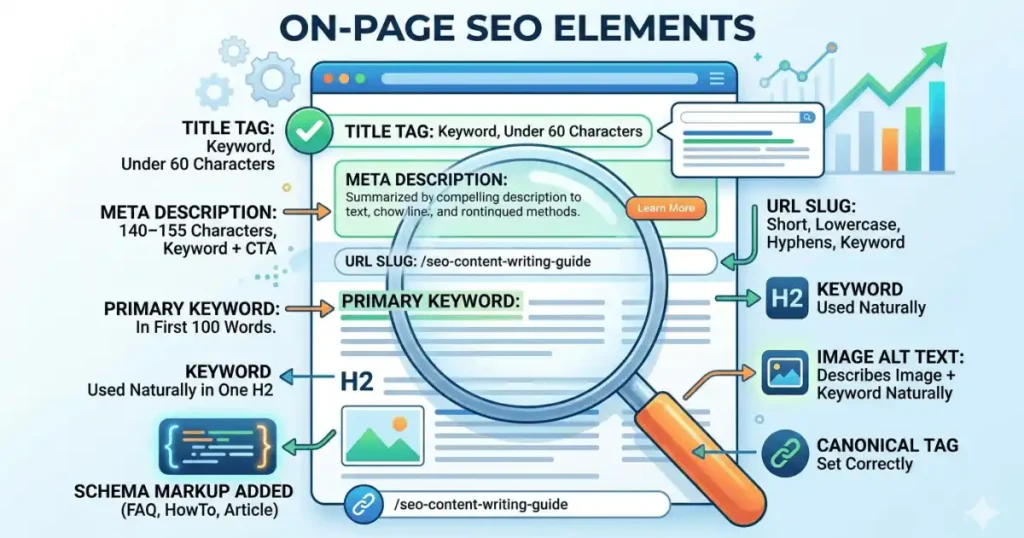
Title tags should lead with the primary keyword, stay under 60 characters, and convey a clear value proposition. Meta descriptions, while not a direct ranking factor, influence click-through rates. Intelliwriter Super SEO Agent wordpress seo plugin can analyze your content, identify its unique selling points, and generate a meta description that summarizes them accurately, complete with a call to action to encourage click-through. URLs should be clean, keyword-rich, and free of unnecessary parameters.
Internal Linking and Anchor Text Strategy
Internal linking distributes authority across your site and reinforces your topic cluster architecture. Use descriptive, keyword-relevant anchor text rather than generic phrases like “click here.” Every new piece of content should link to your pillar page and receive links from at least two to three related cluster pages.
Image Optimization and Schema Markup
Images should include descriptive alt text that incorporates relevant keywords. Compress files for fast load times. For structured content like how-to guides, FAQs, and product reviews, implement schema markup to qualify for rich results. Schema is also a signal to AI systems about how your content entities relate to one another.
Step 9 – Publishing and Indexing
Best Practices for Publishing AI Content
Publish with full transparency about your content production process. If automation is used to substantially generate content, Google asks whether the use of automation is self-evident to visitors through disclosures, and whether you are providing background about how automation or AI-generation was used. Include author bios, publication dates, and last-updated timestamps on every piece.
Submitting to Google Search Console
After publishing, submit the URL directly in Google Search Console’s URL Inspection tool and request indexing. This does not guarantee immediate indexing but signals to Google that the page is ready for crawling. For large content operations, ensure your sitemap is up to date and submitted.
Ensuring Proper Indexing and Crawlability
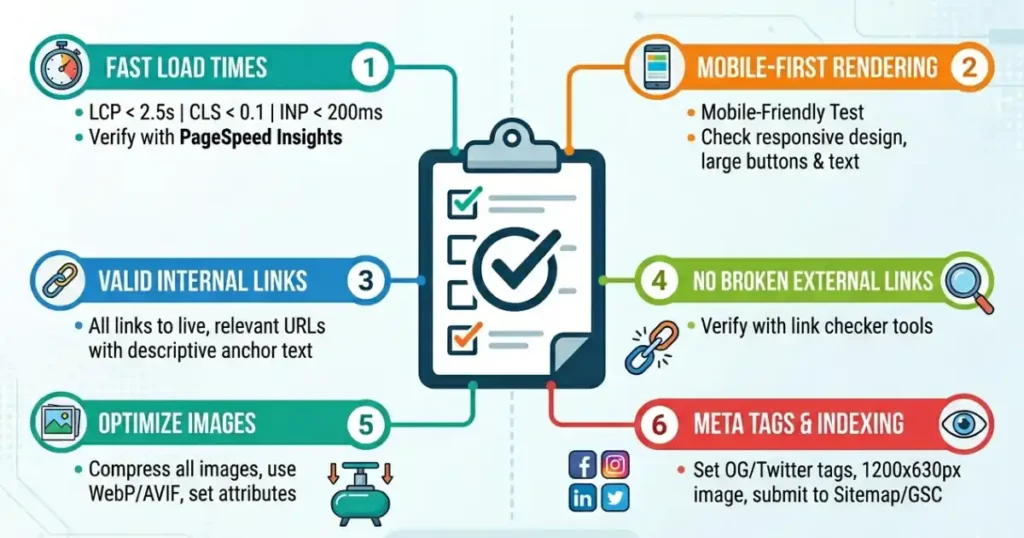
Verify that your page is not blocked by robots.txt, does not have a noindex tag inadvertently applied, and loads within acceptable Core Web Vitals thresholds. Great content means nothing if AI crawlers cannot access or understand it.
Step 10 – Content Promotion and Distribution
Leveraging Social Media and Communities
Distribution amplifies the reach of content that would otherwise sit unseen. Share new content across your brand’s social channels, in relevant LinkedIn groups, and in niche communities where your target audience is active. Authentic participation in these spaces — not just broadcast posting — builds the brand signals that contribute to E-E-A-T over time.
Building Backlinks to AI Content
Backlinks remain a trust signal, even as topical authority grows in importance. Mentions across the web, relevant backlinks, and clean content architecture are all signals that your site knows its subject matter, and one of the biggest SEO trends in 2025 is content architecture and backlinks proving more important each month. Pursue digital PR, expert roundup contributions, and resource page outreach to earn links to your most authoritative content.
Repurposing Content into Multiple Formats
A single well-researched article can generate significant additional reach when repurposed. Brands seeing the most success with video strategically use it to enhance their overall content experience and capture visibility across multiple search formats, adding explanatory videos within complex how-to guides and creating visual demonstrations of products or services. Turn your long-form guide into a LinkedIn carousel, a short-form video, or a downloadable checklist.
Step 11 – Performance Tracking and Continuous Optimization
Monitoring Rankings and Organic Traffic
Use Google Search Console to track impressions, clicks, average position, and click-through rates for your target keywords. Supplement this with a third-party rank tracking tool for competitor benchmarking. Monitor AI visibility as well as traditional rankings — track AI visibility using Perplexity or ChatGPT citations, not just Google rankings, because in 2025, SEO is about ranking, while AI SEO is about being the answer.
Updating Content Based on Performance Data
Content decay is real. Pages that rank well at launch will lose ground without regular updates. Add new content as regularly as possible without compromising quality to keep your site competitive and up to date, and do not forget to update existing content — some queries demand updates, such as breaking news, product releases, or recurring events, and Google will prioritize updated pieces in those instances.
Scaling Your AI Content Workflow for Growth
A repeatable workflow becomes scalable when every step is documented, every role is defined, and every tool is configured. By the end of a well-built automated workflow, you will have a repeatable system that produces SEO-optimized content faster, maintains your quality standards, and scales without proportionally scaling your team.
Common Mistakes in AI Content Workflows (And How to Avoid Them)
Over-Reliance on AI Without Human Editing
The most common mistake teams make is treating AI output as a finished product. Google’s “scaled content abuse” policy penalizes unedited or low-quality AI text. AI should assist content creation, not replace expertise — always have a human editor improve tone, accuracy, and factual integrity.
Ignoring Search Intent and SERP Data
Producing content without analyzing what Google is already rewarding is a fundamental workflow failure. In 2025, SEO is about building the kind of brand trust and semantic authority that LLM-based ranking systems value. AI systems prefer and prioritize content that is well-sourced, attributable, and authoritative — content velocity is no longer the end game.
Publishing Without Optimization or Strategy
Publishing raw AI drafts at volume — without briefs, entity optimization, internal linking, or schema — produces the kind of low-quality content that triggers spam filters and undermines domain authority. Flooding your site with hundreds of low-value posts can trigger spam filters. Build topically related clusters slowly, ensuring each page provides unique, helpful information. Quality over quantity is the way to go, especially post-Spam Update 2025.
Final Thoughts: Building a Scalable AI Content System
Turning Workflow into a Repeatable Process
The difference between teams that struggle with AI content and those that thrive is systematization. Document every step of your workflow — from brief template to publishing checklist — so that any team member can execute it consistently. A well-documented process is the foundation for scaling without sacrificing quality.
Combining AI Efficiency with Human Creativity
AI should augment workflows, streamline processes, and improve decision-making — but human expertise remains essential for trust and strategic oversight. The teams winning with AI content are not replacing human writers; they are freeing them from repetitive tasks so their creativity and judgment can be applied where it matters most — in E-E-A-T signals, original insights, and strategic narrative.
Future of AI Content in SEO
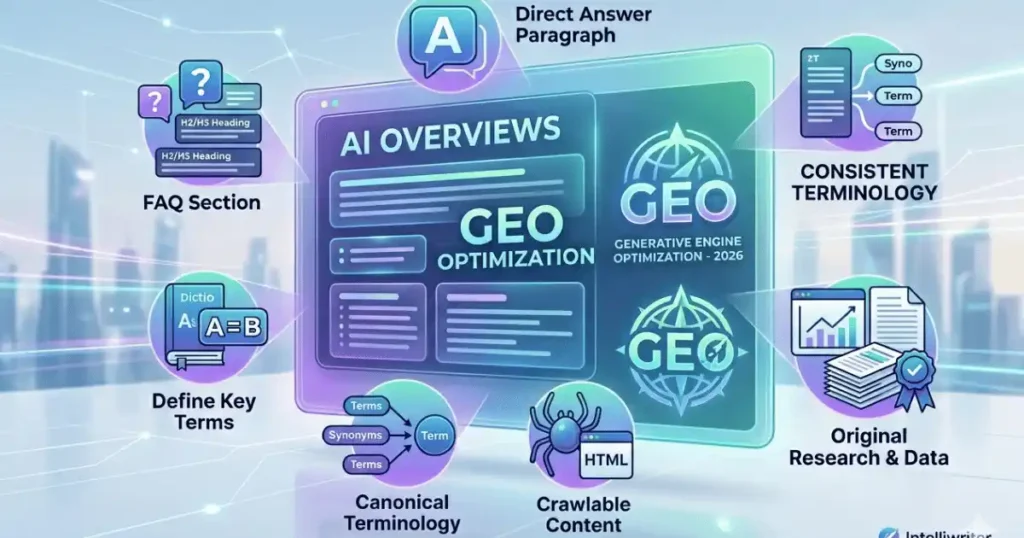
Brands now compete for top rankings in search engine results (SEO), citations in AI answers via answer engine optimization (AEO), and mentions in generative AI tools like ChatGPT and Perplexity via generative engine optimization (GEO). SEO fundamentals like authority, quality, and clarity remain non-negotiable — what is different is how AI interprets those signals.
The future belongs to content operations that treat AI as a strategic partner embedded across a structured workflow — not a button you press to generate articles in bulk. Tools like Intelliwriter are built precisely for this: combining AI-powered drafting, NLP optimization, and content scoring into a single platform that supports every step described in this guide. That is how you build a content machine that ranks today and compounds in value tomorrow.
There’s a reason so much AI-generated content isn’t ranking on Google — and it isn’t because Google penalizes AI content outright. The real problem is subtler: most AI writing tools are built to produce text fast, not to satisfy Google’s Natural Language Processing systems, align with search intent, or build the kind of entity-based topical authority that actually drives organic traffic.
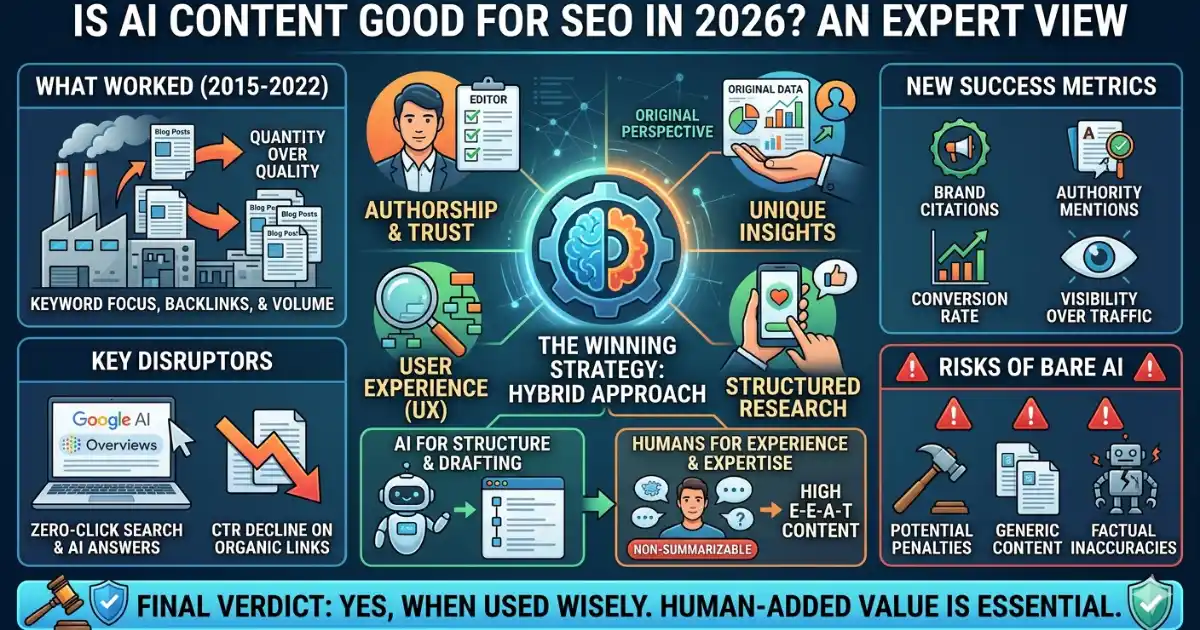
Google’s current stance on AI content is less about origin and more about quality. As one independent testing study published in early 2026 found, the platform focuses primarily on spammy content, whether human-written or machine-generated, and still expects human revision on AI outputs before publishing. The tools that win in 2026 are the ones built with this reality in mind.
This guide compares the leading AI content writers for SEO based on their actual ranking capability — not just their ability to generate words.
Why Most AI Content Writers Fail at SEO
Walk through any list of popular AI writers, and you’ll notice a recurring pattern: they all promise to produce “SEO-optimized” content, yet the outputs routinely underperform in search. The reasons cluster around a few consistent failure modes.
They Ignore Google NLP Optimization
Google processes web content through its Natural Language API, which identifies entities, assesses salience, and evaluates semantic relevance. Most AI writers have no mechanism for this. They suggest keywords based on surface-level frequency rather than entity recognition or knowledge graph alignment. The result is content that checks obvious keyword boxes but misses the semantic signals Google actually weights.
They Don’t Optimize for Search Intent
Generic AI outputs tend to address a topic broadly rather than match the specific intent behind a query. A user searching “best AI content writer for affiliate marketing” wants something different from someone searching “how does AI content writing work” — yet many tools produce nearly identical structures for both. Intent-matched content requires understanding the SERP before writing a word.
No Structured Content Writing
Heading hierarchy, schema-ready structure, internal linking logic, and snippet-optimized formatting are all ranking signals. Most AI writers produce flowing prose that ignores these structural requirements. Testing published in 2026 found that even the best AI outputs — before human editing — left significant gaps in headings optimization, image alt texts, and meta elements that direct SEO tools measure.
Lack of Entity-Based Content Strategy
Entity SEO is about aligning your content with the named entities, concepts, and relationships that make up Google’s knowledge graph. A tool that sprinkles in keywords without building topical authority around related entities creates thin content — even if that content scores well on generic readability metrics.
What Actually Makes an AI Content Writer “SEO-Ready”
Before diving into specific tools, here’s the framework you should use to evaluate any AI writing platform for search performance.
Named Entity Optimization and NLP Salience
The tool should understand which entities are topically relevant to your target keyword and help you incorporate them with appropriate weighting. Tools like Rankability, which combines IBM Watson and Google NLP, are specifically engineered for this. Generic LLMs like ChatGPT have no built-in mechanism for NLP salience at all.
Content Structure for Google NLP API
A truly SEO-ready writer produces content that maps cleanly to how Google’s NLP API parses structure — logical heading hierarchies, clear entity relationships within paragraphs, and snippet-worthy formatting. SE Ranking’s AI Writer, powered by GPT-4O combined with SE Ranking’s own algorithms, achieved the highest SEO optimization score in independent testing at 89.2%, well above the others tested.
SERP Intent Mapping Capability
The best tools analyze the top-ranking pages before generating an outline or draft. Surfer SEO, Frase, and Clearscope all do this, comparing your draft against the top-ranking competitors and surfacing gaps in coverage or keyword distribution.
Internal Linking and Topical Authority Support
A stand-alone article rarely ranks without topical context. Tools that help you build clusters, identify internal linking opportunities, and plan content that supports broader authority — like MarketMuse with its topic modeling and gap analysis — deliver more durable SEO value than single-article generators.
Ability to Generate Rank-Ready Long-Form Content
Testing published in 2026 found that most AI writers produce difficult-to-read content. Copy.ai scored a grade 15 on the Hemingway readability scale (the worst result across all tools tested), and even ChatGPT came in at grade 13, well above the grade 9 threshold considered accessible to most readers. SE Ranking’s AI Writer and Rytr both achieved grade 9, making them the only tools that cleared that bar without extensive editing.
Quick Comparison Table
Tool
Best For
NLP Optimization
SEO Score (Independent Test)
Starting Price
Intelliwriter
Ranking-first SEO content
Entity + knowledge graph optimization
—
—
Surfer SEO
On-page optimization
Live NLP scoring
—
$99/mo
Frase
Content briefs & workflow
SERP-based suggestions
78.1%
$14.99/mo
Clearscope
Enterprise precision
A–F NLP grading
—
$189/mo
Rankability
Agencies needing ranking velocity
Watson + Google NLP blend
—
$149/mo
MarketMuse
Enterprise content strategy
Topic modeling + gap analysis
—
$99/mo
Writesonic
All-in-one platform + GEO tracking
Real-time SERP analysis
78%
$16/mo (annual)
Scalenut
Speed + SEO blend
Cruise Mode + live scoring
—
$49/mo
ChatGPT
General drafting
None built-in
77%
Free / $20/mo
Anyword
Conversion copy + predictive scoring
Custom trained model
77.4%
$49/mo
Copy.ai
GTM workflow automation
None built-in
62.1%
$29/mo
Jasper
Rapid first drafts
SEO + GEO optimization layer
—
$69/mo
Best AI Content Writers for SEO (Detailed Reviews)
1. Intelliwriter — Best AI SEO Article Writer for Ranking Content
If the core problem with AI content is that it writes without regard for how Google actually evaluates pages, Intelliwriter is built as a direct answer to that problem. Where most AI writers treat SEO as a layer added after content is generated — keyword suggestions in a sidebar, a score badge at the top of an editor — Intelliwriter bakes entity optimization, knowledge graph alignment, and structured content generation into the writing process itself.
Key Features
The platform’s core differentiator is its approach to Google NLP optimization. Rather than scanning competitor pages for surface-level keyword frequency, it uses entity-based content strategy to identify the named entities and semantic relationships that signal topical authority to Google’s Natural Language API. This is the gap that most tools — even strong ones like Surfer SEO — leave open by over-indexing on keyword density rather than entity salience.
Automated internal linking suggestions mean the tool doesn’t treat each article as an isolated output. It surfaces opportunities to connect new content to existing pages, which matters for topical authority building over time. Structured content generation outputs heading hierarchies, schema-aware formatting, and snippet-optimized sections by default — not as an afterthought.
Why It Ranks Better Than Other AI Writers
Most AI writers, including well-resourced tools like ChatGPT and Jasper, operate on general-purpose LLMs with no built-in NLP optimization. As testing across multiple platforms confirmed, even tools like Writesonic — which runs on GPT-4 in its most advanced mode — produce content that reviewers describe as having an “AI stiffness” that requires heavy editing. The structural problem isn’t just tone; it’s that these tools have no awareness of entity salience or knowledge graph positioning.
Intelliwriter’s focus on ranking rather than just writing means the workflow begins where most tools end: with an understanding of what Google’s NLP layer expects to find in a well-optimized page.
Best For
SEO professionals managing multiple client sites, agencies that need to scale content without sacrificing optimization quality, and affiliate marketers where ranking precision directly affects revenue.
Limitations
Tools built specifically for ranking depth tend to have a steeper learning curve than general-purpose AI writers. If your primary need is fast first-draft generation rather than ranking-optimized output, a faster tool like Jasper or Writesonic may serve shorter-term production goals more efficiently.
2. ChatGPT — Best for General AI Writing (Not SEO-Specific)
ChatGPT is the most widely used AI writing tool in the world, and that ubiquity reflects genuine utility — just not SEO-specific utility. As one user described it, when used with strong prompts and custom instructions, it functions as a creative partner that helps you produce work faster, though the heavy lifting of prompt engineering still falls entirely on the user.
Key Features
Custom GPTs allow you to build specialized versions of ChatGPT trained for specific marketing or SEO workflows. The platform gives access to cutting-edge models including GPT-4. Its Code Interpreter feature handles data analysis and technical SEO tasks directly in chat. Voice Chat capability lets users brainstorm and dictate content hands-free. For outlines, brainstorming, and first drafts across a wide range of content types, it works quickly and flexibly.
Strengths
The flexibility of ChatGPT is unmatched among general-purpose AI tools. No other platform in this category handles as wide a range of writing tasks without configuration. In SEO optimization testing using WebSite Auditor, ChatGPT-generated content scored 77% — a reasonable baseline comparable to Anyword (77.4%) and Rytr (77.7%). Pricing starts at free, with the Plus plan at $20/month and the Pro plan at $200/month.
Weakness for SEO
ChatGPT has no built-in NLP optimization whatsoever. Getting SEO-relevant outputs requires constructing manual prompts that specify keyword targets, entity requirements, heading structure, and search intent — a significant investment in prompt engineering that most content teams can’t maintain at scale. Readability testing found its outputs scored grade 13 on the Hemingway scale, well above the grade 9 threshold for broadly accessible content. There are no SERP-analysis features, no content scoring, and no comparison against top-ranking competitors. Everything that makes content rank well has to be added by the user manually.
Best For
Writers and marketers who want a flexible drafting partner and are comfortable investing time in custom prompts and workflows. Not recommended as a standalone SEO publishing pipeline.
3. Frase — Best for Content Briefs and Optimization Workflows
Frase’s signature strength is collapsing the gap between research and publishing. Where other tools require you to gather competitor data, build a brief, draft, and optimize across multiple platforms, Frase automates that pipeline — and it does so at one of the most accessible price points in the category.
One user who tested it described the experience plainly: it used to take forever to put together an outline, and with Frase it now takes half the time or less.
Key Features
Frase analyzes the top-ranking search results for your target keyword and automatically generates a data-driven content brief in minutes. Its real-time content editor scores your draft against competitors and surfaces keywords and topics for improvement. Notably, Frase uses its own AI called Frase NLG (Natural Language Generation) rather than a third-party model like GPT-3, which gives it distinct optimization behavior. The platform has also added GEO (Generative Engine Optimization) features designed to help content get cited by AI-powered search engines.
Strengths
In independent optimization testing, Frase’s output scored 78.1% on WebSite Auditor — one of the stronger scores across all tools evaluated. It also achieved a grade 10 on the Hemingway readability scale, better than ChatGPT, Gemini, Perplexity, Writesonic, Anyword, and Copy.ai in the same evaluation. The automated brief generation alone saves significant research time for teams producing high volumes of articles. Pricing runs from $14.99/month (Solo) to $114.99/month (Team), with a $35/month Pro Add-On available.
Weaknesses
Frase’s keyword recommendations lack the precision of premium competitors like Surfer SEO or Clearscope. The tool’s NLP capabilities are solid but not built for the entity-salience optimization that Google’s NLP API weighs most heavily. Content produced with heavy reliance on Frase’s AI drafting features still requires meaningful human editing before publishing.
Best For
Content marketers, SEO professionals, and agencies managing large-scale content production who need an efficient research-to-brief workflow at an accessible price point.
4. Surfer SEO — Best for On-Page Optimization
Surfer SEO has earned its reputation as the on-page optimization benchmark through one thing done exceptionally well: real-time scoring as you write. It parses the top-ranking pages for your target keyword and turns that analysis into an actionable list of NLP terms, structural recommendations, and word-count guidance — delivered live inside a content editor that integrates directly with Google Docs and WordPress.
Key Features
The Content Editor delivers a live content score and keyword recommendations by analyzing top-ranking competitors for your target keyword. The SERP Analyzer breaks down the top search results in detail, surfacing common patterns in structure, word count, and keyword distribution. Keyword research tools help you find and group related keywords for topical authority building. The platform has also added GEO features to help optimize for AI-powered search results. AI writing features are available but require additional investment beyond the base plan.
Strengths
The content score system is the clearest, most actionable optimization feedback loop in the category. You can see in real time exactly which NLP terms are missing and how your current draft compares to the top ten results. Its Google Docs and WordPress integrations let you optimize without leaving existing tools — a significant operational advantage for teams with established workflows. Multiple industry reviewers describe it as the “on-page optimization champion” and a reliable benchmark for structuring articles to meet Google’s expectations. Pricing starts at $99/month for the Essential plan, scaling to $219/month (Scale) and from $999/month for Enterprise.
Weaknesses
Surfer’s heavy reliance on matching what top-ranking pages are already doing creates a structural incentive toward copycat content. When every writer uses Surfer with the same keyword, they receive nearly identical recommendations — and the resulting articles converge on the same structure. That undercuts information gain, which Google and AI search models increasingly treat as a quality signal. AI writing features also require additional investment beyond the base plan, unlike Rankability, which bundles its AI Writer with all tiers. Usage limits on lower tiers can become restrictive for high-volume content operations.
Best For
Content teams and freelancers who want data-driven on-page optimization guidance integrated into their existing Google Docs or WordPress workflow.
5. Clearscope — Best for Enterprise Content Teams That Need Precision
Clearscope is the premium option in this category — priced at $189/month — and its value proposition rests on two pillars: the accuracy of its NLP keyword recommendations and the scalability it offers for larger editorial teams.
Key Features
The platform’s A–F grading system gives writers a single, clear metric to aim for. Keyword and related keyword suggestions are based on deep NLP analysis rather than simple frequency matching. Content inventory tracking lets teams monitor the performance of published articles over time. The Google Docs integration fits seamlessly into existing workflows. Readability analysis, word count guidance, competitor content analysis, and meta title and description suggestions are all included. Unlimited user accounts come with all plans.
Strengths
Clearscope’s NLP recommendations are widely regarded as the most precise in the category. The unlimited seats model removes the per-user pricing friction that makes tools like Semrush costly for larger teams. Support quality is frequently cited in user reviews as a differentiating factor. The content inventory tracking feature — largely absent from competing tools — makes it possible to monitor and maintain published content over time rather than treating optimization as a one-time task.
Weaknesses
At $189/month, Clearscope is among the more expensive options in the category. Its focus is primarily on on-page SEO — there’s no GEO feature set, no AI drafting capability, and no broader digital marketing functionality. Solo creators and small teams are likely to find better value-per-dollar elsewhere.
Best For
Established editorial teams and agencies that run precision-driven content operations and need both NLP accuracy and collaboration-friendly tooling at scale.
6. MarketMuse — Best for Large Sites Focused on Topical Authority
MarketMuse takes a strategy-first approach to content. Rather than optimizing individual articles in isolation, it’s built to help content teams plan topical coverage across an entire site — identifying gaps, prioritizing topics, and generating briefs that keep writers aligned with the site’s broader SEO goals.
Key Features
Topic modeling and gap analysis identify coverage weaknesses across your site and surface which topics to prioritize next. The SERP X-ray and Heatmap features accelerate competitor analysis. Research and Optimize flows with shareable briefs keep editorial teams coordinated. Inventory and strategy documents help content managers see the full picture across large sites with hundreds of published pages. A free tier is available for teams exploring the workflow before committing.
Strengths
For enterprises managing large content operations, MarketMuse’s strategic depth is genuinely differentiated from article-level tools. Automated briefs save significant research time and ensure writers understand the topical context before starting a draft. The free tier allows initial evaluation without financial commitment. Pricing starts at $99/month, competitive for the depth of functionality offered.
Weaknesses
Pricing climbs at higher tiers, and the editor can lag during heavy runs on large sites. Solo creators and smaller teams are likely to find more focused value in tools like Frase or Surfer. The platform’s strategic depth adds complexity that lighter workflows simply don’t need.
Best For
Enterprise content strategists and large sites where topical authority planning and cross-site coverage gaps are the primary challenges, rather than optimizing individual articles.
7. Writesonic — Best for All-in-One SEO and GEO Platform
Writesonic positions itself as a complete platform managing the full content lifecycle — from initial strategy through performance tracking in both traditional search and AI search engines. That’s an ambitious scope, and it largely delivers, though the all-in-one approach creates trade-offs in depth.
Key Features
AI search tracking (GEO) monitors your brand’s visibility in AI-powered search results and surfaces optimization recommendations — a feature very few tools in this category offer. The SEO site audit with AI-powered fixes scans your website for SEO problems and suggests solutions. The AI Article Writer (version 6.0) creates long-form, SEO-optimized articles from a prompt or keyword, with integration into Ahrefs and Semrush data for competitive keyword intelligence. Brand voice customization and a Google Docs add-on are included. The platform runs on GPT-4 in its most advanced writing modes.
Strengths
The GEO tracking capability is genuinely forward-looking as AI overviews reshape organic search. In optimization testing, Writesonic-generated content scored 78% on WebSite Auditor — one of the strongest results across all tools evaluated. With pricing starting at $16/month when billed annually, it’s one of the more accessible options in the category. Ratings on G2 stand at 4.7/5 from over 2,000 reviews, with users citing time-saving automation and an intuitive interface.
Weaknesses
The trade-off for breadth is depth. Writesonic’s AI article output has been described by reviewers as having an “AI stiffness” — content that reads as technically correct but tonally flat. In readability testing, it scored grade 11 on the Hemingway scale, above the grade 9 threshold for broadly accessible content. Published content routinely requires meaningful human editing before it’s ready to go live.
Best For
Content marketers, bloggers, and small businesses that want a single platform covering content creation, SEO optimization, and AI search visibility tracking.
8. Scalenut — Best All-in-One SEO Tool for Speed-Focused Teams
Scalenut combines content planning, AI drafting, and live SEO optimization in a single platform designed for teams that want to move quickly without sacrificing search fundamentals. Its “Cruise Mode” generates a workable first draft fast. Topic Clusters and the SERP Analyzer keep content aligned to search intent from the outset.
Key Features
Cruise Mode accelerates first-draft generation from a target keyword. Topic Clusters help plan and organize content around topical themes for authority building. The SERP Analyzer examines top-ranking competitors to inform structure and keyword strategy. The brief builder includes NLP keywords and a live content score to make the revision process more systematic. Internal linking suggestions and integrations with WordPress and Semrush smooth the path from draft to published.
Strengths
Scalenut delivers a strong combination of AI-powered drafting speed and built-in SEO guardrails in a single interface. The content score makes revision targets clear, and the Semrush integration brings competitive data into the workflow without switching tools. Pricing starts at $49/month with a free plan and trial available, making it competitive for smaller teams.
Weaknesses
AI-generated prose still needs editing before publishing, and large projects can feel sluggish. Extra features can add cost beyond the base plan. Teams with very deep, manual SEO processes may prefer modular tools over an all-in-one workflow.
Best For
Content teams and growing agencies that want speed plus SEO guardrails in one place, without the cost and complexity of enterprise-tier platforms.
9. Copy.ai — Best for Go-to-Market Workflow Automation
Copy.ai has evolved significantly from its origins as a simple content generator. It now operates as a full go-to-market automation platform for sales and marketing teams, handling multi-step workflows including lead processing, personalized outreach, and content generation at scale.
Key Features
AI Workflows automate entire marketing and sales processes, from processing leads in a CRM to generating personalized outreach content. Content Agents let you build and deploy specialized AI agents to handle specific, repetitive content tasks automatically. The Infobase serves as a central knowledge repository that grounds AI outputs in brand-accurate information. Over 2,000 integrations — including Salesforce and HubSpot — connect Copy.ai to existing tech stacks. The platform operates on multiple AI models including GPT-4, Anthropic, and Azure.
Strengths
Copy.ai is strong at automating high-volume, repetitive tasks that go beyond simple content writing. Its integration library and Content Agent capabilities provide a powerful way to build custom, task-specific automations at scale. The $29/month self-serve plan is competitive for teams with broad marketing automation needs.
Weaknesses
In independent testing, Copy.ai produced the worst results across all tools evaluated — a grade 15 on the Hemingway readability scale, described as “poorly written” with many repetitive and wordy sentences, and a 62.1% SEO optimization score, the lowest of any tool tested. User reviews echo this: one reviewer noted that raw AI text from Copy.ai is “generic, detectable, and usually won’t rank long term without heavy human editing.” For SEO-focused content creation, the output quality gap compared to optimization-focused tools is significant.
Best For
Sales and marketing teams whose primary need is go-to-market workflow automation, not SEO content ranking. If ranking is the primary objective, other tools in this list are a better fit.
10. Anyword — Best for Predicting Copy Performance Before Publishing
Anyword takes a different angle than most tools in this category. Rather than focusing primarily on SEO optimization, it’s built for performance-focused marketers who want data-driven predictions of how copy will perform before publishing — reducing the guesswork that makes conversion optimization an expensive trial-and-error process.
Key Features
Predictive Performance Scores grade copy variations and forecast engagement before publishing, letting you choose the likely winner without running full A/B tests. Continuous optimization analyzes the performance of live copy and provides ongoing improvement suggestions. The Blog Wizard provides a guided process for creating SEO-friendly blog posts with a built-in plagiarism checker. A Content Intelligence Platform analyzes your best-performing content to inform future article strategy. Customizable brand voice ensures consistency across all generated content. The platform uses a custom AI model described as “the only one trained on billions of real marketing data points.”
Strengths
Anyword’s predictive scoring is the standout capability in the category — no other tool lets you forecast content performance before going live at this level of detail. As one G2 reviewer put it, Anyword “doesn’t just generate content; it gives me data-driven insights on how my copy will perform before I even hit publish.” The Blog Wizard and over 100 templates make it practical across a wide range of marketing use cases. Pricing starts at $49/month (Starter) or $99/month (Data-Driven) with a 7-day free trial.
Weaknesses
In independent readability testing, Anyword’s outputs scored grade 12 on the Hemingway scale — above the grade 9 accessibility threshold. Its own in-built checker rated the output at 40, described as “difficult to read, likely to be understood by a reader who has at least a college education.” SEO optimization scored 77.4% on WebSite Auditor, comparable to ChatGPT but below Frase and Writesonic. Content can sound generic without sufficient human input and oversight.
Best For
Solo marketers, performance-focused content teams, and eCommerce marketers for whom conversion optimization and predictive copy scoring matter as much as organic rankings.
11. Jasper — Best for Rapid First Draft Generation
Jasper has become a household name in AI content, particularly for marketing teams. Its core strength is speed — generating first drafts for blogs, social media, and marketing campaigns faster than most tools in this category. If you’re comfortable treating AI output as a starting point rather than a finished product, Jasper is one of the most efficient drafting tools available.
Key Features
SEO, AEO, and GEO content optimization tools are built into the platform, taking Jasper beyond general writing into search-aware content creation. A Brand Voice and Style Guide feature lets you train the AI on your company’s specific tone and terminology. The Knowledge Base allows Jasper to learn from your internal documents for more accurate, contextually relevant outputs. Content Automation and Pipelines let you build workflows to handle repetitive content tasks. An AI Image Generation and Editing suite creates and refines visuals for articles directly inside the platform.
Strengths
Jasper is fast and broad. It handles a wide range of content types and formats, making it practical for teams that need to produce varied content at volume. The Brand Voice and Knowledge Base features help maintain consistency across large content operations. Built-in optimization for SEO, AEO, and GEO means it has more search awareness than pure general-purpose LLMs like ChatGPT. Pricing is $69/month for the Pro plan with a 7-day free trial; Business plans are available at custom pricing.
Weaknesses
User feedback on Reddit consistently flags that outputs “always sound so generic now.” The workflow is AI-led and doesn’t incorporate human expertise into the initial drafting process, which means everything that makes content distinctive has to be added in editing. The fully AI-generated output requires heavy editing to meet quality standards, which partially offsets the speed advantage.
Best For
Marketing teams that need to produce large volumes of first drafts quickly and have a strong editing process in place to refine AI outputs before publishing.
Which AI Writer Should You Choose?
The right tool depends entirely on what you’re trying to achieve — and being honest about where AI writing actually fits in your workflow.
For ranking blog content, you need a tool that understands entity optimization and search intent mapping, not just keyword density. Surfer SEO and Clearscope are the established benchmarks here; Rankability is the most technically sophisticated option for agencies that need both optimization depth and expert support.
For quick first drafts, ChatGPT remains the most flexible option — but be clear-eyed about what you’re getting. In readability testing it scored grade 13, and it has no built-in SEO optimization. Use it as a drafting accelerator, not as a publishing pipeline.
For content briefs and research workflows, Frase is the strongest value proposition at its price point. It automates the research-to-brief pipeline, scores reasonably well on SEO optimization tests, and is designed around the workflow of actual content teams.
For enterprise content governance, Clearscope offers the best combination of NLP accuracy and team scalability with unlimited seats. MarketMuse is the right choice if strategic topical planning across a large site is the primary need.
For conversion copy and ads, Anyword’s predictive scoring is the standout capability. Copy.ai’s workflow automation makes sense for GTM teams with complex multi-step processes, though its SEO content quality lags the field.
How to Use AI Content Writers to Actually Rank on Google
Even the best AI SEO writer is a tool, not a strategy. Here’s how to use it effectively.
Step 1: Start with the Keyword and Search Intent
Before generating anything, understand what the top-ranking pages for your target keyword are actually doing. What content format dominates — long-form guides, listicles, comparison pages? What questions do they answer? What entities and topics appear consistently? Tools like Surfer SEO and Frase automate much of this SERP analysis, but you still need to interpret the results strategically.
Step 2: Generate a Structured Outline
AI tools are genuinely useful for outline generation, and this is one of the clearest legitimate use cases. Testing consistently shows that AI produces usable structural frameworks faster than manual research. Use this output as a starting point, then edit the outline to ensure it covers unique angles your competitors haven’t addressed.
Step 3: Optimize for Entities and NLP
If your tool has NLP-term suggestions (Surfer, Clearscope, Rankability, Frase), use them — but use them intelligently. The goal is topical relevance, not mechanical insertion. Entity optimization means your content genuinely addresses the concepts Google associates with your topic, not that you’ve forced a list of terms into paragraphs where they don’t belong.
Step 4: Add Internal Links
Internal linking is a ranking signal that most AI writers either ignore or treat as an afterthought. Build internal linking recommendations into your workflow explicitly. Tools like Scalenut and Outranking include internal link suggestions. For tools that don’t, audit your existing content before publishing each new piece and identify relevant pages to link from.
Step 5: Publish, Then Refine
No AI output should be published without human review. This isn’t optional — it’s the baseline expectation even from Google’s own guidelines, which explicitly require human revision for machine-generated content to avoid being classified as spammy. Read the final draft for accuracy, check entities and statistics against primary sources, and edit for the specific voice and expertise your audience expects.
Common Mistakes When Using AI for SEO Content
Publishing without optimization. Generating a draft and publishing it without running it through a content scorer is one of the most common ways teams waste their AI investment. Even a strong draft from a capable tool will have optimization gaps.
Ignoring entity salience. Keyword density is a blunt instrument. Google’s NLP API is measuring something more sophisticated — which entities are present, how prominently they’re positioned, and how they relate to each other. Tools that optimize only for keyword frequency miss this layer entirely.
Over-relying on generic AI outputs. The most frequently cited problem across independent testing and user reviews is that AI outputs are generic. Jasper content has been described on Reddit as always sounding “so generic now.” Writesonic output has been reviewed as having an “AI stiffness — you know when a sentence sounds technically perfect but just… off.” Publishing these outputs without adding genuine expertise and unique angles is how you produce content that competes for rankings but doesn’t deserve them.
No content structure. Heading hierarchy, schema formatting, and snippet-optimized sections aren’t decorative — they’re structural signals. Tools that produce flowing prose without this architecture create content that reads fine but doesn’t communicate structure to Google’s parsers.
No topical authority building. Single articles rarely rank in competitive niches without the support of topically related content. Using AI to produce disconnected articles, rather than building clusters of content that reinforce each other’s authority, is a structural mistake that no optimization tool can fix after the fact.
Final Verdict: What Is the Best AI Content Writer for SEO?
There isn’t a single answer that applies to every situation — which is precisely the point this guide has been building toward.
If your primary goal is ranking, Surfer SEO and Clearscope remain the clearest benchmarks for on-page NLP optimization. Rankability is the most technically sophisticated option for agencies that need dual NLP processing (IBM Watson combined with Google NLP) plus built-in expert coaching. SE Ranking’s AI Writer achieved the highest SEO optimization score in independent testing at 89.2%, combined with one of the best readability scores at grade 9.
If your primary goal is content production at scale, Frase offers the best workflow efficiency at its price point. Writesonic gives you the most complete platform — including GEO tracking — if you’re managing both traditional SEO and AI search visibility.
If you want content volume without optimization depth, ChatGPT and Jasper are fast and flexible — but be prepared to invest heavily in editing and manual optimization before anything you publish is genuinely competitive.
The honest conclusion from the available testing: AI tools can boost writers’ productivity, they’re capable of producing good small pieces of text, and Google does rank AI-generated articles when they’re of high quality. But all AI-generated texts need human editing before publishing. The tools that acknowledge this openly, and build their workflows around it rather than against it, are the ones worth investing in.
FAQs
Can AI content rank on Google?
Yes — with conditions. Google’s current content policies focus on quality and value rather than origin. AI-generated articles can and do rank, but only when they meet Google’s quality standards, which in practice requires meaningful human editing, factual accuracy, and genuine informational value. One independent testing study found that Google ranks AI-generated articles when they are of high quality, while machine content without human revision may be treated as spammy.
What is the best AI SEO writing tool?
It depends on your use case. For pure on-page optimization, Surfer SEO and Clearscope are the most established options. For SEO optimization scores in independent testing, SE Ranking’s AI Writer achieved the highest result at 89.2%. For agencies managing complex client work, Rankability’s dual NLP approach and coaching model offer a different value proposition. For budget-conscious teams needing solid workflow tools, Frase at $14.99/month (Solo) is the strongest value-per-dollar option.
Does Google penalize AI content?
Not directly. Google’s stated policy is that all content — human or AI-generated — is evaluated on the same quality criteria. Spammy content gets penalized regardless of how it was created. The practical implication is that AI content published without human review, without genuine expertise, and without unique informational value is at risk not because it’s AI-generated but because it tends to fail Google’s helpfulness standards.
How do I optimize AI content for SEO?
Start by running your target keyword through a SERP analysis tool before generating any content. Use an NLP-aware editor (Surfer, Clearscope, or Frase) to identify entity and keyword gaps in your draft. Edit for readability — testing consistently finds AI outputs above grade 9 on the Hemingway scale, which is the ceiling for broadly accessible content. Add specific data points, expert perspectives, and unique angles that competing pages don’t cover. Build internal links to related content on your site. Then publish and monitor performance, using the data to inform future optimization.
Introduction: The Real Question Isn’t AI vs. SEO Anymore
The conversation around AI and SEO has shifted dramatically. A few years ago, marketers debated whether AI-generated content could rank at all. Today, that question is largely settled — and the industry has moved on to a far more nuanced one: how should AI be used strategically to create content that genuinely performs?
The scale of AI adoption in content marketing makes this question unavoidable. According to a Semrush report, 67% of businesses already use AI for content marketing and SEO, and an impressive 65% report better SEO results since adopting these tools. Moreover, 93% of AI users review generated drafts before publishing, underscoring the importance of human oversight.
Meanwhile, the environment in which that content must perform has changed beyond recognition. Google announced at I/O 2025 that AI Mode represents the future of search. AI Overviews now reach 1.5 billion users monthly across more than 200 countries. Gartner projects a 25% decline in traditional search traffic by the end of 2026. In this landscape, the old playbook is genuinely obsolete.
The thesis of this piece is simple: AI content works — but only when combined with human expertise, strategic intent, and a clear understanding of what search and AI engines actually reward in 2026.
The SEO Landscape in 2026: What Changed
Keywords → Intent → Authority
Keyword optimization alone no longer defines SEO success. In past years, especially 2015–2022, SEO rewarded content volume — focusing on keywords used, content length, and strong backlinks. However, in 2026, SEO is all about content quality, authenticity, and user experience, ensuring intent satisfaction. –
Ranking in 2026 means not just using hundreds of keywords and making a brand visible on page one — it’s about using a handful of relevant keywords that fulfill search intent through user experience success signals. The purpose is no longer just getting clicks; it’s about what happens next. Through scroll time, outcome completion, multi-session return value, and bounce-to-return searches, search engines are now tracking how visitors actually interact with websites.
Zero-Click Search & AI Answers
Perhaps the most disruptive shift in the modern SEO landscape is the explosion of zero-click searches — queries where users get their answer directly from the search results page without ever visiting a website.
New data reveals 58% of Google searches now end without a single click to any website — up from 25% just five years ago. The driver behind this shift is the rapid expansion of Google’s AI Overviews. Google’s AI Overviews now appear on 27.43% of search queries as of November 2025, up from just 3.93% in January 2025 — nearly a 7x growth in 10 months.
The CTR consequences are severe. Research from Seer Interactive published in November 2025 found that organic click-through rates plummeted from 1.76% to 0.61% for queries with AI Overviews — a 61% decline. Paid search CTR fared only slightly better, dropping 68% from 19.7% to 6.34% when AI Overviews were present.
Critically, ranking high no longer offers immunity. In March 2024, the average CTR for the #1 result on AI Overview keywords was 7.3%. By March 2025, that number fell to just 2.6% — a 34.5% decrease in clicks when an AI Overview appears at the top of search results.
However, there is a significant silver lining for content that earns citations. When a brand is cited in an AI Overview, it receives 35% more organic clicks and 91% more paid clicks compared to when it is not cited at all.
New Success Metrics
This new reality demands new ways of measuring SEO success. Traditional traffic-centric KPIs tell only part of the story. For 25 years, marketers optimized for rankings, clicks, and traffic. These made sense when every search ended with someone clicking one of ten blue links. That era is over.
AI search drives brand visibility more than referral traffic. Major publishers like Reuters and The Guardian receive less than 1% of referral traffic from AI platforms like ChatGPT and Perplexity despite being frequently cited. The implication is clear: being mentioned matters — not just being linked to. Brand searches, citation frequency, authority mentions, and conversion rates from AI-referred visitors are now the metrics that matter most.
Is AI Content Good for SEO? (Expert Answer)
The definitive answer from Google itself is that AI content is not penalized by default. Google’s official position, as stated by the Search Quality team, is that “appropriate use of AI or automation is not against our guidelines. This means that it is not used to generate content primarily to manipulate search rankings, which is against our spam policies.”
Google’s ranking systems aim to reward original, high-quality content that demonstrates qualities of E-E-A-T: expertise, experience, authoritativeness, and trustworthiness. The focus is on the quality of content, rather than how content is produced.
The data backs this up. According to an Ahrefs study of 600,000 pages, 86.5% of top-ranking pages use AI assistance. Google evaluates E-E-A-T signals and helpfulness — not the production method. AI-generated content gets indexed within 36 days for 70.95% of pages, similar to human-written content.
The real dividing line in 2026 is not AI versus human — it is value versus noise. Recent data from Semrush indicates that sites experiencing AI content penalties typically showed patterns of low-quality, duplicative, or misleading content rather than simple AI usage. The question Google asks is not “was this written by a human?” but “does this genuinely help the person searching?”
What Actually Works with AI Content in 2026
AI for Structure, Not Substance
One of the highest-leverage applications of AI in a content workflow is building strong structure — logical outlines, clear heading hierarchies, and well-organized frameworks that serve as the scaffolding for genuine human insight.
AI-generated text that is repetitive or overly generic won’t provide meaningful value to users or perform well. The best results come from human editing to improve readability, structure, and to ensure facts are accurate. Using AI as a starting point — then adding expertise — is the recommended approach.
AI for Research & Search Intent Mapping
AI tools excel at surfacing patterns in how people search — the specific questions, concerns, and pain points that real users bring to a query. AI tools help identify secondary keywords and semantically related terms. Drafting around clusters boosts content depth and relevance, strengthening a site’s authority. Better internal linking suggestions also improve crawlability and user experience.
AI for Clarity & Readability
AI can significantly improve the readability and structural clarity of content, which has direct implications for both user engagement and AI citation eligibility. Content optimization tips now recommend writing answers in clear 40–60-word paragraphs, using H2 and H3 headings that mirror user queries, and adding FAQ schema and HowTo markup. AI engines favor freshness and recency, and updating content quarterly helps maintain inclusion in AI Overviews.
The Hybrid Content Model (The Winning Strategy)
The most successful content teams in 2026 are not replacing human writers with AI — they are deploying both strategically in a hybrid model where AI handles the structural and research-heavy tasks while humans contribute the irreplaceable layer of real experience and original insight.
AI works best as a support tool — helping with headlines, research, and structure — rather than replacing human writers. Human-authored content remains the most reliable for building trust, authority, and lasting search visibility.
AI tools can assist in content creation, but human oversight and creativity remain essential. Content must be engaging, informative, and aligned with user searches.
What Doesn’t Work (And Hurts SEO)
Mass AI Content Production
The greatest risk of AI in content marketing is the temptation to use it for sheer volume — publishing at scale without a corresponding investment in quality.
Sites that publish large volumes of thin or generic AI blogs often see visibility drop because they fail Google’s Helpful Content standards. You cannot have both content quality and scale — the concepts are opposed to each other unless you have a massive team of subject matter experts.
The algorithmic consequences are real and accelerating. The December 2025 Core Update tightened quality checks further. Websites offering comprehensive, experience-based information saw an estimated 23% boost in organic traffic, while generic content farms saw a nearly 60% drop.
Generic Content with No Information Gain
AI tools often produce text that looks polished but lacks substance. Pages stuffed with generic paragraphs or surface-level information are less engaging for users, leading to high bounce rates, and are flagged by Google’s Helpful Content System as unhelpful — prone to being outranked by competitors with deeper, original insights.
This type of content is also uniquely vulnerable in the zero-click era: if an AI Overview can fully summarize your article, the article itself is not generating clicks. Content must be “non-summarizable” — rich with original data, first-hand experience, and insights that no AI can synthesize from existing sources.
Using Basic AI Tools Without Strategy
The failure mode is not AI itself — it is deploying AI without intent alignment, brand voice, or an understanding of what the target audience actually needs. Even well-written AI content can fall flat if it doesn’t sound like a brand’s voice. AI-generated content can be helpful, but the raw output is rarely ready to publish.
E-E-A-T in the AI Era: The Real Ranking Factor
Google’s E-E-A-T framework — Experience, Expertise, Authoritativeness, and Trustworthiness — has become the defining quality signal in the age of AI-generated content.
It’s important to understand precisely what E-E-A-T is and is not. As Google’s Danny Sullivan has stated, “E-E-A-T itself isn’t a specific ranking factor. We don’t have some E-E-A-T ranking score we use.” Instead, Google’s systems are built to detect signals that align with what good E-E-A-T looks like.
The addition of “Experience” as the first E in 2022 was a deliberate signal about what Google values most. The new “E” for Experience emphasizes the growing importance of authentic, first-hand content. The most important pillar overall is Trust, because without it, the others are worthless.
In 2026, with AI-generated content flooding the web, E-E-A-T signals are more important than ever for differentiation. Sites demonstrating experience and expertise saw 23% gains after the December 2025 Core Update.
The practical implication is that AI alone cannot replicate what Google now values most. Experience is about showing you’ve actually been there and done that — the difference between a review of a coffee machine from someone who has used it for a month versus someone who just reworded the product description on Amazon. Content that just summarizes what’s already out there without adding a unique, lived-in perspective is exactly what this pillar aims to filter out.
Author credibility and multi-platform brand authority compound this effect. Authoritativeness is fundamentally about reputation. Content based on professional knowledge retains its value long after any algorithm has changed. When a site consistently demonstrates authority, it also builds resilience — making expert-driven material one of the best investments for future-proofing SEO strategies.
SEO + AEO + GEO: The New Optimization Framework
The most forward-thinking content and SEO strategists in 2026 have expanded their thinking beyond traditional search rankings to a three-part optimization framework.
Generative engine optimization (GEO) is the practice of optimizing content so large language models like ChatGPT, Perplexity, Gemini, and Claude cite it as a trusted source in their responses. Answer engine optimization (AEO) focuses on formatting content for AI-powered search features like Google’s AI Overviews, Bing Copilot, and Perplexity’s instant answers, preparing content to appear in answer-first snippets that users increasingly rely on.
Gartner predicts a 25% drop in traditional search engine volume by 2026, highlighting the importance of optimizing for SEO, AEO, and GEO simultaneously to maintain visibility in the AI era. The triple-threat optimization strategy includes SEO for search rankings, AEO for featured snippets and AI Overviews, and GEO for influencing AI-generated responses.
These three approaches are complementary rather than competing. GEO and AEO don’t replace SEO. Research by Semrush shows that ChatGPT users don’t abandon Google Search; using generative AI actually expands overall search behavior. Traditional SEO remains important because generative engines rely on the same authority, clarity, and relevance signals that search algorithms have always valued.
As Google’s Nick Fox, Vice President of Google Product, has stated: “Optimizing for AI search is the same as optimizing for traditional search.” The fundamentals do not change — depth, authority, clarity, and trust remain the foundation. What changes is where and how that content gets surfaced.
Real-World Insights from Marketers
The data from real-world practitioners paints a consistent picture. AI content, when used generically, increases impressions but fails to drive meaningful conversions or citations.
Research shows that users increasingly seek authentic voices and first-hand perspectives. Substack demonstrated 40% year-over-year growth in July 2025, rising to the 19th most-visited news website in the U.S. with 67.7 million visits — growth that Google’s own Head of Search identified as driven by users seeking content types that gain traffic in the AI era.
The types of content that win consistently are those that AI cannot easily replicate: original research, personal case studies, expert-sourced data, and practical guides built on lived experience. Pages not updated quarterly lose AI citations at three times the normal rate. Structured data comparison tables are formatted more reliably by AI models than prose for comparative queries.
Brand mentions across platforms now function as authority signals that feed into both traditional rankings and AI citation eligibility. LLMs pull heavily from Reddit, YouTube, and Wikipedia. Reddit alone has 100 million daily active users generating conversations about brands. Brands that treat content as a living asset rather than a one-time publication will maintain stronger AI visibility.
How to Use AI Content Safely (Pro Framework)
Expert-Led AI Workflow
The safest and most effective AI content workflow in 2026 follows a clear sequence: begin with intent and keyword research, use AI to generate a structured outline aligned to that intent, layer in real experience and original insights, optimize readability with AI assistance, and then apply a final human editorial review before publishing.
Google encourages creators to evaluate content in terms of Who, How, and Why in relation to how it is produced — regardless of whether it is AI-generated. Having accurate author bylines when readers would reasonably expect them, and adding AI or automation disclosures when they would be reasonably expected, are both recommended practices.
Content Quality Checklist
Before publishing any AI-assisted piece, apply the following tests derived from Google’s own quality criteria and industry research:
Does the content add new insights not already available on the first page of search results? Does it solve a specific real problem with actionable guidance? Does it include real examples, original data, or first-hand experience? Is there a named, credentialed author whose expertise is verifiable? The sole purpose of creating content should be to help someone get closer to their goals — not to rank. Too many people doing SEO forget this and become fixated on search rankings without considering the target audience and what happens after you rank.
Finally, ask: Can an AI Overview fully summarize this content in three sentences? If the answer is yes, the content is likely too thin to generate clicks even if it ranks, investing in producing it questionable.
The Future of SEO Beyond 2026
The trajectory is clear: SEO is converging with something broader — call it Trust Optimization, or Visibility Optimization across surfaces. EMARKETER’s Kelsey Voss draws the distinction clearly: “SEO is about ranking pages for clicks, while GEO is about being selected as a source in synthesized answers.”
Nearly a third (31.3%) of the US population will use generative AI search in 2026, according to an EMARKETER forecast, pushing marketers to optimize for platforms like ChatGPT, Google AI Overviews, and Perplexity alongside traditional search engines.
In this environment, brands matter more than individual URLs. Mentions are becoming as important as links. Authority — earned through consistent, trustworthy, expert content across multiple platforms — is becoming the primary durable signal. The shift toward Generative Engine Optimization (GEO) — optimizing content for AI citation rather than ranking — represents the emerging strategic framework for the years ahead.
Final Verdict: Is AI Content Good for SEO in 2026?
Google does not penalize AI content by default. Poorly edited, thin, or spammy AI pages can hurt rankings. E-E-A-T applies equally to AI-assisted and human-written content. The blend of human insights with AI is the formula for originality and trust that both users and Google now reward. The most precise way to summarize the current state of AI and SEO comes from the pattern visible in every major study and algorithm update of the past two years: AI is not replacing good SEO — it is exposing bad SEO. Mass-produced, intent-free, experience-less content has always been a poor bet; AI simply makes it far cheaper to produce and far faster for Google to identify and de-prioritize. The real winners in 2026 are those who use AI to work faster and smarter — while anchoring everything they produce in genuine human expertise, original insight, and strategic alignment with what searchers and AI engines actually reward.
SEO in 2026 is no longer just about keywords and backlinks. Google’s AI Overviews, the Helpful Content System, and user experience signals have fundamentally changed what it means to write content that ranks. This guide walks you through every critical step — from keyword research to technical pre-publish checks — so you can produce content that earns visibility, builds trust, and converts.
This guide follows the structure of the SEO Content Writing Checklist (2026 Edition) and expands each section into actionable guidance.
1. Keyword & Topic Research
Solid research is the foundation of every piece of content that ranks. Skip this stage, and you risk writing content nobody is searching for, or content that misses what the searcher actually needs.
Identify Primary Keyword with Clear Search Intent
Every piece of content should target one primary keyword, and that keyword should have a clearly identifiable intent: informational (the user wants to learn), navigational (the user wants to find a site), commercial (the user is comparing options), or transactional (the user is ready to act).
Matching intent is non-negotiable in 2026. Google’s algorithm is highly accurate at detecting content that serves the wrong intent — even if it includes all the right keywords.
Informational: “how to write an SEO article”
Commercial: “best AI writing tools 2026”
Transactional: “buy Intelliwriter Pro subscription”
Find 3–5 Semantically Related Secondary Keywords
Secondary keywords expand your content’s relevance without forcing you to repeat your primary keyword unnaturally. These are terms, phrases, and concepts that co-occur with your primary keyword in top-ranking content.
Tool tip: Use Google’s “People Also Ask” and “Related Searches” sections to surface these naturally.
Avoid simple synonyms. Focus on concepts that add depth: supporting subtopics, related processes, and adjacent questions your reader is likely to have.
Analyze SERP Features for Your Target Keyword
Before writing a single word, spend five minutes on the SERP. Identify which features appear: featured snippets, People Also Ask boxes, image packs, video carousels, local packs, or AI Overviews. Each signals what Google believes the best answer format looks like.
Featured snippet present? Structure your answer as a tight 40–60 word paragraph or a numbered list.
Video carousel? Consider embedding a supporting video or creating complementary written content.
AI Overview present? (see Section 6 for dedicated GEO guidance)
Map Content to a Specific Funnel Stage
Every piece of content belongs to a funnel stage: Top of Funnel (awareness), Middle of Funnel (consideration), or Bottom of Funnel (decision). Funnel stage determines tone, depth, CTA type, and even word count. A TOFU blog post explaining “what is SEO” should not read like a BOFU product comparison page.
Check Search Volume Trend
A keyword’s current volume matters less than its trajectory. A topic with 800 monthly searches and a rising trend line is more valuable than one with 3,000 searches that has been declining for two years. Use Google Trends alongside your keyword tool to assess momentum.
Audit Competitor Top-Ranking Articles for Gaps
Open the top three to five results for your target keyword. Read them fully. Ask: what did they not cover? What angle did they miss? What question in the PAA box did they answer poorly? Content gaps are your competitive advantage. Fill them and you earn rankings the existing content cannot defend.
Check AI Overview Presence for This Keyword
2026 Signal — New: Search for your keyword in a fresh browser window and note whether Google generates an AI Overview above organic results. If it does, your content strategy must account for it. See Section 6 for how to optimize for AI Overviews specifically.
2. Content Structure & Outline
Structure is not an afterthought — it is a ranking signal. Well-structured content is easier for Google to parse, easier for readers to scan, and more likely to earn featured snippet placements.
Write a Clear, Keyword-Forward H1 (Under 65 Characters)
Your H1 is the most important heading on the page. It should include your primary keyword, ideally near the beginning, and stay under 65 characters. Avoid clickbait titles that obscure what the page is actually about. Google rewards clarity.
Example: “SEO Content Writing: The 2026 Step-by-Step Guide” is better than “Everything You Need to Know About Writing for Search Engines This Year.”
Use a Logical H2 → H3 Hierarchy Throughout
Your heading structure should act like a table of contents a reader can skim and immediately understand the scope of your article. Use one H1. Use H2s to divide major topics. Use H3s to break down subtopics within each H2. Never skip levels or use headings purely for visual styling.
Include a Table of Contents for Articles Over 1,500 Words
A linked table of contents improves navigation, reduces bounce rate, and increases the chance Google uses your headings in a featured snippet. Place it immediately after the introduction. Keep it concise — link to H2s only unless H3s are critical to navigation.
Cover All Subtopics the Top 3 SERP Results Address
Topic completeness is a core relevance signal. If all three top-ranking articles cover “keyword research tools,” “on-page optimization,” and “link building,” and your article omits one of those, you have a completeness gap that likely costs you rankings. Use your competitor audit to build a subtopic checklist before writing.
Lead with the Key Takeaway or Answer in the Intro
The inverted pyramid structure — borrowed from journalism — works well for SEO content. State your main answer or the article’s central value proposition in the first 100 words. Readers who find their answer quickly stay longer; readers who are made to hunt for it bounce.
Include a Clear CTA or Next Step at the End
Every article needs a destination for readers who finish it. That could be a related article, a product page, a free trial, a newsletter signup, or a downloadable resource. A vague “let us know in the comments!” is not a CTA. Be specific about what you want the reader to do next.
Intelliwriter’s AI writing assistant can generate structured outlines automatically from a keyword, mapping headings, subtopics, and recommended word counts — saving you 30–45 minutes per article.
3. On-Page SEO Elements
On-page elements tell search engines exactly what your content is about. Getting these right is table stakes — every item in this section should be treated as mandatory, not optional.
Title Tag: Keyword Near the Front, Under 60 Characters
Your title tag is what appears in the search results as the clickable blue link. Include your primary keyword in the first 40 characters where possible. Keep total length under 60 characters to prevent truncation. Avoid keyword stuffing — one clear, compelling title wins every time.
Meta Description: 140–155 Characters, Keyword + CTA
Meta descriptions do not directly influence rankings, but they heavily influence click-through rate, which does. Write a meta description that summarizes the page’s value, includes the primary keyword naturally, and ends with a soft call to action. Keep it between 140 and 155 characters.
URL Slug: Short, Lowercase, Hyphens Only, Includes Keyword
URL slugs should be short (3–5 words), all lowercase, use hyphens to separate words, and include the primary keyword. Remove stop words (“a,” “the,” “and”). A clean URL is easier to share, easier to remember, and easier for Google to parse.
Include your primary keyword naturally within the first 100 words of body content (not counting headings). This confirms to Google what the page is about without delay. Do not force it awkwardly — if the first sentence naturally leads to using the keyword, that is ideal.
Keyword Used Naturally in at Least One H2
Having the keyword appear in a subheading reinforces its relevance throughout the page, not just in the H1. Use it in the H2 that introduces the core topic of the article. Avoid using it in every H2 — that looks manipulative and reads unnaturally.
Image Alt Text Describes the Image and Includes Keyword Where Natural
Alt text serves two purposes: accessibility for screen readers, and a relevance signal for image search. Write alt text that accurately describes the image first. If the keyword fits naturally, include it. Never stuff keywords into alt text for images where it doesn’t make sense.
Schema Markup Added
Structured data (schema markup) helps Google understand your content type and can unlock rich results: star ratings, FAQ accordions, How-To steps, article dates, and more. In 2026, FAQ schema and HowTo schema are especially valuable for capturing space in AI Overviews and People Also Ask results.
Article schema: for editorial and blog content
FAQ schema: for Q&A sections
HowTo schema: for step-by-step guides
Product schema: for product pages and reviews
Canonical Tag Set Correctly
If your content is syndicated, republished, or has near-duplicate versions (e.g., print-friendly pages or paginated content), set a canonical tag pointing to the preferred URL. Missing or incorrect canonicals can split your ranking signals across multiple URLs and dilute authority.
4. E-E-A-T & Credibility Signals
Google’s Quality Rater Guidelines are built around Experience, Expertise, Authoritativeness, and Trustworthiness (E-E-A-T). Content that cannot demonstrate these signals is at a significant disadvantage, especially in YMYL (Your Money or Your Life) topics.
Author Byline Links to an Authoritative Author Bio
Every article should display a clear author byline with the author’s name linked to a bio page. That bio page should demonstrate the author’s credentials, experience, and expertise in the topic area. An anonymous article in 2026 is a liability, not just a missed opportunity.
Content Includes First-Hand Experience, Data, or Case Studies
2026 Signal — New: The first “E” in E-E-A-T stands for Experience, added by Google in 2022 and increasingly weighted in 2026. Content that demonstrates personal experience — through original data, case studies, real examples, or a first-person perspective — outperforms content that merely aggregates information from other sources.
Include at least one of: original research or survey data, a real-world case study or example, a first-person account of the process, or a unique insight drawn from direct experience.
External Sources Cited and Linked
Link to reputable external sources that support your claims: government databases, peer-reviewed studies, authoritative industry publications, or domain experts. Outbound links to high-quality sources are a trust signal. Do not link to competitors, but do link to primary sources.
Last Reviewed / Updated Date is Visible and Accurate
Content freshness matters, especially for topics that evolve quickly. Display a “Last updated” date at the top of the article and keep it accurate. Never update the date without actually reviewing and updating the content — Google is sophisticated enough to detect date manipulation.
Avoid Over-Claiming: Hedge Uncertain Statements
Accuracy and epistemic humility are trust signals. If something is debated, say so. If a statistic has caveats, include them. If a recommendation depends on context, acknowledge that. Overconfident, absolute claims — especially in health, finance, and legal topics — are red flags for Google’s quality reviewers.
No AI-Generated Filler or Padding
2026 Signal — Critical: Google’s Helpful Content System specifically targets content that appears to be produced at scale by AI without meaningful human review or original insight. Every sentence in your article must earn its place. Remove filler, repetitive summaries, obvious padding, and generic statements that add no value to the reader.
Intelliwriter is designed to assist human writers — not replace the editorial judgment, original perspective, and E-E-A-T signals that only a knowledgeable human can provide. Use it to accelerate drafting, not to auto-publish unreviewed content.
5. Readability & UX
Search engines measure engagement signals: time on page, scroll depth, bounce rate, and return visits. All of these are influenced by how readable and navigable your content is. Readability is no longer a soft metric — it directly affects rankings.
Reading Level Appropriate for the Target Audience
General audience content should target approximately a Grade 7–9 reading level (Flesch-Kincaid scale). Technical content for specialists can go higher. Consumer-facing content should go lower. Avoid jargon that your reader won’t know, and define any technical terms you must use.
Paragraphs are 2–4 Sentences Max
Long, unbroken paragraphs are one of the fastest ways to increase bounce rate on mobile devices, which now account for the majority of search traffic. Keep paragraphs to two to four sentences. Each paragraph should have one clear idea. If you are making a second point, start a new paragraph.
Use Bullet Lists and Numbered Lists for Scannable Content
Lists work well for: step-by-step instructions, feature comparisons, tip collections, and any content where items are discrete and parallel. They increase scannability and are more likely to be pulled into featured snippets and AI Overviews. Use numbered lists when order matters; bullet lists when it doesn’t.
Bold Key Phrases, Not Random Words
Bold text draws the reader’s eye and is a mild on-page relevance signal. Bold the key takeaway of a paragraph, a critical term, or a statistic that anchors a point. Do not bold randomly or excessively — when everything is bold, nothing is.
No Walls of Text — Break Up with Visuals, Callouts, or Tables
For articles over 1,000 words, include at least one visual element every 300–500 words: a relevant image, a data table, a callout box, a comparison chart, or an embedded video. Visual breaks improve dwell time, increase shareability, and provide additional indexable content.
Article Passes a Skimmability Test
Before publishing, test your article’s skimmability: collapse all the body paragraphs mentally and read only the H2 and H3 headings. Do they tell a coherent story? Does the reader understand the article’s full scope from headings alone? If not, revise the headings until they do. This is exactly how many readers — and Google’s crawlers — will first encounter your content.
6. AI Overviews & GEO Optimization
Generative Engine Optimization (GEO) is the 2026 term for optimizing content to appear in AI-generated answers: Google’s AI Overviews, Perplexity, Bing Copilot, and similar surfaces. This is no longer a niche consideration — AI Overviews now appear for a significant share of informational queries.
Answer the Query Directly in One Concise Paragraph Near the Top
2026 Signal — New: AI Overviews extract content from well-structured, direct passages. Place a concise, self-contained answer to the primary query within the first 200 words of your article. This passage should make sense in isolation — as if it could be read without the surrounding context and still answer the question completely.
Use Structured FAQ Sections with Question-as-Heading Format
2026 Signal — New: FAQ sections where each question is an H2 or H3 heading, followed by a concise answer paragraph, are the most reliably extracted format for AI Overviews. Structure your FAQ so each Q&A pair is self-contained. Pair this with FAQ schema markup for maximum eligibility.
Define Key Terms Explicitly In-Article
Large language models and Google’s AI systems favor content that is definitionally precise. When you use a term that is central to your topic, define it explicitly — even if it seems obvious. A clear in-text definition increases the likelihood your content is cited as a source in AI-generated answers.
Use Consistent, Canonical Terminology Throughout
2026 Signal — New: AI systems rely on entity disambiguation. Using multiple synonyms for the same concept (e.g., “AI writing tool,” “AI content generator,” and “automated writing software” interchangeably) fragments your entity signals. Pick the canonical term for each concept and use it consistently throughout the article.
Content is Indexable and Crawlable
AI Overviews and Google’s crawlers cannot index content that is rendered by JavaScript client-side and not pre-rendered for the crawler. Ensure all body text is available in the initial HTML response. Avoid placing key content inside lazy-loaded components, modals, or tabs that require JavaScript interaction to reveal.
Cite Original Research or Proprietary Data Where Possible
2026 Signal — New: AI systems and human readers alike prioritize primary sources over secondary aggregators. Original research — even a small survey of your own customers — gives AI citation engines a reason to reference your content specifically. Proprietary data points cannot be replicated by competitors and serve as a durable competitive moat.
Intelliwriter’s research assistant can help you identify data gaps in your draft, suggest statistics to source, and flag claims that would benefit from original data — reducing the time spent on research by up to 50%.
7. Technical Pre-Publish Checks
Technical SEO issues that prevent indexing, slow load times, or break mobile rendering can negate all the content work above. These checks take less than 15 minutes and should be completed before every publish.
Google’s Core Web Vitals are a confirmed ranking factor. In 2024, Interaction to Next Paint (INP) replaced First Input Delay (FID) as the interactivity metric. Your three targets are:
LCP (Largest Contentful Paint): under 2.5 seconds — how fast the main content loads
CLS (Cumulative Layout Shift): under 0.1 — how stable the layout is as it loads
INP (Interaction to Next Paint): under 200ms — how quickly the page responds to user input
Check with: Google PageSpeed Insights or the Core Web Vitals report in Google Search Console
Mobile Rendering Tested and Correct
Google uses mobile-first indexing for all new content. Test your article on at least two real mobile devices or use Google’s Mobile-Friendly Test. Check for: text that is too small to read without zooming, buttons or links that are too close together to tap accurately, content that overflows the viewport horizontally, and images that do not scale correctly.
All Internal Links are Valid and Add Contextual Value
Internal links distribute PageRank and help Google understand your site’s topical structure. Every internal link in your article should: point to a live, indexed URL; use descriptive anchor text (not “click here”); and link to a page that is contextually relevant to the anchor text. Audit links before publishing and after any site restructures.
No Broken External Links
Outbound links to 404 pages or redirected URLs are a minor negative signal and a poor experience for readers. Before publishing, verify every external link is live. Use a link-checking browser extension or a crawl tool like Screaming Frog on your staging environment.
Image Files Compressed and Served in WebP or AVIF
Unoptimized images are the single most common cause of failing LCP scores. Before publishing, compress all images and serve them in modern formats: WebP (widely supported) or AVIF (best compression, growing browser support). Ensure images have explicit width and height attributes in HTML to prevent layout shift (CLS).
Open Graph and Twitter Card Meta Tags Set
Social sharing previews are generated from Open Graph (og: title, og: description, og: image) and Twitter Card meta tags. Set these explicitly for every article. Use a featured image that is at least 1200 x 630 pixels for OG and 800 x 418 for Twitter Cards. Without these tags, social platforms generate unpredictable previews that reduce click-through from shared links.
Article Submitted to Sitemap / Search Console After Publish
After publishing, submit the URL directly in Google Search Console’s URL Inspection tool using the “Request Indexing” function. Verify your sitemap is up to date and reflects the new URL. For high-priority content, consider pinging your sitemap endpoint directly to accelerate crawl scheduling.
Intelliwriter integrates pre-publish SEO audits directly into its editor — checking on-page elements, readability scores, and Core Web Vitals compatibility before you hit publish, so technical issues are caught before they become ranking problems.
Conclusion
SEO content writing in 2026 demands more than keyword placement and adequate word counts. It requires a systematic approach that covers intent alignment, structural clarity, credibility signals, AI optimization, and technical hygiene — all working together.
This guide has walked through all seven areas of the SEO Content Writing Checklist (2026 Edition). Use it as a repeatable process, not a one-time reference. The writers and brands who will dominate search results in the coming years are those who apply this framework consistently, at scale, and without shortcuts.
Intelliwriter is built for exactly this — helping content teams produce E-E-A-T-compliant, GEO-optimized, technically sound articles faster without sacrificing quality. Start your free trial at intelliwriter.io.
If you’ve ever felt that optimizing blog posts is like chasing a moving target, you’re not wrong. Google’s algorithms evolve daily, and in 2025, AI optimization is no longer optional; it’s essential.
In this guide, we’ll break down how to optimize a blog post with AI, revealing how intelligent tools likeIntelliWriter help you write faster, smarter, and more human than ever before.
You’ll discover how AI can:
Analyze your keywords and competitors in seconds
Suggest better titles, headings, and readability improvements
Predict content trends and optimize for Google’s new AI Overviews
1. Understanding AI Optimization: From Keywords to Intent
Search engines today are less about “keywords” and more about “intent.” AI-driven SEO tools interpret what users mean, not just what they type.
Here’s how AI enhances optimization:
Element
Traditional SEO
AI-Optimized SEO
Keyword Research
Manual keyword lookup
Intent-based AI keyword clustering
Readability
Basic grammar checks
Emotion and tone scoring
Optimization
Keyword stuffing
Semantic and context alignment
AI platforms like IntelliWriter take your topic, say how to optimize a blog post with AI, and automatically generate keyword clusters, readability scores, and even SERP competitor insights.
Pro Tip: Use AI not just to find keywords, but to understand why users search for them.
2. Crafting AI-Friendly Blog Structures That Rank
AI thrives on structure, and so does Google. An optimized blog post should follow a logical, scannable layout that appeals to both readers and search crawlers.
Here’s what an AI-optimized blog post looks like:
H2: Focuses on subtopics (semantic relevance)
H3: Breaks complex ideas into digestible chunks
Bullet points: Boost dwell time and readability
Table of comparisons: Adds visual depth
Using IntelliWriter.io’s “Smart Structure” tool, you can instantly identify missing subtopics your competitors overlooked.
Imagine this: You publish an article, and within a week, it ranks in Google’s AI Overview because the structure perfectly matches search intent.
3. Using AI to Align with Search Intent and User Behavior
AI helps you understand why people click, and why they bounce. With behavior-based optimization, you can tailor every paragraph to what your reader expects.
Example:
A user searching “how to optimize a blog post with AI” might want:
Step-by-step process (informational intent)
Tools recommendation (commercial intent)
Real-world examples (experiential intent)
4. Predictive Optimization: Staying Ahead of Google’s Updates
Predictive SEO uses machine learning to forecast what will rank tomorrow, not just today.
AI platforms analyze SERP volatility, trending entities, and contextual sentiment to give you actionable foresight.
Example: If “AI Overview optimization” spikes next month, IntelliWriter can flag that topic before it peaks, letting you publish just in time.
Benefits of Predictive Optimization:
Early content dominance
Better topic authority
Reduced dependency on backlinks
5. Boosting Readability and Emotional Impact with AI
Google’s Helpful Content Update prioritizes content that feels human. AI tools can detect tone, structure, and emotional triggers that affect engagement.
“When I first used AI to optimize my blogs, I feared losing my voice. But after seeing my traffic triple, without sacrificing authenticity, I realized AI isn’t replacing writers. It’s elevating them.”
Readability Tip: Aim for a Grade 8–10 reading level for maximum engagement and translation-friendly clarity.
6. Multi-Platform Optimization: One Blog, Many Channels
An optimized blog can now feed:
Google snippets
LinkedIn articles
Twitter/X threads
Newsletter summaries
AI can help you repurpose sections instantly while maintaining consistency.
Example: IntelliWriter’s “Repurpose” feature converts your article intro into a snippet-ready summary for AI Overviews, saving hours of manual rewriting.
7. Building Topic Authority with AI Keyword Mapping
AI identifies semantic relationships between your focus keyword and related entities. This ensures your content ranks for clusters of terms, not just a single term.
Building topical authority signals to Google that your page is a comprehensive, trustworthy resource.
Conclusion: The Future of Blog Optimization Is Intelligent and Human
The real secret of how to optimize a blog post with AI isn’t about replacing human writers; it’s about empowering them. AI can handle the analytics, the keyword mapping, and the SERP monitoring, but your storytelling, experience, and authenticity remain irreplaceable.
And with tools likeIntelliWriter, you can merge both worlds: data-driven SEO and human creativity, the perfect recipe for ranking success.
FAQs: How to Optimize a Blog Post with AI
Q1. Can AI really improve my SEO rankings?
Yes, AI tools analyze keywords, structure, and readability far faster than humans, helping you create SEO-aligned, intent-matched content.
Q2. Which AI tool is best for blog optimization?
Tools likeIntelliWriter specialize in AI-assisted SEO content, offering real-time optimization and predictive insights.
Q3. Is AI content penalized by Google?
No, as long as your content provides genuine value and demonstrates expertise, it aligns with Google’s EEAT (Experience, Expertise, Authority, Trustworthiness) principles.
Q4. How often should I update my AI-optimized blogs?
Review every 2–3 months using AI trend analysis. IntelliWriter’s “Content Health” checker makes this easy.
Final Takeaway
“AI doesn’t make your writing less human; it helps your humanity shine through the noise.” Start optimizing smarter today withIntelliWriter, your partner for intelligent, high-ranking, and emotionally resonant content.
Learn how an SEO-trained AI analyses search results, applies NLP optimisation, and produces articles built to rank — not just to fill a page
1. Why Most AI Content Fails to Rank
The Real Problem: Content Without Search Intent Alignment
The majority of AI-generated articles fail before Google even crawls them. The root cause is simple: they are written to sound complete rather than to satisfy a specific search intent. A user typing ‘best CRM for small business’ wants a comparative guide with actionable recommendations — not a 2,000-word essay on the history of customer relationship management. When intent is missed, dwell time collapses and rankings follow.
Generic AI vs SEO-Trained AI Systems
A general-purpose language model generates text that is statistically probable given a prompt. An SEO-trained AI system does something structurally different: it studies what is already ranking, identifies the patterns that the algorithm rewards, and reverse-engineers those patterns into the draft. The output of the second system is shaped by data, not by language statistics alone.
Generic AI Writer
SEO-Trained AI (Intelliwriter)
Prompt-driven output only
Analyses top-10 SERP before writing
No SERP data ingested
Classifies search intent
Keyword density guessing
NLP entity and semantic coverage
No competitor benchmarking
Benchmarks length, depth, headings
Intent alignment is accidental
Optimises for featured snippets
Lack of SERP-Driven Content Strategies
Writing without examining the SERP is writing blind. The search results page tells you exactly what Google’s algorithm has validated: which content formats it prefers, how long successful articles tend to be, which subtopics appear consistently across the top results, and what types of pages dominate. Ignoring this data wastes every word produced.
Missing Semantic Depth and Entity Coverage
Google’s ranking systems have moved well beyond individual keyword matching. The algorithm evaluates whether a page demonstrates comprehensive understanding of a topic through its coverage of related entities, concepts, and semantic relationships. An article about ‘content marketing’ that never mentions editorial calendars, buyer personas, or distribution channels signals shallow topical authority — regardless of how polished the prose is.
Why Intelliwriter Approaches SEO Before Writing
Intelliwriter treats SERP analysis as a prerequisite, not an afterthought. Before a single sentence is generated, the system queries the target keyword, classifies the dominant search intent, extracts heading structures from ranking pages, benchmarks content length, and maps the semantic entities competitors cover. The article draft is then built around these validated parameters — giving every piece of content a structural reason to rank.
What Is an AI SEO Article Writer?
Definition: SEO-First AI Content Generation
An AI SEO article writer is a content generation system that combines large language model capabilities with real-time search data analysis. Unlike a standard AI writer that simply responds to a prompt, an SEO-first system ingests keyword data, SERP signals, competitor content patterns, and NLP optimisation guidelines before producing a draft. The output is structured to align with how search engines evaluate and rank content.
Difference Between LLM Writers and SEO-Focused AI Tools
Large language models (LLMs) generate text based on learned patterns from training data. They are broadly capable but lack live search awareness. SEO-focused AI tools wrap these language capabilities with an analytics layer: they pull live SERP data, analyse competitor content, classify intent, and inject all of these signals into the generation prompt and post-processing pipeline. The distinction matters enormously at the output level.
Role of SERP Data in Content Generation
SERP data is the primary calibration signal for SEO content AI. It reveals which content types rank, what heading structures appear repeatedly, how comprehensive top-ranking pages are, and what questions users ask in the People Also Ask section. Each of these signals informs structural and editorial decisions in the generated content.
How NLP and Search Algorithms Influence Content Output
Google uses natural language processing to evaluate whether a document genuinely covers a topic. Systems like MUM and BERT allow the algorithm to understand context, synonyms, and entity relationships rather than matching raw keyword strings. An AI SEO writer that applies the same NLP principles — ensuring entity coverage, semantic coherence, and contextual completeness — produces content that aligns with how the algorithm interprets relevance.
E-E-A-T Signals and Their Integration in AI Content
Experience, Expertise, Authoritativeness, and Trustworthiness (E-E-A-T) are quality signals that Google’s human raters and algorithms use to evaluate content. AI systems integrate E-E-A-T by structuring content with clear author attribution placeholders, citing data sources, including experience-based context, and structuring claims with appropriate factual grounding rather than unqualified assertions.
Core Components of an AI SEO Article Writer Engine
A complete AI SEO article writer engine typically consists of: a SERP scraping and analysis module, a search intent classifier, a keyword clustering and entity extraction system, an NLP-guided content generation layer, an on-page optimisation scoring engine, and a structural formatter for heading hierarchy and snippet eligibility. Intelliwriter integrates all of these components into a single workflow.
How Intelliwriter Analyses the SERP Before Writing
Every article begins not with writing — but with reading. Intelliwriter analyses the top-ranking pages for your target keyword before generating a single sentence.
Keyword Clustering and Topic Grouping
Before analysis begins, Intelliwriter groups semantically related keywords around the target term. This prevents content from being written in isolation when multiple related keywords share the same search intent. Clustering ensures the article can target a group of related terms simultaneously, improving topical coverage without creating separate, thin pages for each variant.
Competitor Content Gap Analysis
Intelliwriter examines the top-ranking pages for subtopics and entities that appear consistently. It then identifies which of those subtopics your existing content is missing. These gaps become mandatory coverage areas in the generated article — ensuring the output is at minimum as comprehensive as what is currently ranking, and typically more thorough.
Search intent classification determines the entire structural approach to the article. An informational query demands an educational structure with definitions and examples. A transactional query requires comparative tables, pricing signals, and CTAs. Intelliwriter classifies intent automatically and adjusts content format, tone, and structure accordingly.
Identifying Ranking Patterns Across Top Results
Beyond individual competitor analysis, Intelliwriter identifies patterns that appear across multiple top results. When 7 of the top 10 results begin with a definition paragraph, that pattern carries a strong signal. Pattern recognition at scale makes the SERP analysis more reliable than studying any single competitor.
Extracting Heading Structures from Top-Ranking Pages
Heading tags (H1–H3) reveal how top-ranking articles organise their information. Intelliwriter extracts and analyses these heading structures to understand which subtopics are covered, in what order, and at what depth. This analysis directly informs the AI-generated article outline, producing a structure that mirrors the architecture Google has already validated through its rankings.
Content Length, Depth, and Coverage Benchmarking
Intelliwriter benchmarks the average length of the top five ranking results, the number of subtopics covered, and the presence of supporting elements such as images, tables, lists, and examples. The generated article is calibrated to meet or exceed these benchmarks — without padding content to inflate word count artificially.
NLP Optimisation and Semantic Keyword Coverage
Understanding Google’s NLP and Entity-Based Ranking
Google’s understanding of language has advanced dramatically since 2019, when BERT launched and allowed the algorithm to process words in full sentence context for the first time. Today’s ranking systems evaluate topical completeness through the presence of entities — people, places, concepts, and their relationships — rather than relying on keyword repetition as the primary relevance signal.
LSI Keywords vs Semantic Entities (What Actually Matters)
Latent Semantic Indexing (LSI) keywords are frequently misunderstood. The concept is largely outdated; Google does not use LSI as a ranking mechanism. What matters instead is semantic entity coverage: ensuring the article mentions and contextualises the concepts, tools, people, and processes that are topically relevant. These are identified through knowledge graph data and entity extraction, not simple co-occurrence analysis.
TF-IDF and Term Frequency Optimisation Explained
TF-IDF (Term Frequency–Inverse Document Frequency) is a statistical measure that identifies which terms are used more frequently in top-ranking documents than across the broader web. Intelliwriter uses TF-IDF analysis to surface the terms and phrases that correlate with high rankings for a given query, then ensures the generated article includes these terms at appropriate frequency — without forcing unnatural usage.
Building Topical Relevance Through Entity Coverage
Topical relevance is built by covering the full map of entities associated with a subject. An article about ’email marketing’ earns stronger topical signals when it addresses entities such as open rates, A/B testing, segmentation, deliverability, and automation. Intelliwriter maps these entities and ensures coverage throughout the article structure.
Avoiding Keyword Stuffing With Natural NLP Optimisation
Keyword stuffing — repeating a target keyword at artificially high density — is penalised under Google’s spam policies. NLP optimisation takes the opposite approach: it ensures the topic is addressed comprehensively using natural language, synonyms, and related concepts, so that the keyword appears in context where relevant rather than inserted mechanically into every paragraph.
How Intelliwriter Ensures Complete Semantic Coverage
Intelliwriter cross-references the generated draft against its entity map and semantic analysis before finalising content. Missing entities trigger insertion into relevant sections. Underrepresented terms are flagged for natural integration. The result is a document that covers the topic as thoroughly as the algorithm expects — validated against what is already ranking.
Content Structuring for Featured Snippets and PAA Boxes
Importance of H1–H3 Hierarchy for SEO
Heading hierarchy is not cosmetic. Search engines parse heading tags to understand the structure and relative importance of information on a page. A well-structured H1 → H2 → H3 hierarchy tells the algorithm exactly how the topic breaks down into subtopics and sub-subtopics. Broken or inconsistent heading structures make it harder for Google to extract content for featured placements.
Writing Definition-Style Paragraphs for Snippet Eligibility
Paragraph snippets — the most common featured snippet type — are typically 40–60 word direct answers that begin with a clear definition or explanation. Intelliwriter generates definition-style opening paragraphs for key H2 sections, formatted to answer the implied question of the heading directly. This structure maximises the probability that Google selects the paragraph for a featured snippet position.
List Formatting for Featured Snippets
List snippets appear when Google identifies an ordered or unordered list as the clearest answer to a query. Using proper HTML list tags and keeping list items parallel in structure and concise in length increases eligibility. Intelliwriter applies correct list formatting to procedural steps, benefit enumerations, and comparison breakdowns — all common list snippet targets.
Structuring Answers for People Also Ask (PAA)
People Also Ask boxes display questions that users frequently ask alongside the primary query. Ranking in PAA requires a short, direct answer (typically 2–4 sentences) immediately following a question-formatted heading. Intelliwriter identifies the most common PAA questions for a target keyword and structures H3 headings and accompanying answer paragraphs to match this format precisely.
Using Question-Based Headings Strategically
Question-based headings serve two purposes: they signal to Google that the section answers a specific query (improving PAA eligibility), and they match the natural language queries that users type into search. Distributing question headings strategically throughout an article — rather than using them for every section — preserves structural variety while targeting high-value PAA opportunities.
Optimising Paragraph Length and Clarity for SERP Features
Featured snippet paragraphs perform best when they are 50–80 words: long enough to be informative, short enough to be extracted without truncation. Intelliwriter calibrates section-opening paragraph length against these benchmarks and flags paragraphs that are either too sparse to be useful or too long to display cleanly as snippets.
Internal Linking and Topical Authority Building
What Is Topical Authority and Why It Matters
Topical authority is the degree to which a website is recognised by search engines as a comprehensive and trustworthy source on a given subject. Sites with high topical authority tend to rank more easily for new content within their domain of expertise. Authority is built not through a single article but through a network of interlinked content that covers a topic at multiple levels of depth.
Pillar–Cluster Content Architecture Explained
The pillar–cluster model organises content into a central pillar page (broad, high-level coverage of a topic) surrounded by cluster pages (deep dives into specific subtopics). Each cluster page links back to the pillar and to relevant sibling cluster pages. This architecture distributes topical signals across the site and creates a logical user journey through related content.
Strategic Internal Linking for SEO Signals
Internal links pass authority (link equity) between pages, signal topical relationships to search engines, and guide user navigation. Strategic internal linking means adding links deliberately — from high-authority pages to newer pages that need ranking support, from general overview content to specific subtopic pages, and from contextually relevant passages rather than navigation menus alone.
Anchor Text Optimisation Best Practices
Anchor text — the clickable words in a hyperlink — is a direct relevance signal for the destination page. Over-optimised anchor text looks manipulative. Best practice is to vary anchor text between exact match, partial match, and descriptive variations, with natural sentence-level phrasing being the most common format. Intelliwriter applies this variance automatically when generating internal link suggestions.
Distributing Link Equity Across Your Site
Not all pages on a site carry equal authority. Pages with more external backlinks and stronger engagement signals pass more equity through their internal links. Effective link equity distribution means identifying your highest-authority pages and ensuring they link to the new content you want to rank, rather than leaving that new content isolated in the site architecture.
How Intelliwriter Suggests Internal Links Automatically
Intelliwriter analyses your existing content library to identify relevant internal linking opportunities for each new article. It suggests anchor text variations, flags which existing pages are most relevant to link from, and highlights subtopics within the new article where outbound internal links would reinforce topical relationships — removing the manual audit step that most writers skip.
Step-by-Step: From Target Keyword to Publish-Ready Article
Step 1: Keyword Selection and Validation
Enter your target keyword. Intelliwriter validates it against search volume data, keyword difficulty scores, and intent classification. Keywords with mismatched difficulty or ambiguous intent are flagged with alternatives before any content is produced.
Step 2: SERP Analysis and Competitor Breakdown
The system queries the live SERP, scrapes the top-ranking pages, and extracts heading structures, word counts, entity maps, content formats, and PAA questions. This data is summarised in a competitor brief visible before content generation begins.
Step 3: AI-Generated SEO-Optimised Outline
Using SERP analysis and intent data, Intelliwriter produces an article outline: H1, H2s, H3s, recommended word count per section, and entity coverage requirements. The outline is editable before generation proceeds, giving you full control over structure.
Step 4: Content Drafting With NLP Integration
Content is generated section by section, with the NLP optimisation layer ensuring entity coverage, semantic completeness, and appropriate term frequency throughout. Definition paragraphs are calibrated for snippet eligibility. List formatting is applied where structurally appropriate.
Step 5: On-Page SEO Scoring and Optimisation
The completed draft is scored across: keyword placement, semantic entity coverage, heading hierarchy, readability, paragraph length benchmarks, and internal linking opportunities. A scored checklist highlights remaining optimisation gaps.
Step 6: Final Publishing and Indexing Strategy
Once the article is finalised, Intelliwriter provides a publishing checklist: meta title and description, schema markup recommendations, canonical tag guidance, and indexing strategy — including which existing pages to update with internal links pointing to the new article.
Does AI Content Rank on Google? (The Honest Answer)
Google’s Stance on AI-Generated Content
Google’s official position is that the method of content production — human or AI — is not itself a ranking factor. What the algorithm evaluates is quality: does the content demonstrate experience, expertise, and genuine helpfulness? AI-generated content that meets these standards is treated identically to human-written content.
Helpful Content Update and Quality Signals
Google’s Helpful Content Updates introduced a site-wide quality classifier. If a site publishes large volumes of low-quality, unhelpful, or search-engine-first content — regardless of whether it is AI or human-generated — the classifier applies a site-level penalty that suppresses all content on that domain. High-quality AI content, properly reviewed and accurate, does not trigger this classifier.
When AI Content Ranks Successfully
AI-generated content ranks when it accurately satisfies search intent, covers the topic comprehensively, is factually accurate and up to date, and is reviewed by a knowledgeable editor who adds genuine insight or experience where the AI draft falls short.
Common Reasons AI Content Fails to Rank
AI content fails to rank most often because of four issues: intent mismatch (the article answers the wrong question), shallow entity coverage (the topic is addressed superficially), factual inaccuracy (particularly damaging on YMYL topics), or no editorial review (the draft is published as-is without human quality control).
Role of Human Editing and Expertise (E-E-A-T)
AI systems cannot genuinely claim first-hand experience, hold professional credentials, or provide authoritative opinion grounded in real-world practice. Human editors add these dimensions: personal experience notes, expert quotes, original data, and accurate nuance. The strongest-ranking AI-assisted content treats the AI draft as a research-informed starting point and human expertise as the final layer of differentiation.
Case-Based Explanation of Ranking Outcomes
A niche finance site publishing 80 AI-generated articles per month without editorial review will likely trigger a quality classifier penalty. The same site publishing 20 articles per month — each reviewed by a certified financial planner who adds original commentary — can build strong topical authority over 6–12 months. Volume without quality signals failure; quality without efficiency is just slower.
Who Should Use an AI SEO Article Writer?
SEO Managers Focused on Scalable Rankings
In-house SEO managers responsible for growing organic traffic across large content programmes benefit most. The ability to produce research-backed, SERP-aligned drafts at scale removes the bottleneck between keyword research and content production — allowing teams to execute content calendars that would otherwise require significantly larger writing teams.
Niche Site Owners Building Topical Authority
Niche site owners — particularly those operating in focused verticals such as personal finance, health and fitness, or software reviews — require comprehensive topical coverage to compete with established domains. An AI SEO writer enables systematic coverage of all keyword clusters within a niche, building the breadth of content that topical authority requires.
Content Strategists Managing SERP Performance
Content strategists responsible for SERP performance metrics can use AI SEO tools to move from strategy to execution faster. The SERP analysis and intent classification features align directly with the diagnostic work strategists already do — the AI simply operationalises those insights into draft content automatically.
When NOT to Use an AI SEO Article Writer
AI SEO writers are not appropriate for: highly regulated medical or legal content requiring licensed professional sign-off; breaking news where original reporting is the primary value; opinion journalism where distinctive human perspective is the product; or highly specialised technical niches with limited public documentation.
Required Knowledge Level to Maximise Results
To extract maximum value from an AI SEO article writer, users should understand the fundamentals of search intent classification, on-page SEO, and editorial quality control. A basic working knowledge of SEO (equivalent to reviewing Google Search Central documentation) is the recommended minimum before using AI content tools in production.
Frequently Asked Questions
Is AI content safe for Google rankings?
Yes — provided it is high quality, accurate, and genuinely useful. Google’s guidelines state that any content, regardless of how it was produced, is evaluated on quality and helpfulness. AI content that meets those standards is not penalised.
How long does AI-generated content take to rank?
Ranking timelines depend on domain authority, competition level, and content quality — not on whether the content is AI-generated. For a new domain targeting competitive keywords, 6–12 months is realistic. For an established domain targeting lower-competition keywords, first-page rankings can appear within 4–8 weeks of indexing.
Does it handle E-E-A-T requirements?
Intelliwriter addresses the structural and semantic dimensions of E-E-A-T: comprehensive, accurate topic coverage and content architecture associated with authoritative sources. However, the ‘Experience’ and ‘Expertise’ signals from a named author’s credentials and first-hand accounts must be added by a human editor.
Will Google penalise AI-generated articles?
Google does not penalise AI content as a category. It penalises low-quality, spammy, or manipulative content — which can be AI-generated or human-written. High-quality, helpful, accurate AI-assisted content that goes through editorial review carries no additional ranking risk.
Can AI fully replace human SEO writers?
Not completely. AI excels at research synthesis, structural optimisation, and first-draft production at scale. Human writers add experience-based insight, brand voice differentiation, original reporting, and quality judgement that AI cannot reliably provide. The most effective content operations use AI to increase human writer output, not eliminate human involvement.
How accurate is AI in matching search intent?
Intelliwriter’s intent classification is driven by live SERP analysis rather than pattern matching alone, making it significantly more reliable than general-purpose AI writers. For unambiguous queries with consistent SERP patterns, accuracy is very high. For ambiguous or mixed-intent queries, the system surfaces the intent classification for user review before proceeding.
Rank for more keywords, build topical authority, and dominate search results
Introduction to Keyword Clustering
Definition of Keyword Clustering
Keyword clustering is the practice of grouping semantically related keywords together so that a single web page can rank for all of them at once. Instead of creating a separate page for every single keyword you want to target, you identify keywords that share the same search intent and topic context, then group them into a “cluster” that one piece of content can satisfy.
Think of it this way: if someone searches for “keyword clustering,” “keyword clustering SEO,” and “how to cluster keywords for SEO” — they all want the same answer. Keyword clustering recognizes this overlap and lets you serve all three audiences with one comprehensive, well-optimized page.
Why Keyword Clustering Is Important for Modern SEO
The SEO landscape has changed dramatically. Google no longer evaluates pages based on how many times a single keyword appears. Modern search algorithms analyze the entire content of a page, looking for topical depth, semantic relevance, and whether the content genuinely satisfies user intent. Keyword clustering is the strategy that aligns your content creation with how Google actually works today.
Without clustering, most websites fall into a trap: they publish dozens of posts each targeting isolated keywords, end up competing against themselves, and dilute their own authority. Clustering fixes this by building structured, interconnected content that signals expertise to search engines.
How Google Understands Topics Instead of Single Keywords
Google uses a technology called Natural Language Processing (NLP) to understand the meaning and context behind search queries — not just the literal words. When you search for something, Google’s algorithm doesn’t just match keywords; it identifies the topic, the intent, and the entities involved.
This means that a page optimized around a topic cluster — covering the primary keyword plus a rich set of related terms and subtopics — will consistently outperform a page stuffed with a single keyword. Google rewards depth and topical completeness, and keyword clustering is how you deliver that.
The Role of Keyword Clustering in Topical Authority
Topical authority is the concept of becoming the go-to resource on a specific subject in Google’s eyes. When your website covers a topic comprehensively — with well-organized, interlinked content addressing every major angle — Google begins to trust your site as an authoritative source and ranks it more readily for related queries.
Keyword clustering is the engine behind topical authority. By organizing your content around clusters (groups of related keywords), and then mapping those clusters to specific pages, you build a content architecture that demonstrates depth and expertise across an entire subject area rather than isolated islands of information.
Real-World Example of Keyword Clustering in SEO
Imagine you run a blog about digital marketing. You want to rank for keywords related to keyword research. Instead of publishing 15 separate articles each targeting a different keyword, keyword clustering helps you identify that these keywords can be grouped into just 3-4 pages:
Real-World Cluster Example
Cluster 1 — Keyword Research Basics: keyword research, how to do keyword research, keyword research for beginners
Cluster 2 — Keyword Research Tools: best keyword research tools, free keyword research tools, ahrefs vs semrush
Cluster 3 — Keyword Clustering: keyword clustering, keyword clustering seo, how to cluster keywords
Cluster 4 — Long-Tail Keywords: long tail keywords, long tail keyword strategy, long tail keyword examples
Each cluster becomes one page. That’s four high-performing, comprehensive articles instead of fifteen thin, competing ones. The result: better rankings, more traffic, and a cleaner site structure.
Understanding the Fundamentals
What Is Keyword Clustering?
Keyword clustering is the process of grouping a large set of keywords into smaller clusters based on their shared meaning, topic, or search intent. Each cluster represents a set of keywords that a single page can rank for because they all reflect the same underlying topic and user need.
At its core, keyword clustering answers a fundamental SEO question: “Which of my keywords can be targeted together on one page, and which ones need their own dedicated page?” When done correctly, this process transforms a raw list of hundreds or thousands of keywords into an actionable, organized content plan.
Simple Explanation of Keyword Clusters
A keyword cluster is simply a group. You take a large pile of keywords and sort them into groups where each group represents one topic or intent. Every group gets one page. That page is written to address all the keywords in that group — the primary one front and center, and the supporting ones woven naturally throughout the content.
The result is content that ranks for multiple search terms simultaneously, drives more organic traffic per page, and builds a stronger topical signal than any single-keyword approach ever could.
How Keywords Are Grouped Based on Similarity
Keywords can be grouped by several types of similarity:
Topical similarity — keywords that belong to the same subject (e.g., all about “on-page SEO”)
Intent similarity — keywords where users want the same type of answer (e.g., all informational, all transactional)
SERP similarity — keywords that rank the same pages in Google search results
Semantic similarity — keywords that are linguistically related (synonyms, variations, entity associations)
Difference Between Keyword Clustering and Single Keyword Targeting
Traditional SEO followed a simple rule: one page, one keyword. You’d pick your target keyword, optimize a page around it, and move on. This approach worked in the early days of search, but it has serious limitations in today’s competitive landscape.
Single Keyword Targeting
Keyword Clustering
One keyword per page
Multiple related keywords per page
Limited traffic potential
Higher combined traffic potential
Focused on exact match terms
Focused on topics and intent
Risk of keyword cannibalization
Eliminates cannibalization structurally
Shallow content coverage
Deep, comprehensive content
Weak topical authority signal
Strong topical authority signal
Example of a Keyword Cluster
Here is what a real keyword cluster looks like in practice:
Example Cluster: Keyword Clustering
Primary Keyword: keyword clustering
Supporting Keywords:
• keyword clustering seo
• clustering keywords seo
• seo keyword clustering strategy
• how to cluster keywords
• keyword clustering tool
All of these keywords point to the same topic and the same user intent — understanding and implementing keyword clustering. A single, well-written guide targeting this cluster can rank for every one of these terms and drive significantly more organic traffic than a page optimized for just the primary keyword alone.
Why Keyword Clustering Matters for SEO
Helps Rank for Multiple Keywords With One Page
This is the most immediate and tangible benefit. When you target a cluster of related keywords on a single page — rather than spreading thin content across multiple pages — you give that page a much broader ranking surface. Instead of one keyword, you’re in competition for five, ten, or twenty related terms, all from the same URL.
Google’s algorithm recognizes when a page comprehensively addresses a topic. A page that naturally incorporates the full cluster of related terms signals topical completeness, which correlates strongly with higher rankings across all terms in that cluster.
Builds Topical Authority
Search engines don’t just evaluate individual pages in isolation — they assess the overall topical depth of your entire website. When your site has a structured architecture of interlinked cluster pages, each thoroughly covering their respective topic cluster, Google develops a model of your site as a trusted authority on that subject.
Topical authority compounds over time. As you build out more clusters within your niche, Google increasingly trusts your site to answer queries in that space, and your rankings improve across the board — even for keywords you haven’t specifically targeted yet.
Improves Content Relevance
A page built around a keyword cluster is inherently more relevant and comprehensive than a page built around a single keyword. By addressing the full range of questions and sub-topics that people explore within a given cluster, your content becomes genuinely more useful — and usefulness is ultimately what Google is trying to reward.
More relevant content also tends to perform better on engagement metrics like time on page, scroll depth, and return visits — signals that further reinforce Google’s confidence in your rankings.
Reduces Keyword Cannibalization
Keyword cannibalization happens when multiple pages on your site compete for the same keyword, confusing search engines about which page to rank. This is an extremely common problem on content-heavy websites that have grown without a strategic structure.
Keyword clustering prevents cannibalization by design. Before you create any page, you’ve already determined exactly which keywords that page will target. No overlap. No confusion. Every page has its clearly defined keyword territory, and every keyword has exactly one “home” on your site.
Improves Internal Linking Structure
When your content is organized around keyword clusters, your internal linking strategy becomes intuitive and powerful. Cluster pages naturally link to each other because they’re related — and they all link back to a central pillar page that covers the broader topic.
This interconnected structure distributes PageRank effectively across your site, keeps users navigating deeper into your content, and sends clear topical signals to search engines — all of which contribute to stronger overall rankings.
Keyword Clustering vs Traditional Keyword Research
Understanding the difference between traditional keyword research and keyword clustering isn’t just academic — it fundamentally changes how you plan, create, and publish content. Traditional keyword research gave us the tools to find what people search for. Keyword clustering gives us the strategic framework to act on that information intelligently.
Traditional SEO Approach
Keyword Clustering SEO Approach
Targets one keyword per page
Targets multiple related keywords per page
Limited traffic potential per page
Higher combined traffic potential per page
Focus is on individual keywords
Focus is on topics and user intent
Pages compete against each other
Pages complement and support each other
Content can feel thin or repetitive
Content is deep, rich, and comprehensive
Internal links feel forced
Internal linking is natural and strategic
Keyword cannibalization is common
Cannibalization is eliminated structurally
Difficult to scale content strategy
Scales naturally with cluster-based planning
The shift from traditional keyword research to keyword clustering isn’t about abandoning the fundamentals — it’s about elevating them. You still need to find keywords with volume and relevance. But instead of treating each one as an isolated target, you now group them into strategic clusters that form the building blocks of your entire content ecosystem.
Search Intent and Clustering
Understanding Search Intent
Search intent — also called user intent or query intent — is the underlying reason or goal behind a search query. Every time someone types something into Google, they have a specific outcome in mind. Understanding that outcome is the key to creating content that ranks and converts.
There are four primary types of search intent, and getting them right is absolutely critical to building effective keyword clusters:
Informational Intent
The user wants to learn something. They’re looking for answers, explanations, how-tos, definitions, or educational content. These searches typically rank blog posts, guides, and articles.
Examples: “how does keyword clustering work,” “what is topical authority,” “keyword clustering guide”
Navigational Intent
The user is trying to reach a specific website or resource. They already know where they want to go — they’re just using Google to get there faster.
The user is ready to take action — usually to make a purchase. They’re in buying mode, and they want to find where to do it.
Examples: “buy SEO tools,” “subscribe to SEMrush,” “keyword clustering software pricing”
Commercial Investigation Intent
The user is in research mode before making a decision. They’re comparing options, reading reviews, and building toward a purchase but aren’t ready to buy yet.
Why Search Intent Is Critical in Keyword Clustering
Search intent isn’t just a useful concept — it’s the single most important filter in keyword clustering. You can have two keywords that are topically related, but if they serve different intents, they must live on separate pages. Attempting to satisfy two different intents on one page will result in a page that satisfies neither — and ranks for neither.
Google’s algorithm has become extremely sophisticated at detecting intent alignment. A page that serves informational intent but is crammed with transactional content will be outranked by a page that purely serves the intent Google has determined for that query. Intent mismatch is one of the most common and damaging clustering mistakes.
How Intent Affects Clustering Decisions
Every time you’re deciding whether two keywords belong in the same cluster, run this check: do they both expect the same type of answer? If yes, they can cluster together. If no, they need separate pages.
Intent-Based Clustering Decision
Keyword A: “SEO tools”
Intent: Informational / Commercial Investigation
User wants: A list or overview of SEO tools
Keyword B: “buy SEO tools”
Intent: Transactional
User wants: A page where they can purchase
⚠ These keywords CANNOT be in the same cluster.
They require separate pages with completely different content structures.
Types of Keyword Clustering
Topic-Based Keyword Clustering
Topic-based clustering is the most intuitive method. You group keywords together based on whether they belong to the same subject matter. If a human reader would expect to find all the keywords addressed within the same article, they likely form a topic-based cluster.
This approach is ideal for content planning, especially when you have a large keyword list and need to quickly organize it into a logical content architecture. It’s less technical than SERP-based clustering but highly effective when combined with good judgment about user intent.
Cluster Topic
Primary Keyword
Supporting Keywords
SEO Tools
best seo tools
seo tools list, free seo tools, seo tools for beginners
Link Building
link building strategies
how to build backlinks, link building guide, white hat link building
On-Page SEO
on-page seo
on-page seo checklist, on-page optimization tips, on-page vs off-page seo
SERP-Based Keyword Clustering
SERP-based clustering is the most technically accurate method. The idea is simple and powerful: if two keywords produce largely the same set of search results (i.e., the same pages rank for both), then Google considers them to be about the same topic — and you should too.
This method removes guesswork entirely. Rather than relying on your own judgment about whether keywords are related, you let Google’s actual ranking data tell you. If Google is showing the same URLs for multiple keywords, it’s telling you those keywords can be satisfied by the same page.
SERP-based clustering is particularly valuable for:
Validating whether your topic-based clusters are accurate
Identifying unexpected keyword relationships you wouldn’t have grouped manually
Ensuring you’re not splitting clusters that Google treats as one unified topic
Catching cases where two seemingly similar keywords actually represent very different search intents
Semantic Keyword Clustering
Semantic clustering uses the linguistic and conceptual relationships between keywords to form clusters. Rather than relying on exact topical overlap or SERP data, semantic clustering looks at how words relate to each other in meaning — synonyms, related concepts, entities, and co-occurring phrases.
Modern AI-based clustering tools use natural language processing to perform semantic clustering automatically. They understand that “content strategy,” “content planning,” and “editorial calendar” are semantically connected — even if they don’t share the same root words.
Semantic Cluster Example: Content Marketing
Cluster: Content Marketing
Keywords in this cluster:
• content marketing strategy
• content marketing guide
• content marketing examples
• content marketing for beginners
• how to create a content marketing plan
• content marketing ROI
These keywords share semantic relevance even though they use different modifiers.
A single, comprehensive guide can rank for all of them.
Step-by-Step Keyword Clustering Process
Step 1: Keyword Research
The foundation of every keyword cluster is a comprehensive keyword list. You cannot cluster keywords you haven’t found yet, so the first step is to cast the widest possible net. Your goal at this stage is quantity — you’ll refine and filter later.
Start with your seed topics — the broad subject areas your content will cover. For each seed topic, use keyword research tools to generate hundreds or even thousands of related keyword ideas. Don’t filter aggressively at this stage. Include everything, from high-volume head terms to specific long-tail phrases.
Popular Keyword Research Tools
Tool
Best For
Cost
Ahrefs
Comprehensive keyword data, competitor analysis
Paid
SEMrush
Full SEO suite, keyword gap analysis
Paid
Google Keyword Planner
Search volume data, Google Ads integration
Free
Ubersuggest
Beginner-friendly keyword ideas
Free/Paid
Google Search Console
Actual queries driving your traffic
Free
Step 2: Expand the Keyword List
After your initial keyword research, expand your list by mining additional keyword opportunities that tools alone might miss. Some of the highest-value keywords come from sources that reflect real, current user language.
Google Autocomplete — start typing your seed keyword and note every suggestion Google offers
People Also Ask — the question boxes in Google search results reveal exactly what related questions users are asking
Related Searches — scroll to the bottom of any Google results page for related search suggestions
Competitor Keyword Analysis — find what keywords your top competitors rank for that you don’t yet
Forums and communities — Reddit, Quora, and niche forums reveal the exact language your audience uses
Step 3: Clean the Keyword Data
Before you can cluster, your keyword list needs to be clean. A messy, bloated list full of duplicates and irrelevant terms will produce messy, inaccurate clusters. Take the time to clean your data thoroughly — it pays off significantly in the quality of your clusters.
Remove the following:
Duplicate keywords and near-identical variants (e.g., “keyword cluster” and “keyword clusters” — pick one)
Irrelevant keywords that don’t align with your content goals or audience
Keywords with unclear or ambiguous intent that you can’t confidently assign to a cluster
Tools for cleaning your keyword data:
Microsoft Excel or Google Sheets — for manual filtering and sorting
Python scripts or data cleaning tools — for large-scale automated deduplication
Step 4: Analyze Keyword Similarity
With a clean keyword list, you’re ready to begin the clustering analysis. This step involves evaluating each keyword against others to determine whether they belong in the same group. You’re assessing three key dimensions of similarity:
Keyword Similarity Analysis Framework
1. Similar search intent — Do users searching these keywords want the same type of result?
2. Similar topic meaning — Could both keywords be addressed in the same article naturally?
(Subject matter overlap, shared entities, related subtopics)
3. Similar SERP results — Does Google rank largely the same pages for both keywords?
(This is the most objective signal — let Google’s data decide)
Step 5: Create Keyword Clusters
Now it’s time to actually form your clusters. Using the similarity analysis from the previous step, group your keywords into clusters. Each cluster will eventually map to one page or piece of content on your site.
A few important principles for this step:
Each cluster should have a clear, unambiguous topic focus — if you can’t describe the cluster in one sentence, it may need to be split
Cluster size can vary — some clusters have 3 keywords, others have 30. Size doesn’t determine quality
When in doubt, err on the side of splitting rather than forcing unrelated keywords into the same cluster
Keep a record of keywords you’ve excluded and why — these may be useful later
Example Cluster Build: Keyword Clustering Topic
Cluster 1: Keyword Clustering
keyword clustering
keyword clustering seo
seo keyword clustering
clustering keywords strategy
keyword grouping seo
Cluster 2: Keyword Clustering Tools
keyword clustering tool
best keyword clustering tools
free keyword clustering tool
automated keyword clustering
Step 6: Choose a Primary Keyword
Every cluster needs a primary keyword — the anchor term that the page will be most directly optimized for. The primary keyword is typically the highest-volume, most broadly relevant keyword in the cluster. It should appear in your title tag, H1, URL slug, and introduction.
Around the primary keyword, you’ll organize two additional tiers of supporting keywords:
Keyword Type
Role
Example
Primary keyword
Page’s main optimization target; highest volume/relevance
keyword clustering
Secondary keywords
Close variants and related terms; used in H2s and body
clustering keywords seo, seo keyword clustering strategy
LSI keywords
Semantically related terms; used naturally throughout
The final step in the clustering process is mapping each cluster to a specific page. This is where your keyword clusters transform into an actionable content plan. Each cluster gets its own page, and that page is built to target every keyword in the cluster.
Build your content map in a spreadsheet or content planning tool, recording:
The page URL or planned URL slug
The content type (blog post, landing page, pillar page, product page, etc.)
The primary keyword for the page
All secondary and LSI keywords for the cluster
The target word count and content format
Internal linking relationships to other cluster pages
Page
Content Type
Keyword Cluster
/keyword-clustering-guide
Pillar page / Guide
keyword clustering, how to cluster keywords, keyword grouping
/keyword-research-strategy
Blog post / Guide
keyword research strategy, seo keyword research, how to do keyword research
/best-seo-tools
Comparison / List post
best seo tools, seo tools list, free seo tools 2024
/on-page-seo-checklist
Blog post / Checklist
on-page seo, on-page optimization, on-page seo checklist
Keyword Clustering Methods
Manual Keyword Clustering
Manual clustering involves a human reviewer going through a keyword list and making grouping decisions based on their knowledge, judgment, and analysis. It’s the most labor-intensive approach but offers the highest level of accuracy and nuance — especially for complex topics where context matters.
Steps for Manual Keyword Clustering
Export your full keyword list into a spreadsheet (Excel or Google Sheets)
Add columns for: Search Volume, Keyword Difficulty, Intent, and Cluster Name
Sort keywords alphabetically or by topic to surface obvious groups
Review each keyword and assign it to a cluster name (create new clusters as needed)
Review your clusters and merge or split as necessary
Assign a primary keyword to each cluster
Pros of Manual Clustering
Cons of Manual Clustering
High accuracy — human judgment catches nuance that tools miss
Extremely time-consuming for large keyword lists
Full control over cluster boundaries and decisions
Prone to inconsistency across large datasets
No tool costs required
Difficult to scale beyond a few hundred keywords
Allows for industry-specific context to be applied
Requires SEO expertise to do well
Automated Keyword Clustering
Automated clustering uses software to analyze your keyword list and form clusters algorithmically — typically based on SERP data, semantic similarity, or a combination of both. For large-scale keyword research with hundreds or thousands of terms, automation is not just convenient — it’s essential.
The best automated clustering tools compare SERP overlap: they pull the top Google results for each keyword and check how much overlap exists between different keywords’ result sets. Keywords that share many of the same ranking URLs are clustered together automatically.
Best Keyword Clustering Tools
Tool
Type & Key Features
Google Sheets + Formulas
Free — manual organization, sortable and filterable
Google Keyword Planner
Free — volume data, basic grouping by ad group
Ahrefs
Paid — keyword explorer with grouping features, SERP analysis
SEMrush
Paid — keyword magic tool with cluster and intent filters
Paid — AI clustering with automated content planning
Choosing the Right Method
The best approach for most SEO professionals is a hybrid: use automated tools to cluster a large keyword list quickly, then manually review and refine the output. Automation handles the volume; human judgment handles the nuance. This combination gives you both scalability and accuracy.
For smaller keyword lists (under 200-300 keywords), manual clustering is completely feasible and often produces the best results. For anything larger, automation is worth the investment.
Practical Keyword Clustering Examples
Example 1: SEO Niche
An SEO blog covering tools, strategies, and technical topics would organize its keyword clusters around the major subtopics within the SEO space. Here’s how a few clusters might look:
Cluster Topic
Primary Keyword
Supporting Keywords
SEO Tools
best seo tools
seo tools list, free seo tools, seo tools for small business, top seo tools 2024
Technical SEO
technical seo guide
technical seo checklist, technical seo audit, technical seo tips
Link Building
link building strategies
how to get backlinks, white hat link building, link building techniques
Keyword Research
keyword research guide
how to do keyword research, keyword research tools, keyword research for beginners
Example 2: E-Commerce Website
An e-commerce site selling athletic footwear would organize clusters around product categories, buyer intent, and specific use cases. The key here is distinguishing informational clusters (for blog content) from transactional clusters (for product pages and category pages).
Cluster Topic
Intent
Keywords in Cluster
Running Shoes (Transactional)
Transactional
best running shoes, buy running shoes online, running shoes for men, running shoes sale
Running Shoes Guide (Informational)
Informational
how to choose running shoes, running shoe types, running shoe guide for beginners
Trail Running Shoes
Transactional
best trail running shoes, trail running shoes men, trail running shoes women
Example 3: SaaS Website
A SaaS company offering AI content creation software would use keyword clustering to map their content strategy across the buyer journey — from awareness-stage informational content to bottom-funnel comparison and pricing pages.
Cluster Topic
Content Type
Keywords in Cluster
AI Writing Tools (Awareness)
Blog/Guide
ai writing tool, ai content generator, ai copywriting software, best ai writing tools
AI vs Human Writing
Comparison post
ai writing vs human writing, can ai replace copywriters, ai content quality
AI Tool Pricing
Landing page
ai writing tool pricing, affordable ai content tools, ai writer cost
Keyword Clustering for Content Strategy
Building Topic Clusters
Topic clusters are the macro-level content architecture that keyword clustering enables. A topic cluster consists of a central pillar page — a comprehensive, authoritative resource on a broad topic — surrounded by multiple cluster pages, each addressing a specific subtopic within that broader theme.
The cluster pages link back to the pillar page, and the pillar page links out to each cluster page. This creates a clear, navigable content hierarchy that both users and search engines can follow. Google’s algorithm uses this internal link structure to understand the topical relationships between your pages and to determine which page should rank for broad vs. specific queries.
Topic Cluster Structure
Topic Cluster Architecture Example
PILLAR PAGE: The Ultimate SEO Guide
URL: /seo-guide
Targets: seo, seo guide, learn seo, seo for beginners
│
├── CLUSTER PAGE: Keyword Research
│ URL: /keyword-research-guide
│ Targets: keyword research, how to do keyword research, keyword research tools
│
├── CLUSTER PAGE: Keyword Clustering
│ URL: /keyword-clustering
│ Targets: keyword clustering, keyword clustering seo, how to cluster keywords
│
├── CLUSTER PAGE: On-Page SEO
│ URL: /on-page-seo
│ Targets: on-page seo, on-page optimization, on-page seo checklist
│
└── CLUSTER PAGE: Link Building
URL: /link-building-guide
Targets: link building, how to build backlinks, link building strategies
Internal Linking Strategy for Clusters
A well-executed internal linking strategy is the connective tissue of your cluster architecture. Without intentional internal links, even perfectly structured keyword clusters won’t deliver their full SEO value. The links are what tell Google about the relationships between your pages.
Follow these core rules for cluster-based internal linking:
Every cluster page should link back to its pillar page — this passes authority upward and signals topical relationship
The pillar page should link to every cluster page — this distributes authority downward and creates a navigable hub
Cluster pages within the same topic cluster should link to each other where relevant — this strengthens the topical signal
Use descriptive, keyword-rich anchor text — never use generic anchors like “click here” or “read more”
Audit your internal links regularly and update them as your cluster architecture evolves
Content Planning With Keyword Clusters
Keyword clusters transform chaotic content brainstorming into structured, strategic content planning. Instead of publishing articles based on individual keyword opportunities (which leads to a disorganized site full of competing pages), you plan your entire content calendar around your cluster architecture.
Here’s the difference in practice:
Unstructured Content Planning
Cluster-Based Content Planning
Publish whatever keyword has volume this week
Plan content by cluster — complete one cluster before starting the next
Articles compete with each other
Articles support and reinforce each other
No clear topical focus
Clear topical territory for every page
Internal links feel unnatural
Internal linking flows naturally from cluster structure
Hard to measure content performance as a system
Measure cluster performance: total traffic, rankings, and authority by topic
A well-planned cluster-based content calendar might look like this: you identify 8 clusters in your niche, prioritize them by traffic potential and competition level, then systematically create all the content for Cluster 1 (pillar page + all supporting cluster pages) before moving to Cluster 2. Each completed cluster is a fully interlinked, topically authoritative section of your site.
Common Keyword Clustering Mistakes
Ignoring Search Intent
This is the single most impactful mistake you can make in keyword clustering. Grouping keywords with different search intents into the same cluster will result in a page that can’t satisfy either intent — and a page that doesn’t satisfy intent won’t rank, regardless of how well it’s optimized technically.
Before finalizing any cluster, run every keyword through an intent check. If two keywords in your cluster produce fundamentally different types of search results in Google, split them into separate clusters. Intent alignment is non-negotiable.
Over-Clustering Keywords
Bigger clusters are not better clusters. Some SEO professionals fall into the trap of making their clusters as large as possible, cramming every vaguely related keyword into a single page to maximize their targeting breadth. This approach backfires for several reasons.
A page that tries to address too many different aspects of a topic ends up being unfocused. It can feel disjointed to readers, it fails to comprehensively address any single subtopic, and it sends mixed signals to search engines about what the page is actually about. If a cluster is getting too large and unwieldy, split it into two or more focused clusters — each with its own dedicated page.
Creating Thin Content
Keyword clustering can create a false sense of security: you’ve organized your keywords, you have a clear plan, now you just need to publish something. But if the content you create for each cluster is thin, shallow, or doesn’t genuinely address the user’s needs, the clustering work is wasted.
Each cluster page must be the best available answer for the keywords it targets. That means comprehensive coverage of the topic, genuine depth, accurate information, clear structure, and real value for the reader. Google’s quality signals (engagement metrics, E-E-A-T, helpfulness) apply to clustered content just as much as to any other page.
Keyword Cannibalization
Ironically, poor keyword clustering can itself create cannibalization. If your clusters are poorly defined and have too much overlap, you’ll end up creating multiple pages that compete for the same keywords — exactly the problem clustering is supposed to solve.
The fix is rigorous cluster boundary definition during the planning phase. Before publishing any page, check whether any of its target keywords are also being targeted by an existing page. If they are, you need to either consolidate the pages or redefine the clusters to eliminate the overlap.
Measuring Keyword Cluster Performance
Track Keyword Rankings
The most direct measure of whether your keyword clusters are working is keyword ranking data. You want to see your pages climbing in the rankings for every keyword in their respective clusters — not just the primary keyword, but the secondary and LSI keywords as well.
Track rankings at the cluster level, not just the individual keyword level. A cluster is performing well when the majority of its keywords are ranking on page one, and improving when keywords are consistently moving up from page two or three.
Tool
Key Features for Cluster Tracking
Google Search Console
Free — impressions, clicks, average position; shows all ranking keywords
Ahrefs
Paid — rank tracking with history, keyword grouping, SERP analysis
SEMrush
Paid — position tracking, visibility score, rank distribution
Mangools / SERPWatcher
Paid — focused rank tracking with keyword grouping
Monitor Organic Traffic Growth
Rankings are a leading indicator, but organic traffic is the true measure of success. As your cluster pages climb in rankings, you should see corresponding growth in organic traffic to those pages. Monitor traffic at the cluster level — the total organic visits across all pages in a topic cluster — to understand the real-world impact of your clustering strategy.
Key metrics to track in Google Search Console and your analytics platform:
Clicks — total organic clicks to each cluster page over time
Impressions — how many times your pages appear in search results (indicates ranking breadth)
Average position — where your pages rank on average for all their associated keywords
Ranking keywords — the total number of keywords each cluster page ranks for
Organic traffic growth — month-over-month and year-over-year traffic to cluster pages
Engagement metrics — time on page, bounce rate, and pages per session (indicates content quality)
Advanced Keyword Clustering Strategies
Topical Authority SEO
Topical authority is the culmination of a well-executed keyword clustering strategy. When you’ve built out comprehensive cluster content across every major subtopic in your niche — with strong internal linking, consistent content quality, and regular updates — Google begins to recognize your site as the authoritative resource in that space.
Building topical authority through keyword clustering is a compounding strategy. Each new cluster you complete adds to your overall topical coverage. Your existing pages benefit from the authority of newly published cluster pages. And Google’s trust in your domain grows with every layer of expertise you add to your content ecosystem.
The key principles for building topical authority through clustering:
Go deep before going broad — fully build out one topic cluster before starting the next
Update existing cluster pages regularly to keep them current and comprehensive
Identify and fill content gaps — look for subtopics your competitors cover that you don’t yet
Build external links to your pillar pages — authority flows through internal links to cluster pages
Monitor competing sites’ cluster strategies and look for opportunities they’re missing
Programmatic SEO Clustering
Programmatic SEO is the practice of using data and templates to create large numbers of SEO-optimized pages at scale. Keyword clustering is what makes programmatic SEO viable: you identify clusters of highly specific, long-tail keywords that share a similar structure, then create templated pages that target each cluster automatically.
This approach is particularly powerful for:
Location-based pages — (e.g., “[service] in [city]” clusters grouped by service type and region)
Product category pages — clusters based on product attributes (type, size, color, use case)
Comparison and alternative pages — clusters of “[competitor] alternative” and “[product A] vs [product B]” terms
Data-driven content — pages based on structured datasets (statistics, rankings, directories)
AI-Powered Keyword Clustering
Artificial intelligence has transformed keyword clustering from a painstaking manual or semi-automated process into a scalable, intelligent workflow. Modern AI-powered clustering tools can analyze thousands of keywords in minutes, apply semantic understanding to group them accurately, and even generate content briefs for each cluster automatically.
AI clustering tools go beyond simple SERP overlap analysis. They use natural language processing to understand the semantic relationships between keywords, identify the likely user intent behind queries, and even predict which keywords are trending before they reach peak volume.
Leading AI-Powered Keyword Clustering Tools
IntelliWriter — Full AI content workflow from clustering to brief generation to writing
Frase — AI topic research, clustering, and content optimization in one platform
Surfer SEO — AI content editor with built-in cluster analysis and NLP optimization
Keyword Insights — Dedicated AI keyword clustering with intent classification
Alli AI — Site-wide SEO automation including cluster-based content deployment
Conclusion
Keyword clustering isn’t a tactic you apply once and forget — it’s a fundamental shift in how you think about SEO content strategy. By grouping related keywords into clusters and mapping each cluster to a single, comprehensive page, you align your content creation with the way modern search engines actually evaluate and rank content.
The results speak for themselves. Websites that implement keyword clustering consistently outperform those that don’t: they rank for more keywords per page, build topical authority faster, eliminate cannibalization, and create a content architecture that compounds in value over time. Each new cluster you build adds to the topical depth that Google rewards.
Start with what you have. Take your existing keyword list, group it into clusters using the methodology outlined in this guide, and audit your current content to see which pages already serve a cluster and which ones need to be created or consolidated. The work you put into clustering now will pay dividends in organic traffic, rankings, and authority for years to come.
Key Takeaways
✔ Keyword clustering groups semantically related keywords so one page ranks for all of them
✔ Always filter by search intent first — different intents require separate pages
✔ Use SERP-based clustering for the most accurate, data-driven groupings
✔ Map each cluster to one page with a clear primary keyword and supporting terms
✔ Build pillar pages and cluster pages with strong internal linking for topical authority
✔ Track performance at the cluster level — not just individual keywords
✔ Use AI-powered tools to scale clustering across large keyword sets
✔ Clustering is a long-term strategy — build it out systematically, cluster by cluster